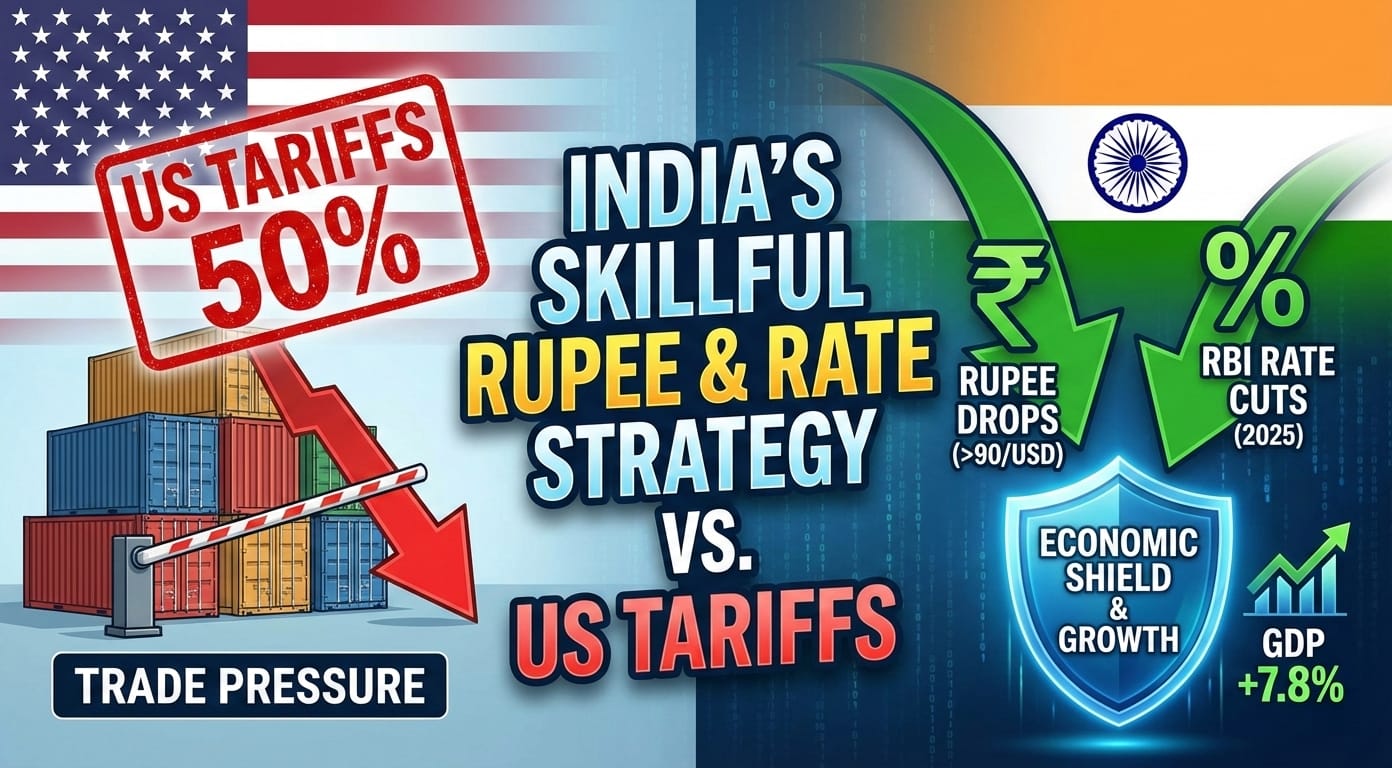
When the Indian rupee went below 90 to the dollar last winter, some news headlines were scary, talking about a crisis. But what if that drop wasn’t an accident and was instead a smart plan? It looks like the rupee’s drop was India’s way of pushing back against the United States’ 2025 tariff increase, where taxes rose to 50% on important exports like electronics and textiles.
The RBI mentioned this in its June 2025 report, saying there was more uncertainty in trade policy. Instead of putting tariffs on US goods like China did, which caused money to leave China, India quietly changed two things: interest rates and the value of its currency. This approach handled the problem without causing any diplomatic issues. It helped exporters and allowed India to lower interest rates, which was needed. This worked well because inflation was low at 1.54% by October 2025, and India had nearly $700 billion in foreign reserves.
Back in late 2024, India was stuck trying to balance keeping its exchange rate steady, keeping capital flowing freely, and having control over its own money policy. The US Federal Reserve’s high interest rates of 5% after Covid made it hard to make changes.
The Indian economy needed help: inflation was below 5%, core inflation was falling to 3.8%, lending to industry was slow at 4.2%, and real interest rates were higher than other G20 countries at 2.5%. But the RBI stayed put, spending over $35 billion in reserves in November and December 2024 to keep the rupee around 83-84.
Could the central bank lower rates on its own? Not without risking big problems like Japan, where zero interest rates caused a drop in the yen from 115 to 160 despite efforts to stop it. India’s large portfolio exposure—$50 billion in foreign investment in FY24 —meant that such volatility could be disastrous, giving Delhi less room to move as global money became tighter.
Then, in 2025, the US increased tariffs, which threatened to hurt India’s exports by $30 billion, according to the Federation of Indian Export Organisations. Suddenly, the situation changed: a weaker rupee became helpful, making Indian goods cheaper abroad and reducing the damage from tariffs. For example, a 10% drop in the rupee could cancel out 20% of a 50% tariff, as trade data suggests.
Markets saw this coming and reduced their expectations; there was no need to waste reserves on keeping the rupee at a certain level when a change was unavoidable. The RBI acted, cutting the repo rate by 50 basis points to 5.75% in June 2025—a big move—and then by another 25 bps to 5.50% on December 5. They also used $5 billion in forex swaps and bought bonds worth ₹2 lakh crore. This made financial conditions easier before the tariffs hit, and domestic investment jumped 12% year-over-year by Q3 FY26.
Instead of defending a fixed exchange rate, the RBI managed a glide path, intervening with $25 billion from September to mid-November 2025 to limit volatility to 2.5% per month—the lowest among similar countries —according to dealer estimates in the Economic Times.
The rupee followed a controlled path: 86 by June, 88 by August, and over 90 by early December, but without causing funding problems or foreign investors pulling out; net inflows reached $15 billion in H2 FY26. By managing it this way, the drop in the rupee stabilized things—exporters became 8-10% more competitive compared to ASEAN countries due to negative real rates, while rate cuts lowered EMIs, boosting industrial production by 5.2%. In contrast, China’s tariffs caused the yuan to become volatile, reaching 7.5/USD, and led to $100 billion in outflows.
Why did India avoid escalating the situation when China didn’t? India’s open capital account—unlike China’s restrictions—meant that currency problems would be more costly, with foreign investment flows being 5 times larger than trade surpluses. A rate cut shows that India is prioritizing its domestic economy, not being hostile; managing the rupee’s drop avoids issues with the WTO. Recent US policy shows the wisdom of being restrained: Trump’s tariffs came and went, but India’s smart move avoided a tit-for-tat situation, keeping talks open for a small trade deal. With oil at $65/barrel (compared to $90 peaks) and inflation near 2%, reserves only fell by 5% after the intervention, staying at $670 billion.
The results prove that the change in strategy was right: GDP grew by a surprising 7.8% in Q1 FY26, exports to non-US markets like the EU and ASEAN rose by 15%, and inflation stayed at 2.1% despite the weaker rupee. The rupee at 90 isn’t a sign of weakness—it shows flexibility, turning tariff issues into a policy opportunity that wasn’t available in 2024 when the Fed had control. India changed its position, making sure that external problems didn’t cause internal issues. In a world full of problems, sometimes the best solution is a subtle adjustment.