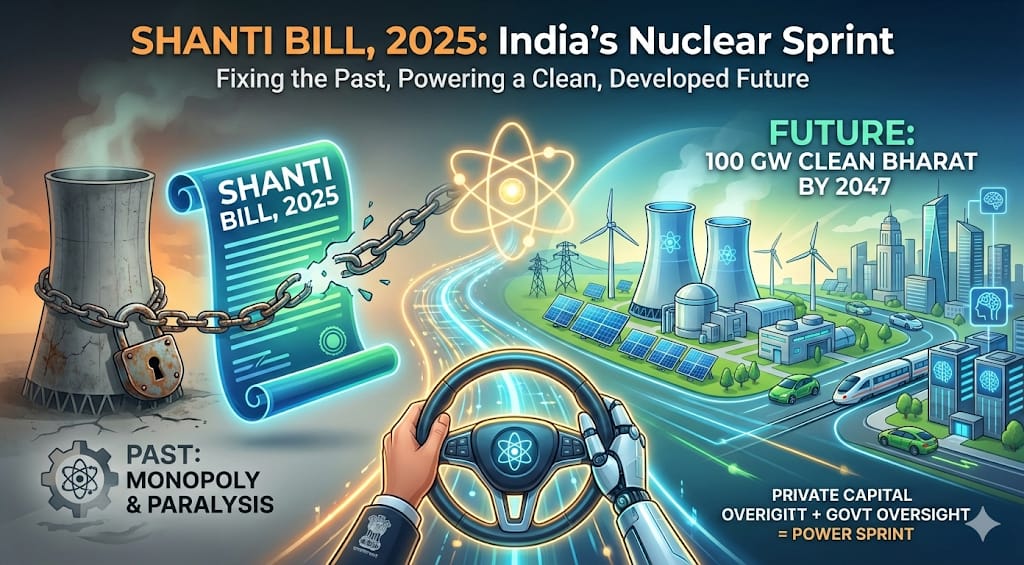
From Congress‑era monopoly and paralysis to Modi‑era markets and liability clarity, India’s atomic story is being rewritten for a 100 GW future.
SHANTI Bill, 2025 is India’s boldest bet yet that the road to a clean, developed Bharat by 2047 will run through nuclear power—and this time, unlike the Congress era, the state is finally ready to share the steering wheel with private capital, technology and ambition.
SHANTI—Sustainable Harnessing and Advancement of Nuclear Energy for Transforming India—is more than a cosmetic rebranding of the Atomic Energy Act, 1962; it is a complete demolition and rebuild of India’s nuclear legal architecture, folding both the old Atomic Energy Act and the Civil Liability for Nuclear Damage Act, 2010 into one unified framework.
For the first time, private companies can build, own and operate nuclear power plants and participate across the value chain, while the Union government retains tight control over fuel, spent fuel, heavy water and strategic materials, echoing global practice in the US, France or the UK where the state regulates and safeguards while private players construct, innovate and scale.
Why does this matter now? Because India wants to jump from today’s single‑digit gigawatts to 100 GW of nuclear power by 2047, a leap impossible to finance and execute if government continues to insist on going it alone through NPCIL and a handful of public-sector entities.
To understand the scale of the strategic course‑correction, it is worth asking: what exactly went wrong over the last five decades? Under Congress‑era policy, nuclear power was treated as a closed holy temple—only a few state‑owned priests allowed inside, everyone else kept out in the name of sovereignty and secrecy.
Even after the landmark 2008 India–US nuclear deal opened global doors, the domestic laws were left largely unreformed: private utilities could not own reactors, their participation was restricted to supplying components, and the CLND Act created an open‑ended, politically driven “right of recourse” against suppliers that scared off serious international and domestic investors.
As other countries—from the US in the 1950s to France, South Korea and Japan in the 1970s—used private utilities and vendors to build dense nuclear ecosystems, India stayed stuck with a monopoly model, a research‑heavy but deployment‑light thorium programme, and an electricity mix locked into coal and imports even as climate pressures mounted.The cost of this inaction showed up in higher pollution, energy insecurity and a lost opportunity to turn India’s scientific capabilities into a global nuclear manufacturing hub.
The SHANTI Bill is the present government’s answer to that lost half‑century: if state monopoly caused stagnation, can regulated private participation unlock speed, scale and affordability without compromising safety? The Bill’s core bet is that nuclear economics, when allowed to play out over 60–80 years of plant life, actually favours consumers—high upfront capex but low and stable fuel costs, 24×7 baseload power that reduces the need for expensive storage and backup, and lower long‑run tariffs when projects are executed efficiently.
By allowing private developers, public–private JVs and even specialised nuclear subsidiaries of existing power majors to enter, the government is trying to bring competition in project management, construction timelines and financing structures, while still reserving the right to fix tariffs transparently, factoring in fuel, waste management and decommissioning costs so that “cheap power” is not achieved by hiding long‑term risks. In effect, India is finally copying the global playbook: governments regulate, set safety and liability norms, and guard the fuel cycle; private entities raise capital, build reactors and deliver electrons.
But the most politically sensitive—and arguably the most important—area where SHANTI rewrites history is liability. Under the 2010 CLND Act, the operator’s liability was capped at the rupee equivalent of 300 million Special Drawing Rights, but suppliers could be dragged into endless recourse actions if equipment defects were suspected, creating a fog of legal uncertainty that vendors never fully priced or accepted.
SHANTI preserves the operator cap at roughly the same SDR benchmark and introduces a graded rupee liability slab—₹3,000 crore for large reactors above 3,600 MW thermal, stepping down for smaller reactors and fuel cycle facilities—while sharply narrowing the circumstances in which suppliers can be pursued, largely to cases explicitly written into contracts or intentional misconduct.
Beyond this operator cap, the Bill clearly positions the Union government as the backstop payer, empowered to create a Nuclear Liability Fund and to tap international arrangements like the Convention on Supplementary Compensation for Nuclear Damage when compensation exceeds domestic caps, shifting the regime from open‑ended political blame to predictable, insurable risk that investors, insurers and lenders can actually model.
The question critics will ask is obvious: does limiting supplier liability and clarifying government backstop mean letting big corporates off the hook? The answer depends on how strictly contracts, safety codes and enforcement are designed—but it is undeniable that without such clarity, the 100 GW dream would die in courtrooms long before any accident occurred in the real world.
Then there is the quieter, but crucial, modernisation of how India thinks about nuclear itself. SHANTI expressly promotes non‑power applications—radiation in cancer care, mutation breeding in agriculture, food irradiation, desalination, industrial non‑destructive testing—areas that remained policy afterthoughts when the political imagination saw nuclear only through the lens of bombs and megawatts under earlier governments.
Today, the Modi government is pitching nuclear as a backbone for EV charging, AI data centres, green hydrogen and clean industrial growth, but also as an enabler of everyday public goods like Tier‑2 cancer hospitals, safer food and clean water, anchoring the narrative that “nuclear is not about fear, it is about life”.
Critics of the Congress‑era approach will say that a mix of ideological suspicion of private capital, risk‑averse bureaucracy and post‑Bhopal political panic fossilised India’s nuclear policy, while the current regime is using the “space and defence reform” template—where private entry turned closed strategic sectors into job‑creating, export‑oriented ecosystems—and applying it, belatedly, to atoms.
So, is SHANTI a historic correction or a risky leap? It is both: a necessary structural reform that drags India’s nuclear sector into global best‑practice territory on licensing, independent regulation and liability, while staking the nation’s clean‑energy future on the assumption that public oversight and private innovation can be made to coexist without catastrophe.
If the regulator remains genuinely independent, if safety is enforced as ruthlessly as investor comfort is protected, and if the promised benefits—cheaper power, cleaner air, high‑skilled jobs and technological leadership—are widely shared beyond a few conglomerates, SHANTI will be remembered as the moment India stopped treating nuclear as a fragile relic of the past and started using it as a hard‑edged tool for a developed future.
Ultimately, SHANTI isn’t gamble—it’s course-correction, weaving nuclear into EVs, AI, green hydrogen, slashing imports for energy security. From Congress’s stall to this sprint, India trades caution for courage—will it deliver? Track the gigawatts, jobs, clean air; the proof powers tomorrow.