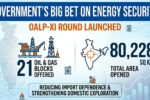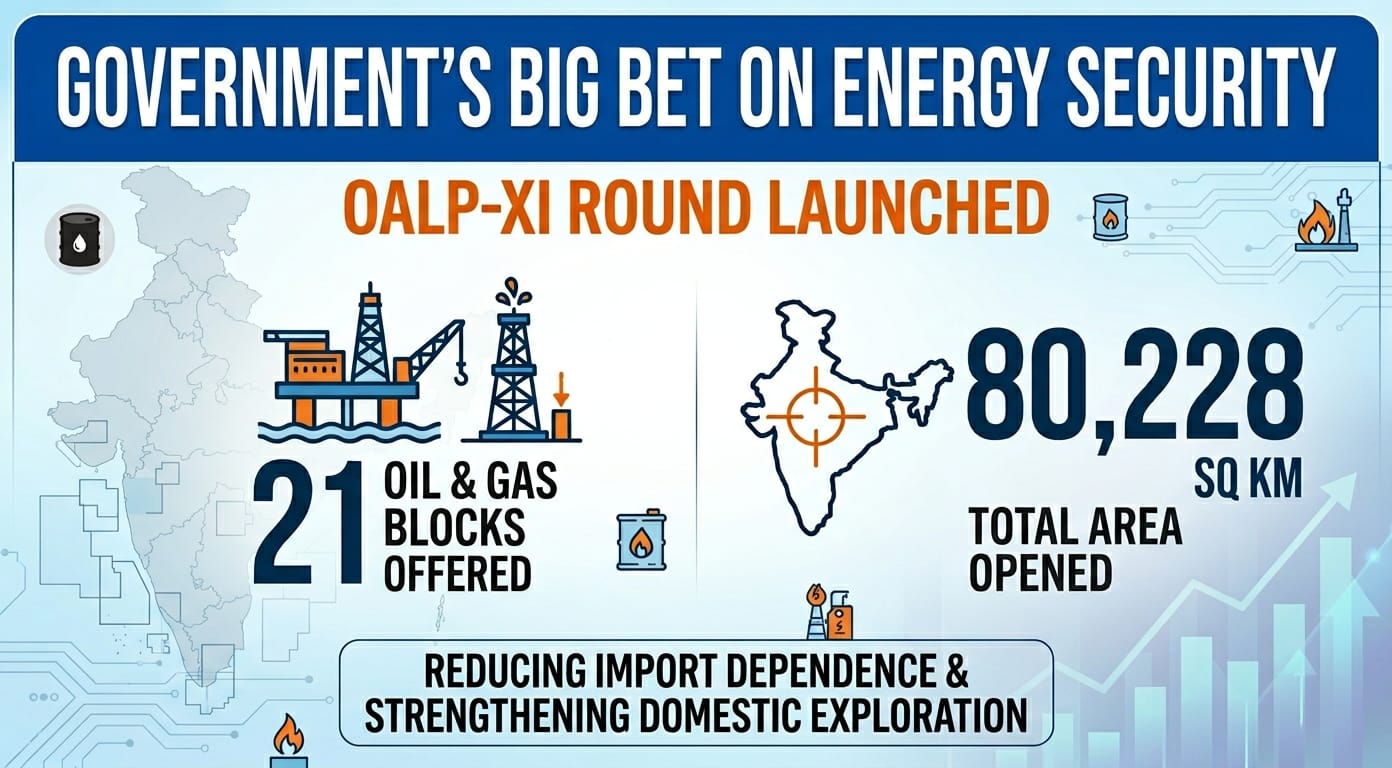
With OALP-XI, the government opened 21 oil and gas blocks across 80,228 sq km in a fresh push to reduce import dependence and strengthen domestic exploration.
India has taken another major step toward energy security by launching the 11th round of the Open Acreage Licensing Policy, or OALP-XI, offering 21 oil and gas blocks spread across 80,228 square kilometres. The new round is designed to attract exploration activity across land and offshore areas, with 12 onshore blocks, four shallow-water blocks, one deepwater block and four ultra-deepwater blocks on offer. Together with OALP-X, the total area opened for exploration has now risen to about 2.63 lakh square kilometres.
This move matters because India still depends heavily on foreign energy supplies. Recent reporting shows that the country imports close to 89% of its crude oil needs, while official briefings have also said India imports about 60% of its LPG consumption and around half of its gas requirement. In simple terms, that means a large part of the fuel that keeps factories running, vehicles moving and kitchens supplied still comes from outside India, leaving the economy exposed to global price shocks, shipping disruptions and geopolitical tensions.
That is why the government is placing greater emphasis on upstream exploration, which means finding oil and gas before it can be produced and used. By offering a larger and more diverse set of blocks, the state is trying to encourage private and public players to search in areas that may still hold untapped resources, including challenging offshore zones. Petroleum Minister Hardeep Singh Puri has described the latest round as part of a broader effort to strengthen energy security, expand acreage and reduce dependence on imports.
The timing of this push is also important. India has been trying to protect itself from supply risks by diversifying crude sources and keeping domestic supply lines stable, especially as global energy markets remain unpredictable. Official updates have said India now imports crude from around 40 countries and that a large share of those supplies no longer depends on the Strait of Hormuz, a key global oil passage often seen as vulnerable during conflict. In that backdrop, expanding domestic exploration is not just about geology; it is also about strategic caution.
For ordinary consumers, the impact may not be immediate, because exploration takes time, investment and successful drilling before any new oil or gas reaches the market. But the long-term logic is clear: if India can discover more of its own resources, it can lower import bills, reduce exposure to sudden supply shocks and improve energy resilience. OALP-XI is therefore less of a headline auction and more of a long-term insurance policy for a country that is still highly dependent on imported fuel.