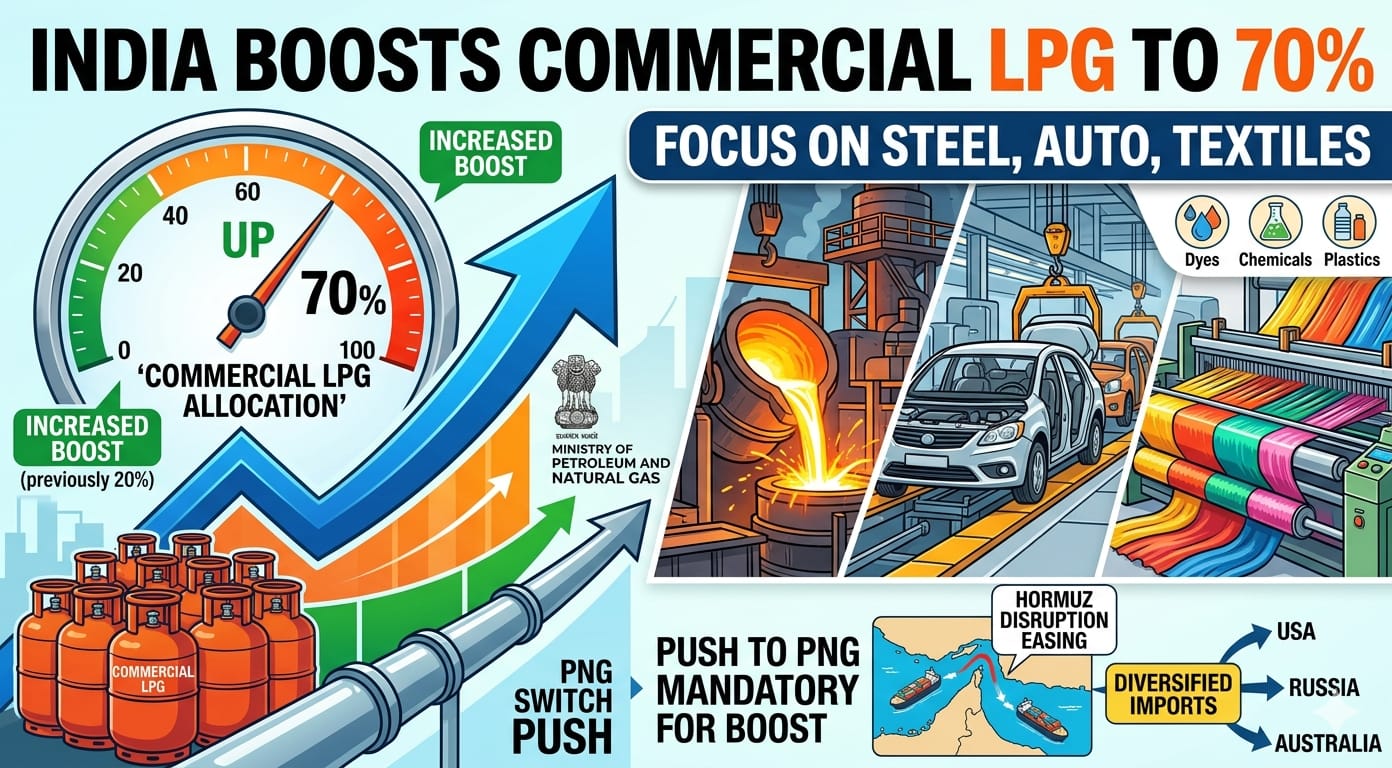
After weeks of tight supply, India’s industrial sector is finally getting a clearer breathing space. The Union Ministry of Petroleum and Natural Gas has announced that commercial/non‑domestic LPG allocation will be raised to 70% of pre‑crisis levels, a move that directly benefits factories, small units, and large manufacturers hit by earlier rationing . In a communication addressed to Chief Secretaries of all States and Union Territories, Petroleum Secretary Neeraj Mittal spelt out the details: The extra 20% allocation must be directed to industries, with special emphasis on steel, automobiles, textiles, dyes, chemicals, and plastics .
These sectors were singled out because they are labour‑intensive and support broader value chains in agriculture, construction, and exports . Even within this list, the government has asked State authorities to prioritise process industries or those sections where LPG is used for specialised heating and cannot be easily replaced by natural gas . That nuance is critical: not every factory can simply switch to PNG overnight, especially where precise temperature control and portability of fuel matter.
The current 70% figure is the result of a step‑by‑step relaxation that began in March 2026. Earlier, commercial LPG supply had been cut sharply to protect household cooking gas, especially after the closure of the Strait of Hormuz disrupted traditional shipping routes . The Strait of Hormuz carries about 90% of India’s LPG imports, which in turn account for roughly 60% of the country’s total LPG demand . With that chokepoint blocked, the Centre had to decide which users got fuel first—and households were given priority .
Initially, the government allowed only 20% of pre‑crisis commercial LPG to flow to industries . Then, it added another 10% allocation for States that took specific steps to accelerate piped natural gas (PNG) infrastructure, such as fast‑tracking approvals and rolling out distribution networks . This was a clear nudge: industries and States were being asked to look beyond LPG and start leaning on PNG where possible .
On March 21, 2026, the Centre announced yet another 20% increase in commercial LPG, this time focused on restaurants, dhabas, hotels, industrial canteens, food processing units, dairies, subsidised government canteens, community kitchens, and commercial cylinders used by migrant workers . That move was aimed at protecting daily‑wage workers, small eateries, and informal food‑service units from the worst of the fuel crunch .
The new 20% hike announced on Friday brings the total commercial allocation to 70%, but it still carries a condition: all commercial and industrial LPG consumers must register with public sector fuel retailers and apply for a PNG connection, so that the long‑term fuel mix drifts toward natural gas . The only exception is for industries where LPG is used for specialised processes that cannot be replaced by natural gas, such as certain high‑temperature heating or niche manufacturing applications .
Parallel to these policy changes, the supply side has also improved. The government asked refineries to maximize LPG production, diverting some propane, butane, and other streams from petrochemical manufacturing to LPG . Union Minister Dharmendra Pradhan has later stated that these measures have helped domestic LPG production rise by about 40% compared with pre‑Hormuz‑crisis levels, which is a significant buffer for the national inventory . That message has been echoed in official‑leaning statements: India’s domestic production now covers a much larger share of the current requirement, while the net import need has shrunk .
On the import front, the government has also been actively diversifying beyond West Asia, sourcing LPG from countries such as the United States, Russia, and Australia . This diversification is crucial because about 55–60% of India’s natural gas imports, too, pass through the Strait of Hormuz, though the impact on gas has been less acute than on LPG . Senior energy officials have argued that by reducing dependence on a single chokepointIndia can make its energy supplies more resilient over time, even if disruptions in West Asia remain a recurring risk.
In the same vein, the government has repeatedly appealed to both households and commercial users to switch to PNG where feasible, so that LPG can be reserved for uses where it is truly indispensable. PNG is better suited for large, fixed‑point users like factories and city‑gas networks, while LPG cylinders remain essential for mobile or remote operations.
All of this is now gearing up to a more stable picture. The latest Ministry‑level and journalist‑level narratives suggest that there is no LPG shortage for households, and the supply situation is improving with higher domestic output and additional cargoes arriving from non‑West Asian sources. The broader message is that the worst phase of the industrial LPG crunch is behind us, but the episode has underlined how fragile India’s fuel‑import structure can be, and how vital PNG expansion, refinery optimisation, and non‑regional sourcing will be in the coming years.