
Two recent incidents — a tribal protest in Odisha’s Rayagada and a labour agitation in Noida — carry a common signature. They suggest the Left-Wing Extremism question did not end in Bastar. It appears to have relocated.
On April 7, clashes erupted near Kashipur in Odisha’s Rayagada district between tribal villagers and police, leaving at least 40 security force personnel and 25 villagers injured. Credible intelligence inputs indicate the presence of CPI (Maoist) front organisations within the agitation. Days earlier, in Noida, a labour protest descended into violence. The principal accused, Aditya Anand — an NIT-educated engineer — turned out to be a sympathiser of pro-Left-Wing Extremist (LWE) organisations, with traceable links since 2022 to Mazdoor Bigul, a Lucknow-based labour rights group led by Anubhav Sinha. Investigators further connected him to the Disha Student Organisation, the Revolutionary Workers’ Party of India, and Naujavan Bharat Sabha — pro-LWE urban entities.
Individually, each flare-up appears as isolated unrest. But strung together, they sketch a larger trajectory. On March 31, 2026, India formally declared the end of armed Naxalism on March 31, 2026. The Maoist movement, however, did not dissolve. Having shed its forest skin, it is morphing, adapting to terrains beyond the jungle.
Protests were not spontaneous
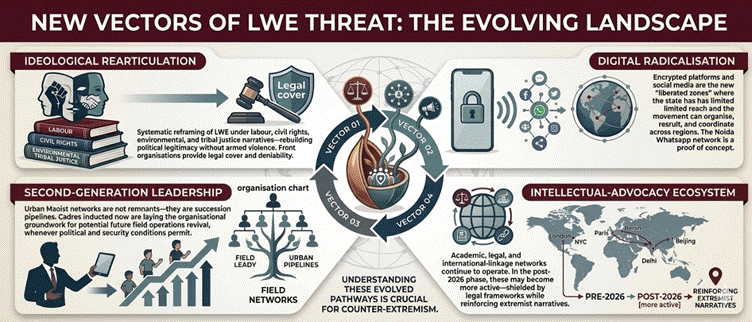
Urban Maoism is not improvisation. It is classical Maoist “mass line” doctrine —— the cultivation of mass support through grievance-driven mobilisation — recalibrated for the post- military defeat phase. The CPI (Maoist) has historically maintained an urban apparatus: logistics, finance, legal support, and ideological orientation. What is changing, in the post-2026 environment, is its transformation from a support structure to a possible medium for LWE revival.
The Noida incident shows how this works. Investigations have revealed that protestors were quickly added to WhatsApp groups through QR codes, under labour union and workers’ movement identities. Inside these groups, provocative messages spread fast, pushing the crowd toward confrontation. This is not spontaneous outrage. It is a system being activated — the digital version of the courier lines that once linked Maoist formations in the forests. The ecosystem identified in Noida – four organisations, an engineer as a hub, and a labour union as cover came together. This is not a cell. It is a structure.
Cities can become a recruitment ground
Three structural conditions in urban India are creating a landscape that LWE ideology is well-positioned to exploit. The first is the aspirational trap. Many young people — with degrees, technical training, and as first-generation graduates — are entering a job market that fails to meet their expectations. The gap between education and opportunity has often been a path to radicalisation in contemporary insurgency history. The accused in Noida is not an exception; he is a warning sign.
The second condition is the gap between digital access and economic opportunity. Rising smartphone and online connectivity in urban areas and formerly LWE-affected districts has created populations that are informationally plugged in but economically peripheral. Grievances now spread quicker than solutions. Organised groups who know how to exploit narratives into these networks have a structural advantage over state communication machinery, which remains relatively slow, institutional, and less calibrated for digital-native audiences.
The third condition is unresolved structural grievances. Issues like tribal land displacement, forest rights disputes, contract labour problems, and conflicts over mining projects remain unaddressed and Maoist fronts are adept at exploiting them. The clashes in Kashipur, Rayagada did not begin as a Maoist operation; they became one when the conditions were ripe for infiltration.
History as warning
The pattern is familiar. Peru’s Shining Path was operationally decapitated in 1992 with the capture of Abimael Guzmán but re‑emerged within a decade as a narco‑insurgency in the VRAEM valley. Turkey’s DHKP‑C lost its rural base yet survived for thirty years as an urban terror network, sustained by diaspora support and front organisations working inside European legal systems. In both cases, the lesson was identical: military defeat of an armed insurgency does not extinguish the ideology — it shifts, adapts, and reappears in new forms.
India’s risk profile is more complex. A large, educated, politically articulate sympathiser base in cities — with access to legal institutions, media, universities, and international platforms — is a more resilient and harder-to-monitor substratum than a forest cadre network.
A different threat demands a different strategy
The counter-insurgency strategy that dismantled the armed capacities of the CPI (Maoist) — area domination, cordon-and-search, intelligence-driven neutralisation of field commanders — has no direct application here. The urban Maoist threat requires a qualitatively different response architecture. Intelligence-led monitoring of front organisations, with legal delineation between legitimate civil society activity and organisational fronting for a proscribed entity, is required. Equally important is the development of digital forensics capacity and platform-level coordination to monitor LWE radicalisation networks before mobilisation events occur, rather than after.
Governance and security cannot be separated. The most durable counter to urban Maoist recruitment is the resolution of grievances being exploited — on contract labour conditions, unresolved tribal land rights, displacement from projects, and the aspirational deficit of educated youth. A state that wins the military campaign and then neglects the political economy of discontent is not securing peace; it is postponing the next round of unrest.
India declared the end of armed Maoist insurgency on March 31, 2026 — a historic milestone. But the Maoist question did not end in the forests of Bastar — it is morphing, adapting, and can re-emerge in the urban landscape, maybe in an engineer’s WhatsApp group in Noida or in a tribal protest in Rayagada. A Maoist cadre with a rifle in Bastar is a security problem. An organiser with a smartphone and a law degree in a Noida labour colony is a governance problem — and a tougher one. The post‑insurgency phase is not closure. It is transition. And the next phase of the LWE challenge will be fought not with rifles in forests, but with law, governance, and counter-narrative in the contested spaces of urban India.
– Kanchan Lakshman is a Delhi-based national security analyst.

