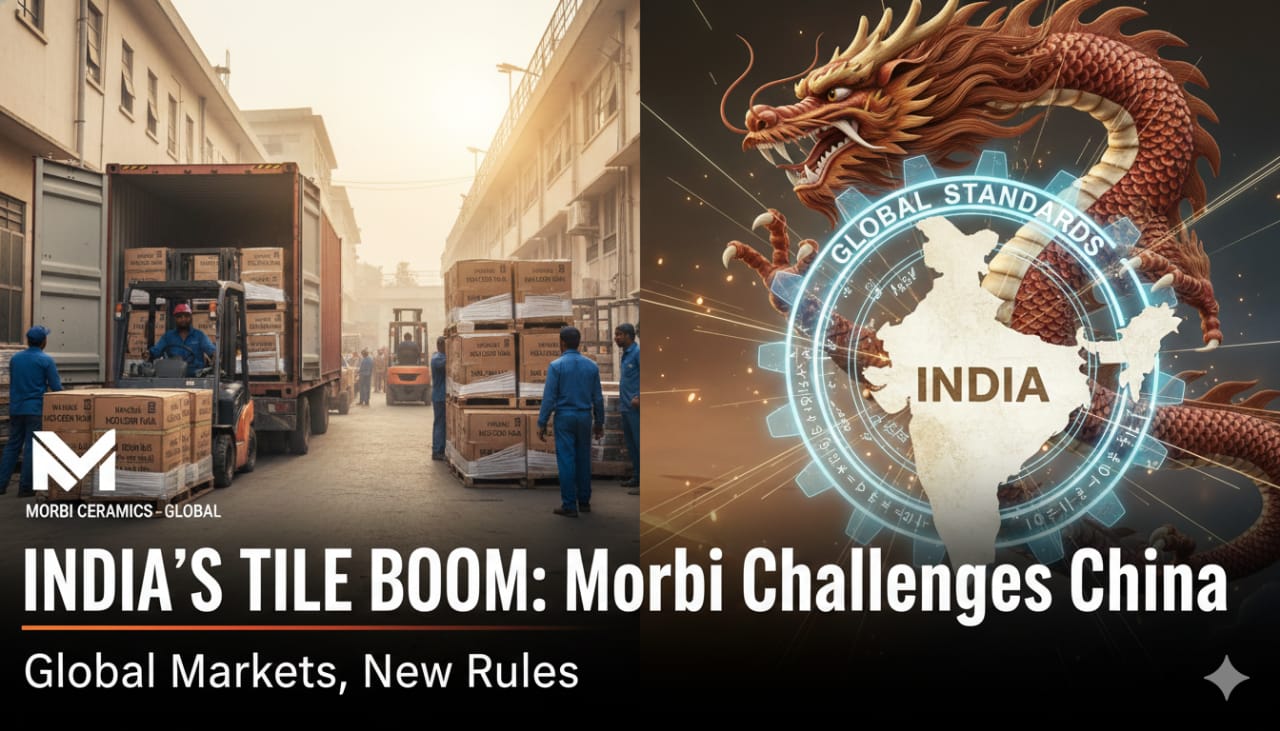
As Gujarat’s ceramic capital conquers global markets with cheaper, faster, better tiles, Beijing scrambles to push new “standards” that could trip up Morbi’s exporters at the border.
For years, China ruled the global ceramic tile trade like a dragon guarding its hoard, but a town on the banks of Machhu river in Gujarat has quietly rewritten the script. Morbi, once known mainly to traders and transporters, is today the engine behind India’s rise as the world’s second-largest tile exporter, and its aggressive pricing and scale have started biting into Chinese dominance in key markets from the Middle East to Africa and Latin America.
Walk into any construction site in Israel, Mexico, South Africa or Russia and chances are that the glossy floor tiles being laid came from a factory cluster within a two-hour radius of Morbi. Over 800 manufacturing units, firing kilns day and night, have turned this region into a massive export machine that ships hundreds of millions of square metres of tiles every year, often at prices 20–30% lower than many global rivals while still meeting international quality norms. For builders squeezed by tight budgets, Morbi has become the natural answer to the question: “Why pay more for the same look?”
Predictably, this shift has not gone unnoticed in Beijing. As global buyers diversify away from Chinese suppliers, industry observers say China has begun to lean on a different playbook: not just competing on price and design, but trying to redraw the rulebook itself through new testing norms, stringent certification demands and technical standards at international forums.
On paper, these proposals talk about “safety”, “performance” and “harmonisation”, but Indian experts warn that the fine print often sets conditions that Morbi exporters would find expensive, time-consuming or plain impractical to comply with in the short term.
A recent flashpoint came when China reportedly pushed a fresh set of ISO testing criteria that industry bodies in India flagged as discriminatory and potentially devastating for Morbi’s small and mid-sized units.
The proposed methods would have increased the number of tests, tightened certain parameters and altered sampling procedures in a way that raised costs and compliance risks for exporters, without clearly improving consumer safety. Indian representatives lobbied hard and eventually managed to block the move, but the episode was read in Morbi as a warning shot rather than the final battle.
For tile makers on the ground, the pressure is real. Freight volatility, anti-dumping duties in some Western markets and intense competition have already squeezed margins, and any additional layer of “standard-linked barriers” could tilt orders away from India.
Exporters fear a scenario where a container is held up at a foreign port on the basis of a technical standard allegedly “not met”, giving an edge to suppliers from countries that wrote the norm in the first place. In trade diplomacy language, this is called a non-tariff barrier; in Morbi’s narrow factory lanes, it is simply seen as the dragon changing the dice on the gambling table.
Yet the mood in Morbi is far from defeatist. Many factories have already upgraded to modern kilns, automated lines and advanced digital printing technologies that allow them to match or exceed international benchmarks on water absorption, strength and finish.
Industry associations are pushing members to document processes, invest in labs, and obtain globally recognised certifications so that no buyer can dismiss Indian tiles as “cheap but risky”. At the same time, exporters are hedging against any standards-led squeeze by targeting a wider spread of markets instead of relying on a handful of countries.
This diversification is showing results. Demand for Indian tiles has surged in new geographies such as Israel, Mexico, Chile, Kenya and Ethiopia, where builders value the mix of design variety, durability and affordability that Morbi offers.
In several of these markets, India has either narrowed China’s lead sharply or emerged as the top supplier, helped by trade agreements, currency advantages and the trust built through consistent deliveries during and after the pandemic. As more governments launch infrastructure and housing pushes, Morbi’s tiles—ranging from basic ceramic to high-end vitrified slabs—are increasingly becoming part of the default material shortlist.
India’s policymakers, too, have begun to treat standards as a strategic battlefield rather than a technical afterthought. By successfully resisting proposals seen as tilted in China’s favour and by participating more actively in global standard-setting bodies, New Delhi is signalling that it will not allow others to quietly write rules that penalise its sunrise sectors.
For Morbi, this diplomatic backing is as important as any incentive, because the town’s future depends not only on how efficiently it fires its kilns, but also on how effectively India defends its right to compete on a level playing field.
The story unfolding now is bigger than tiles and tariffs. It is about whether an agile, decentralised industrial cluster in a developing country can take on a manufacturing superpower that is willing to recast norms to retain its grip on a global market.
As long as Morbi keeps innovating on the shopfloor and India keeps holding its ground in the standards arena, the dragon may roar—but the echo from Gujarat’s ceramic capital is getting louder with every export-bound container that rolls out toward the ports.