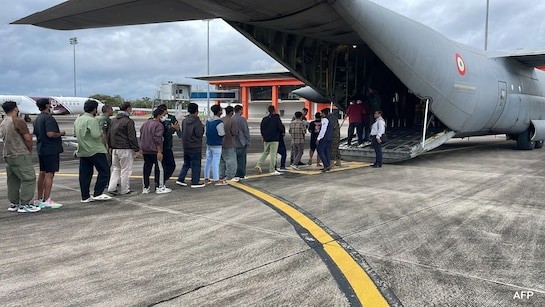
When the Indian Air Force’s C-17 aircraft touched down at Hindon Air Base on a November night this year, its passengers, all 270 Indian citizens who were earlier rescued from northern Thailand, stepped out carrying wounds far deeper than exhaustion. Many bore bruises and cuts, some limped as they walked, and a few stared blankly, unable to process the fact that they had finally escaped. The group, which included 26 women, had been trafficked into Myanmar’s cyber-slavery compounds. A vast, militarized criminal enclaves along the Thailand–Myanmar border that have become Asia’s newest and most frightening crime factories.
Their rescue marks the latest chapter in a crisis that has grown rapidly over the past year. Earlier operations in March and April had brought home more than 600 victims. Collectively, the survivors describe a shadow economy of digital exploitation run by transnational criminal syndicates who lure Indians with false job offers then smuggle them across borders, seize their passports, and force them into cyber-fraud operations under threats of torture and death.
Increasingly, Indian agencies have begun describing this ecosystem as “one of the most dangerous criminal enterprises in the region” that consists of a hybrid of trafficking, forced labour, digital crime, and, in its darkest corners, organ exploitation as well.
The rise of the cyber-slavery belt
The border region stretching across Myawaddy, ShweKokko, and the KK Park located next to the Moei river in southeast part of Myanmar bordering Thailand has emerged as the nerve centre of this vast criminal network. These enclaves, controlled by an unstable mix of ethnic militias majorly backed by Chinese-origin triads, and private armed groups, flourished after Myanmar’s 2021 military coup created a lawless vacuum. Criminal syndicates who once operated scam centres in Cambodia and Thailand shifted deeper into Myanmar’s territory, constructing fortified compounds equipped with surveillance systems, armed guards, dormitories, torture cells, and high-speed digital infrastructure.
International investigations by international media outlets such as Reuters, CNA, Frontier Myanmar, and the South China Morning Post have also reported how thousands of trafficked workers from India, Malaysia, Nepal, Bangladesh, China, Kenya, Dubai, and the Philippines have been confined in these compounds. The industry they serve is vast, ranging from crypto scams and investment fraud to digital extortion, impersonation operations, and money laundering. Organ trafficking networks, operating quietly at the edges of this ecosystem, add an even darker dimension to an already brutal system. Lately Indians have increasingly become prime targets for such recruitments.
A job offer that becomes a trap
The typical journey begins innocently. A young graduate receives an Instagram message advertising a “high-paying IT job in Thailand.” A Telegram channel circulates openings for “digital marketing roles.” A local recruiter, often someone known to the family, promises placement in Bangkok or Ho Chi Minh City. The offers appear legitimate as they come with fabricated appointment letters, polished websites, and videos from supposed “HR teams.”
Indian intelligence data shows that between January 2022 and May 2024, nearly 30,000 Indians had travelled to Cambodia, Thailand, Myanmar, and Vietnam on tourist visas and never returned, an unmistakable indicator of large-scale trafficking. For many victims, the descent begins with a flight to Bangkok arranged by the recruiter. On landing, their passports are often taken “for processing.” Some are then driven to the Mae Sot border crossing and smuggled into Myawaddy.
Others are ferried to safe houses where traffickers tell them they must repay the cost of their travel and accommodation, a debt they can only settle by working inside the scam compounds.
Life and torture inside the compounds
Once inside, the illusion of a job offers collapses immediately. Survivors describe being surrounded by armed guards, subjected to strict surveillance, and forced to work under brutal conditions. The compounds operate like modern-day slavery hubs, where workers are assigned to teams responsible for running various cyber scams targeting Indians, Southeast Asians, and the global diaspora.
Beatings are a common day affair. Survivors recount being assaulted for failing to meet daily scam quotas, for using the washroom without permission, even for sitting in an unacceptable posture during training sessions. Some victims describe particularly brutal punishments, their nails being torn out, electric shocks administered as warnings, sleep deprivation used as a disciplinary tactic, and isolation cells designed to break resistance.
The work involves impersonating bank representatives, investment advisors, government officials, or online relationship partners. Victims are trained to manipulate their targets into transferring large sums of money. Workdays stretch as long as 18 hours, with minimal breaks and constant digital surveillance. Many survivors say they began to feel complicit in crimes they never chose to commit, adding a crushing psychological burden to the physical torment.
A darker layer: organ trafficking
While not every victim encounters it directly, multiple independent investigations have revealed the presence of organ-harvesting rings operating in proximity to the cyber-slavery compounds. Thai authorities reported in 2023 that bodies recovered from the border region bore surgical scars suggesting organ removal. Myanmar Now and Frontier Myanmar have connected several Myawaddy syndicates to kidney-trafficking operations. Survivors from Kenya and Nepal have told regional newspapers that workers who refused to cooperate simply “disappeared” after being taken to clinics controlled by local militias. Indian agencies, though cautious in confirming individual cases, now treat these reports as credible warnings of how far the criminal networks are willing to go.
Stories of survival: Three Indian victims
Among the rescued is Satish, a restaurant manager from Maharashtra who accepted what he believed was a hospitality job in Thailand. After being smuggled into Myawaddy, he learned that he had been “sold” to a syndicate for $5,000. Satish was forced into “digital arrest” scams in which callers impersonated as police officers to extort money from Indian families. He recalls being thrashed for the smallest infractions, once for crossing his legs during work hours, another time for failing to meet his daily scam quota. Guards pulled out his nails to enforce compliance. “We were beaten like animals,” he said after his rescue. “Every day someone was punished publicly.”
Another survivor, Pradeep Vijay, was only twenty-four when he was recruited for what he thought was a data-entry job abroad. Instead, he found himself in a sprawling cyber compound targeting NRIs with crypto-investment frauds. He endured months of torture until his family raised ₹10 lakh to secure his release, only for him to be discovered by authorities during a raid. He continues to struggle with trauma and refuses interviews, speaking only rarely about the ordeal to investigators.
The third survivor, an IT engineer from Hyderabad, spent weeks confined at KK Park, where he was forced to operate crypto-fraud consoles under threat of execution. He survived by pretending to comply. Once rescued, he described nights when he believed he would not live to see morning. His group was part of the 540 victims flown home by the Indian Air Force in March 2025.
How the rescues were pulled off
The rescue efforts were part diplomacy, part intelligence work, and part sheer luck. Many victims escaped their compounds and reached Thai soil, where local authorities granted them emergency protection. Indian embassies in Bangkok and Yangon then coordinated with Thai officials to document, verify, and
extract survivors.
IAF flights became the lifeline for large groups of rescued Indians. The operations were complex as paperwork, verification, emergency shelters, medical screening, and debriefing of every survivor was meticulously carried out. Each flight represented weeks of coordination among Indian diplomats, Thailand’s immigration authorities, and local law enforcement agencies. As per intelligence agencies, still many Indian nationals remain trapped in these torture compounds.
Why Indians are a primary target
Several structural reasons make Indian workers attractive to syndicates. India’s vast youth population faces a competitive job market, making overseas offers appealing. The country’s digitally connected society provides fertile ground for cyber-fraud campaigns. WhatsApp-based scams, UPI transfer systems, and widespread trust in social media platforms make Indians particularly vulnerable to manipulation.
Criminal syndicates have optimized their scam scripts specifically for the Indian market. Training manuals used in Myanmar compounds recovered during raids show step-by-step instructions for defrauding Indian bank customers, NRIs, and small business owners.
A cross-border nexus: Myanmar, Bangladesh, and Pakistan
Indian investigative agencies have identified a triangular network driving the cyber-slavery industry. Myanmar hosts the physical compounds, whereas Bangladesh serves as a recruitment base and a transit corridor, with traffickers using Chittagong and Cox’s Bazar routes to smuggle in trapped victims and
Pakistan provides voice operators, forged call-centre identities, and SIM- laundering networks used for digital impersonation.
This transnational architecture resembles older terror-financing and money-laundering networks that is equally organized, equally opaque, and equally dangerous.
A rapidly evolving threat
Despite hundreds of rescues, the criminal system continues to grow stronger. As Thailand cracks down, compounds move deeper into Myanmar. As Chinese pressure increases on scam centres that target the Chinese citizens, Indian victims become a preferred commodity. Artificial intelligence now enhances scam scripts, making fraud harder to detect and more profitable. Analysts estimate that the cyber-slavery industry across Southeast Asia may be generating between $12 billion and $15 billion annually, a figure likely to rise
exponentially in the coming years.
Conclusion: A humanitarian crisis hidden in plain sight
The cyber-slavery network operating from Myanmar represents a new form of 21st-century exploitation, one that merges digital crime, human trafficking, torture, and transnational finance. India’s young job seekers have become its most vulnerable targets.
Each rescue flight that lands at Hindon is both a relief and a warning as the reports indicate that the syndicate is expanding faster than governments can respond. Unless India and its regional partners confront this as a coordinated global emergency, thousands more will fall into the same trap of a digital promise that literally bounds them up in chains.
Note: The article is written by Raja Muneeb, independent journalist and geopolitics expert. He can be reached on X at @rajamuneeb.