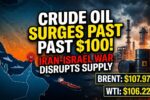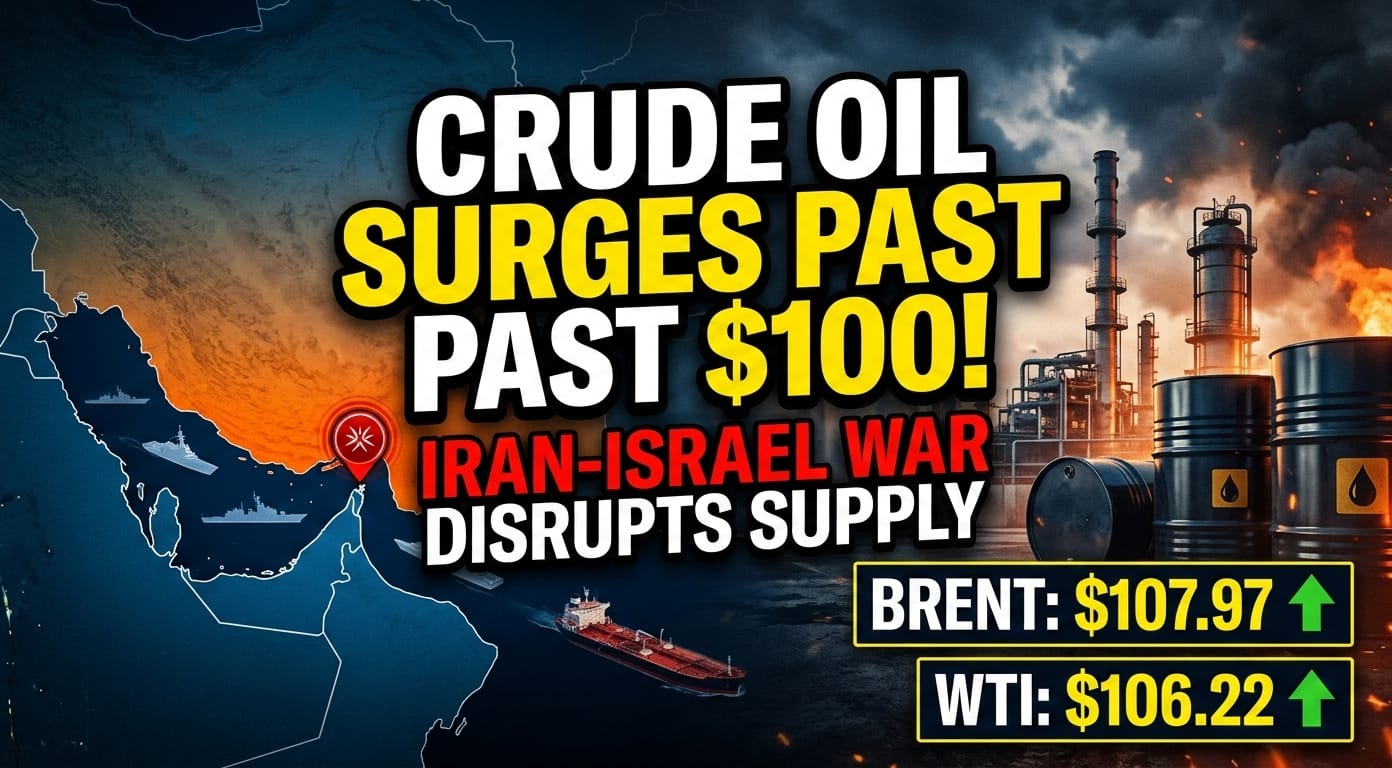
Crude oil prices surged past the $100 mark for the first time in more than three and a half years on Sunday, as the ongoing war between Iran and Israel continues to cripple oil production and disrupt vital shipping lanes in West Asia. The conflict has severely strained global energy markets, sending shockwaves through financial systems and raising concerns about inflation, consumer spending, and overall economic stability.
Brent crude, the international benchmark, jumped to $107.97 per barrel after trading resumed on the Chicago Mercantile Exchange, climbing 16.5 per cent from its Friday close of $92.69. Similarly, West Texas Intermediate (WTI), the primary US crude benchmark, soared to $106.22 per barrel—an increase of nearly 17 per cent from its previous closing of $90.90. The rapid escalation in prices comes on the heels of a week-long rally, with US crude spiking 36 per cent and Brent up 28 per cent, as the war intensifies across a region central to global oil supply.
At the heart of this surge lies the disruption of crude shipments through the Strait of Hormuz—a narrow but crucial corridor through which around 15 million barrels of oil, roughly 20 per cent of global supply, flow daily. With escalating missile and drone threats from Iran, oil tankers have largely halted movement through the strait, effectively choking off exports from major producers like Saudi Arabia, Kuwait, Iraq, Qatar, Bahrain, the UAE, and Iran itself. According to Rystad Energy, this unprecedented shipping paralysis has left several Gulf producers, including Iraq and Kuwait, cutting output as storage facilities reach full capacity amid export blockages.
The conflict, now entering its second week, has seen direct strikes on critical energy infrastructure. Israeli air raids on Iranian oil depots in Tehran and a petroleum transfer terminal early Sunday reportedly killed four people, while the US has confirmed limited strikes targeting Iranian-linked energy assets. Mohammad Bagher Qalibaf, Iran’s parliamentary speaker, warned that the war’s consequences on global oil markets “will spiral” if attacks continue. Iran, which exports an estimated 1.6 million barrels of oil per day—mainly to China—faces the risk of export paralysis. This could compel Beijing to seek alternative supply sources, further tightening global availability and pushing prices higher.
The shock is reverberating beyond oil. Natural gas prices have also climbed, with futures reaching $3.33 per 1,000 cubic feet—a 4.6 per cent rise from Friday and an 11 per cent weekly gain. The spike reflects broader anxieties that extended disruptions in the Persian Gulf will cascade through energy markets worldwide, from Asia to Europe.
In the United States, consumers are already feeling the pinch. The average price of regular gasoline rose to $3.45 per gallon on Sunday, up 47 cents from the previous week, according to AAA. Diesel climbed to $4.60 a gallon—an 83-cent jump that could translate into higher transport and logistics costs. While US Energy Secretary Chris Wright expressed optimism that gas prices would dip below $3 “before too long,” analysts remain skeptical, warning that sustained crude prices above $100 per barrel could prove devastating for global economic growth. “In the worst case, this is a weeks—not months—long shock,” Wright said in an interview, suggesting US reserves and alternative supply arrangements might cushion the impact temporarily.
Stock markets reacted sharply to the turmoil. Futures for the S&P 500 dropped 1.6 per cent late Sunday, while contracts on the Dow Jones Industrial Average fell 1.8 per cent and the Nasdaq composite declined 1.5 per cent, signaling a weak start to Monday’s trading. On Friday, markets had already tumbled, with the Dow plunging as much as 945 points before paring losses to close down 450, and the S&P 500 and Nasdaq each shedding over 1 per cent.
The last time oil traded above $100 was in mid-2022, when post-pandemic recovery and Russia’s invasion of Ukraine stoked supply fears. Today’s surge, however, stems directly from armed conflict in the world’s most oil-sensitive region, making the stakes significantly higher. Analysts warn that if hostilities continue, the shockwaves could ripple across industries, accelerate inflation, and tighten monetary policies just as key economies begin to stabilize after years of volatility.