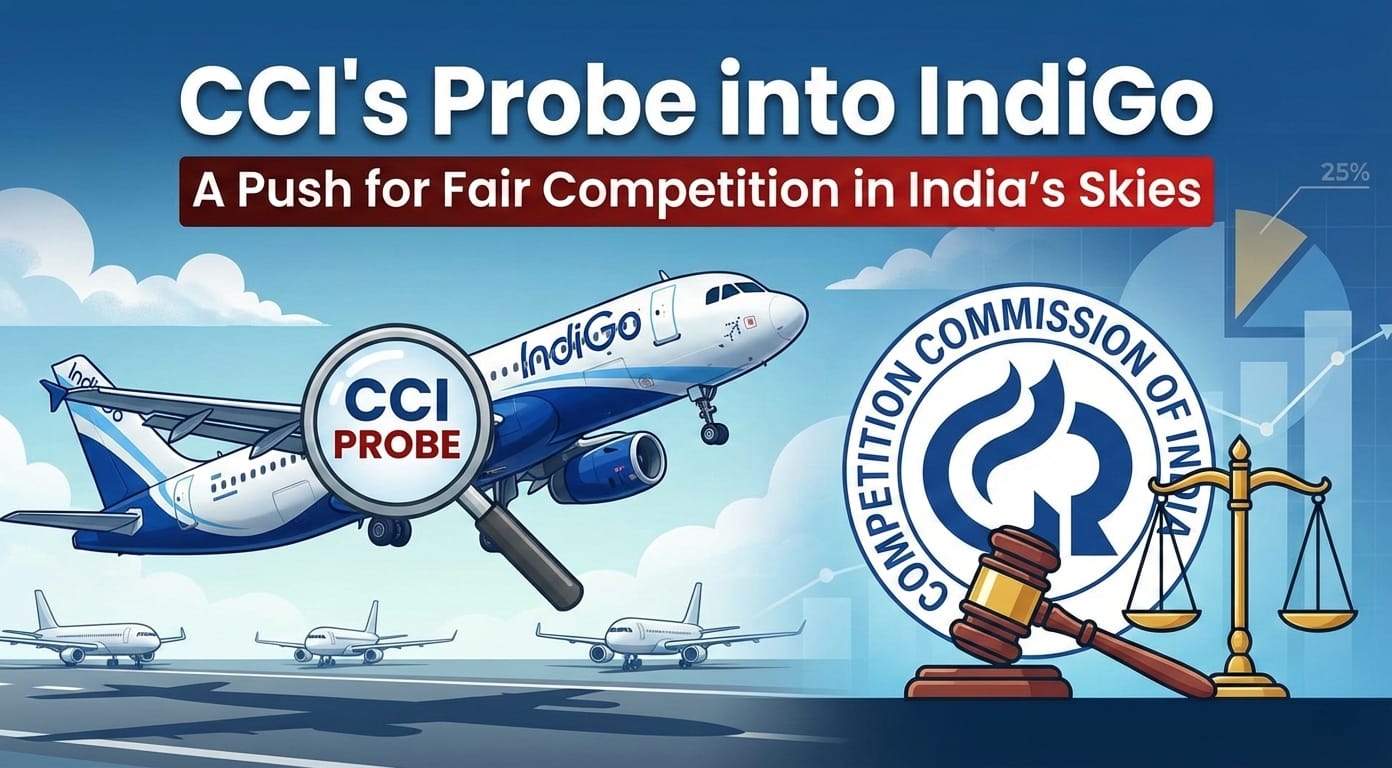
India’s aviation space, one of the fastest-growing in the world, is witnessing a defining moment as the Competition Commission of India (CCI) launches a formal probe into IndiGo. The airline, which controls over 60% of the domestic market, came under scrutiny after the cancellation of thousands of flights in December, leaving more than one million passengers affected.
The CCI, in its 16-page order, noted that IndiGo’s actions “effectively withheld services from the market,” creating an artificial scarcity and restricting consumer access during peak demand. The concern is not simply about operational lapses—it is about whether a dominant enterprise wielded its position in a way that distorted the competitive playing field.
At the heart of this issue lies the concept of a “position of dominance,” defined under Section 4 of the Competition Act, 2002. The Act describes it as a situation where an enterprise enjoys the power to operate independently of market forces or influence competitors and consumers to its advantage. Dominance, in itself, is not unlawful; however, the abuse of such dominance—by restricting supply, manipulating prices, or excluding rivals—constitutes a violation. IndiGo’s sustained control over more than half of India’s domestic air capacity and its commanding presence on key city-pair routes provide ample grounds for CCI’s concern that the carrier’s conduct could hinder effective competition.
The CCI’s order signals that the government wants to keep India’s skies open and competitive. In a market that’s finally seeing new players like Akasa Air and a rejuvenated Air India Group, ensuring fair play is crucial. Even though IndiGo lost 59.6 per cent in December and 14.3% drop in market share recently, it still holds more than half of the market — a clear sign of dominance. This probe isn’t just about penalties; it’s a reality check for the entire industry. For air travel in India to stay affordable and accessible, no single airline should be too powerful to ground the competition.
For India’s aviation sector to develop healthily, multiple carriers must have fair opportunities to compete, and dominant players must be held accountable when their actions—intentional or otherwise—create artificial constraints on market supply. This probe, therefore, isn’t just about punishing past conduct but about establishing guardrails that ensure India’s skies remain genuinely competitive for the benefit of millions of travelers who depend on affordable and accessible air transport.