
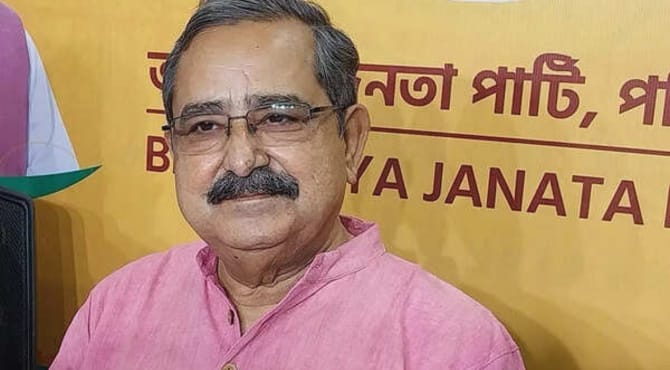
Renowned economist Ashok Kumar Lahiri has been formally appointed Vice‑Chairman of NITI Aayog, effectively becoming the institution’s chief executive under Prime Minister Narendra Modi, who continues as Chairman.
The move marks a major leadership change at the government’s premier policy think tank and replaces Suman Bery, who has held the vice‑chairmanship since May 2022. Lahiri, a former Chief Economic Adviser to the Government of India and a member of the 15th Finance Commission, is a sitting BJP MLA from Balurghat in West Bengal, though he is not contesting the ongoing assembly elections.
His appointment signals both a return of a seasoned economic policy‑maker to the centre and an attempt to strengthen the BJP’s intellectual heft in the east even as the party battles the Trinamool Congress in West Bengal.
Lahiri brings over four decades of experience in public policy, having served as India’s 12th Chief Economic Adviser between December 2002 and June 2007, across the governments of Atal Bihari Vajpayee and Manmohan Singh. A graduate of Presidency University in Kolkata and the Delhi School of Economics, he has also worked with the Asian Development Bank, the World Bank and the International Monetary Fund, besides holding senior research and leadership roles at the National Institute of Public Finance and Policy and later at Bandhan Bank.
His profile as a senior “Bhodrolok” economist from Kolkata makes his elevation to the vice‑chairmanship a notable moment for the state’s intellectual leadership in national policymaking. Within NITI Aayog, he is expected to reshape the think tank’s agenda on fiscal federalism, state–centre financial relations, and growth‑oriented reforms, at a time when India is aiming for higher, more inclusive growth as it moves toward its 2047 development goals.
Alongside Lahiri’s appointment, immunologist and molecular scientist Professor Gobardhan Das has been named a full‑time Member of NITI Aayog, bringing science and public‑health expertise to the council. Das is currently Director of the Indian Institute of Science Education and Research (IISER) in Bhopal and earlier taught at Jawaharlal Nehru University’s Special Centre for Molecular Medicine in New Delhi.
He has led frontline research on tuberculosis and infectious diseases, with long spells at institutions such as Yale University and Houston Methodist Hospital in the United States, as well as at the University of KwaZulu‑Natal and the National Research Foundation in South Africa, before choosing to return to India to contribute to domestic research and education.
His international recognition for work on the pathogenesis of TB and his role in training young scientists position him as a key voice in shaping India’s health, biotechnology and scientific innovation policies under the NITI Aayog framework.
Das’s personal journey adds another layer of significance to the appointment. Born to Hindu Dalit refugees from Bangladesh who fled persecution, he grew up in very difficult conditions in West Bengal, once studying under street lamps and later losing 17 family members in riots.
Rising from a poor farming background, he carved a successful career in immunology and molecular medicine, embodying social mobility and resilience. His elevation to a central policy body is being read both as a recognition of merit and as a symbolic gesture of inclusiveness, especially as the ruling establishment seeks to broaden its base beyond traditional elites.
Within NITI Aayog, his presence is expected to influence strategies on health‑system strengthening, vaccine and drug development, and the integration of research universities and IISERs into India’s innovation ecosystem.
The double appointment of two prominent scholars is being closely watched in political and academic circles. Though the BJP remains a relatively newer player in Bengal state politics, the selection of Lahiri and Das underlines the Centre’s attempt to project an image of competence and diversity in its policy architecture.
It also underscores the government’s interest in using respected economists and scientists to anchor long‑term development planning, especially as India navigates the post‑pandemic growth phase, climate‑related challenges and the push for a more self‑reliant industrial and technological base.
For Lahiri, the shift from state‑level politics to the apex policy body means moving from direct electoral politics to the backstage of national decision‑making, where ideas on fiscal discipline, public‑investment efficiency and inter‑state coordination will now shape his daily work. For Das, it marks a formal entry into the intersection of science, governance and long‑term national planning, giving him a platform to translate cutting‑edge research into actionable policy recommendations for the country.

