
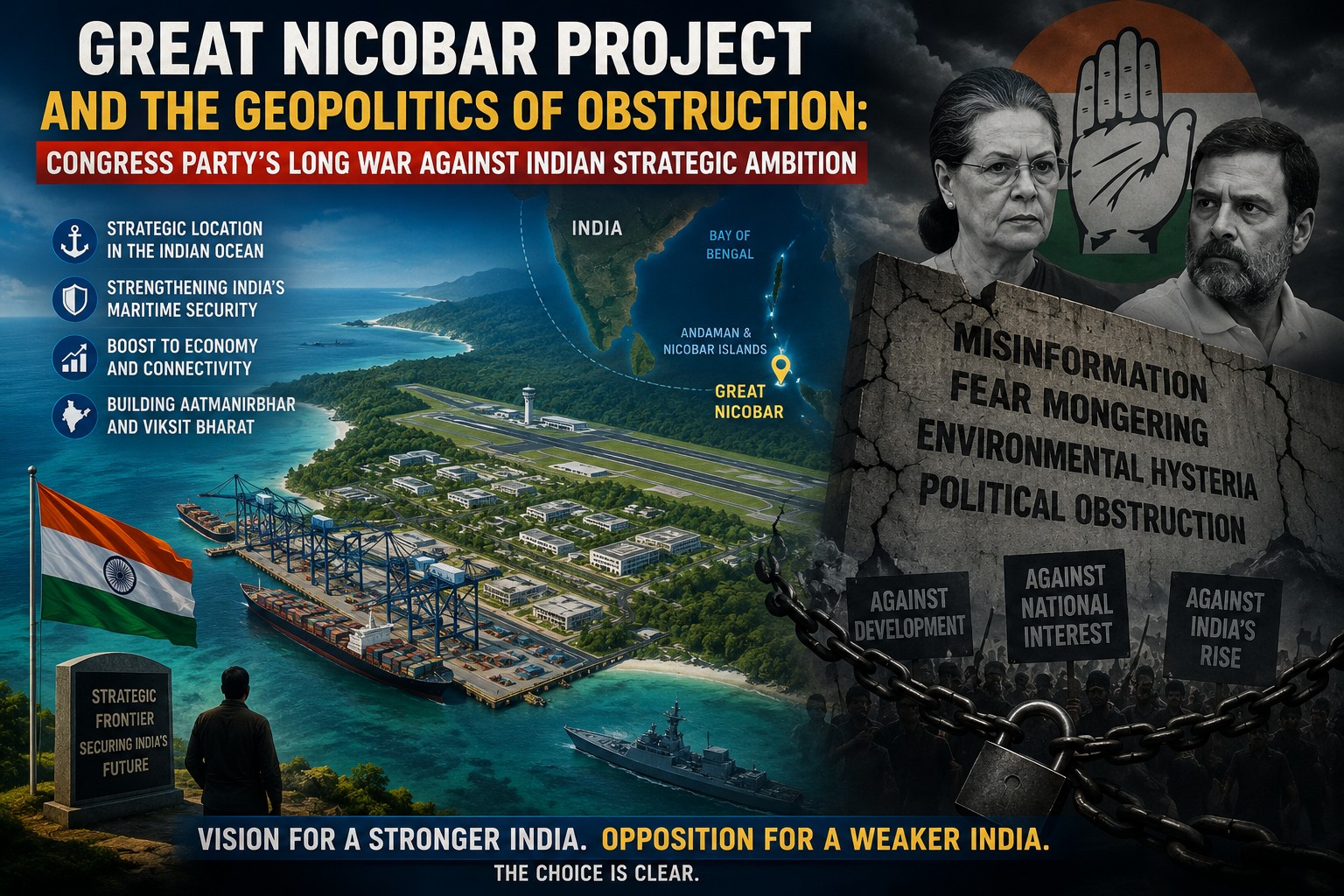
There is a pattern so structurally consistent, so immune to the passage of government and generation, that its attribution to coincidence would require an almost heroic act of intellectual dishonesty. Every time the Indian state moves to assert sovereign will over its own strategic geography, to build, to connect, to project – a remarkably well-oiled machinery swings into motion. It arrives wearing the language of ecology, carrying the grammar of tribal rights, and funded by interests that have very clear, very material reasons to ensure India does not arrive at the destination it is building toward.
The most recent theatre of this operation is Great Nicobar Island. To understand what is happening there, one must resist the temptation of the present tense. The story does not begin in 2025. It begins with a dynasty, and a pattern of alignment whose implications, read across time, are rather more troubling than any single episode allows.
The original sin, and the convenient amnesia it requires
Sonia Gandhi’s September 2025 opinion piece in The Hindu, describing the Great Nicobar Project as a “planned misadventure” that makes “a mockery of all legal and deliberative processes” was, as political interventions go, admirably crafted. It was also, as history goes, breathtakingly dishonest.
The demographic transformation of the Nicobar archipelago, the very transformation now weaponised as evidence of the current government’s predation upon indigenous communities, was an entirely Congress-era enterprise. Official records of the Nicobar District administration confirm that it was in the late 1960s, under Congress governance, that the administration began systematically settling non-tribals on the Nicobar group of islands. Three hundred and thirty ex-defence personnel were settled on de-reserved areas of Great Nicobar itself. By the mid-1970s, plantation Tamils were brought in for rubber cultivation in Katchal. In 1973-74, 165 Car-Nicobari families were forcibly relocated to Little Andaman to manage population pressures that Congress settlement policies had themselves created.
This is not a footnote. It is the central fact. The party that built the demographic architecture of the Nicobar Islands, that settled ex-servicemen on tribal land, administered these islands for six decades without erecting a single piece of strategic infrastructure, is the party now writing op-eds about the sanctity of tribal consultation.
Rahul Gandhi’s letter to Tribal Affairs Minister Jual Oram alleges that the Shompen and Nicobarese communities were not “properly consulted” with no acknowledgment that the Shompen voted in a general election for the first time in their history in 2024, having been excluded from the electoral process entirely during the decades of Congress rule he apparently mourns. This is not an omission born of ignorance. It is a selective memory deployed as a political weapon.
The machinery behind the morality play
The campaign against Great Nicobar is not a spontaneous uprising of ecological conscience. It is an organised operation with identifiable actors, traceable funding, and a strategic logic that has almost nothing to do with leatherback turtles or the welfare of a Shompen population numbering fewer than a hundred individuals. Survival International, operating from London, dispatched a dossier titled “Crushed” to UN bodies in April 2025, warning of the impending extinction of the “uncontacted” people.
The organisation’s intervention is not novel. It had previously agitated against the Andaman Trunk Road, coordinating directly with Sonia Gandhi’s National Advisory Council, that extra-constitutional body through which the Congress president exercised policy authority she had not been elected to hold. The NAC, composed almost entirely of civil society members with documented links to foreign-funded NGOs, served during 2004-2014 as the institutional interface between transnational activist networks and Indian state power. That the same corridor now functions in opposition rather than through government is a structural continuity worth examining.
The Association of Indian Primatologists issued statements of ecological alarm about the Nicobar long-tailed macaque. Its Secretary simultaneously serves as Manager of the Food and Land Use Coalition, whose core funding emanates from the UK Foreign, Commonwealth and Development Office, the Norwegian International Climate and Forest Initiative, and the IKEA Foundation. The climate organisation “There Is No Earth B” orchestrated a letter-writing campaign to fifteen Members of Parliament. Of fifteen letters sent, one response was received, from Sonia Gandhi. When a London-based tribal rights organisation, a Norwegian climate group, and a British-funded think tank all converge on the same Indian infrastructure project at the same moment, deploying the same vocabulary of indigenous extinction and ecological catastrophe, one is not witnessing a spontaneous convergence of conscience. One is witnessing a coordinated campaign, with domestic political handlers providing the parliamentary voice that transnational networks cannot provide for themselves.
The 2008 MOU, and the question that was never asked
On 7 August 2008, in the Great Hall of the People in Beijing, Rahul Gandhi, then Congress General Secretary, signed a Memorandum of Understanding with the International Liaison Department of the Chinese Communist Party. The agreement, signed in the presence of Sonia Gandhi and a then-Vice President named Xi Jinping, provided both parties “the opportunity to consult each other on important bilateral, regional and international developments.”
Sonia Gandhi confirmed the MOU herself in a written interview to the Xinhua News Agency in June 2011. It was signed at the precise moment when China was constructing the “String of Pearls”, the systematic cultivation of port assets across India’s maritime neighbourhood designed to encircle Indian power in the Indian Ocean. The MOU established a formal channel between India’s principal opposition party and the political command of India’s primary strategic competitor at the exact historical moment when the contest for the Indo-Pacific was being decided. Indian public discourse processed this as a footnote. It was not a footnote.
Seventeen years later, on 7 September 2025, Rahul Gandhi was in Langkawi, Malaysia, geographically proximate to both the Chinese-proposed Kra Isthmus Canal project in Thailand and the Great Nicobar development zone. The following day, Sonia Gandhi’s opinion piece appeared in The Hindu. The day after, Rahul Gandhi’s formal letter to the Tribal Affairs Minister was released. Three coordinated strikes across seventy-two hours – an editorial, a parliamentary intervention, and a pre-positioned foreign presence, timed with the precision of a communications operation.
India’s Ministry of Home Affairs had in 2016 placed George Soros’s Open Society Foundations on a watchlist, restricting its ability to fund Indian NGOs without prior government sanction, having concluded that its activities posed risks to national sovereignty. The ideological network the OSF constructed in India, spanning funded media, legal advocacy groups, and academic institutions, was operational long before Great Nicobar became the current battleground. None of this constitutes forensic proof of conspiracy. What it constitutes is a pattern, generationally consistent, institutionally traceable, and strategically coherent, that Indian liberal discourse has consistently refused to examine with the rigour it deserves.
Who benefits, and why – That is the only question that matters
The strategic stakes are not difficult to state. Great Nicobar sits 40 to 90 nautical miles from the western entrance of the Strait of Malacca, through which an estimated 80% of China’s oil imports transit and roughly 50% of global trade by volume moves. China’s former President Hu Jintao described Beijing’s dependence on this chokepoint as the “Malacca Dilemma.” A fully operational Indian transshipment hub and military-capable airfield at Great Nicobar converts a passive geographic advantage into an active instrument of deterrence and directly threatens the transshipment revenues of Singapore and Malaysia, whose port dominance is predicated on India’s continued inability to handle its own containers. Currently, 25% of India’s originating container traffic is routed through Colombo, Singapore, and Port Klang, at an annual revenue cost of ₹15,000 crore to Indian infrastructure.
Who benefits from India not building the Great Nicobar? China – its Malacca Dilemma remains uncontested. Singapore and Malaysia – their transshipment dominance is preserved. The ecological argument, applied with surgical precision to Great Nicobar while remaining entirely absent from Western discussions of their own industrial infrastructure, is not environmentalism. It is, at best, “Green Colonialism” – the imposition of a de-growth philosophy on India that no Western power applied to itself during its own industrialisation. The insistence that India must subordinate its Indo-Pacific posture to the habitat requirements of the leatherback turtle, as determined by Norwegian climate funds and London advocacy groups, is a proposition that deserves to be named for what it is.
The verdict that history will deliver
The Congress party governed the Nicobar archipelago for sixty years, settled ex-servicemen on tribal land, administered a strategically priceless geography as an administrative backwater, and built nothing of consequence for India’s maritime future. It cultivated instead an international network of civil society relationships, NGO funding channels, and foreign ideological alignments now being deployed with the practiced coordination of a machine that knows exactly what it is doing, against the first serious attempt to actualise the strategic potential of these islands since independence.
Sonia Gandhi is not writing about the Shompen because she cares about the Shompen. Rahul Gandhi is not writing to the Tribal Affairs Minister because he has discovered tribal jurisprudence. He is writing because the project, if completed, will alter the strategic balance of the Indo-Pacific in India’s favour in ways directly uncongenial to the interests of the networks he moves within and the alignments his party formalised in Beijing in 2008. The ecology of this campaign – its foreign financing, its domestic handlers, its generational continuity from the Congress settlement era to the Congress obstruction era, its synchronisation with the commercial anxieties of Singapore and the strategic calculations of Beijing, is the more urgent subject of national examination. India is not fighting an environmental debate at Great Nicobar. It is fighting, as it has always fought, for the right to exist on its own terms.
Author – Nitya Ahuja is Policy Consultant and Research student in Political Economy at the University of Delhi with specialisation in Geopolitical Affairs and Socio-Economy.

