
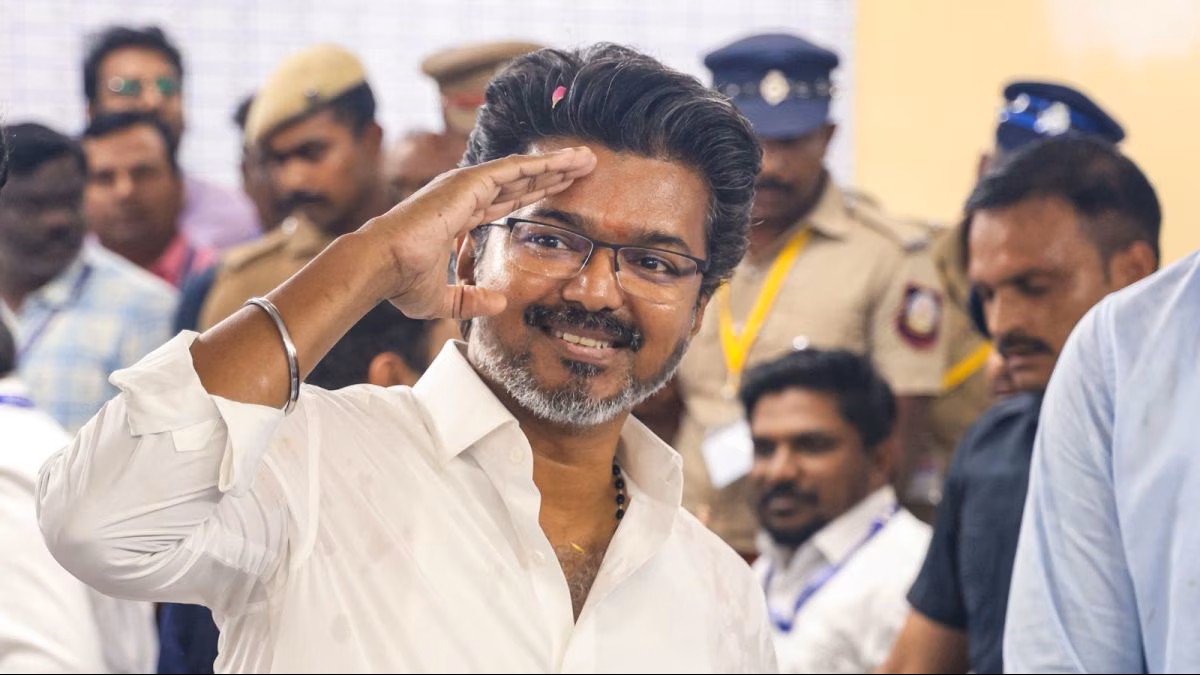
Actor-turned-politician Vijay appears set to script a historic political breakthrough in Tamil Nadu, with his party Tamilaga Vettri Kazhagam (TVK) emerging as the nucleus of a possible new government after securing crucial support from smaller parties in the state. Things looked in jeopardy for a while after TVK took support from Congress party, but now it looks like they will have enough numbers to form government.
BREAKING 🚨
— Shiv Aroor (@ShivAroor) May 8, 2026
VCK & Left set to announce support to TVK at 4.30pm briefing, Vijay to meet Governor at 6pm to stake claim.
TVK’s strong electoral performance had already shaken the foundations of Tamil Nadu’s traditional Dravidian political order. The party’s impressive seat tally established Vijay as a serious political force capable of challenging the decades-long dominance of the DMK and AIADMK. However, despite the momentum, TVK initially remained short of the numbers required to independently form the government and needed alliance partners to get over the line.
That problem appears to have been solved after the Left parties signaled their support for Vijay-led TVK. The backing from communist parties and smaller allies will push TVK over the majority mark. Hence, Tamil Nadu may be on the verge of witnessing its first major power transition led by a political newcomer in decades.
The Left’s support for TVK is being seen as both strategic and ideological. The communist parties, weakened electorally but still influential in coalition arithmetic, reportedly viewed Vijay as a more viable anti-establishment alternative capable of halting both the DMK’s continued dominance and the BJP’s growing ambitions in southern India. For the Left, aligning with a rising regional force also offers an opportunity to regain relevance in Tamil Nadu politics.
For Vijay, the development marks a remarkable transformation from cinema icon to chief ministerial contender. His political journey had initially been met with scepticism, with critics dismissing TVK as another celebrity-driven experiment lacking organisational depth. But the election campaign demonstrated that Vijay’s appeal extended beyond fan clubs and urban youth. TVK managed to attract first-time voters, sections of the middle class, women voters, and even rural constituencies disillusioned with conventional political parties.
The possibility of a TVK-led government has also triggered anxiety among established parties. The DMK, which expected anti-incumbency to remain manageable, is now losing power to a first-time challenger. AIADMK, meanwhile, risks further marginalisation if TVK successfully consolidates the anti-DMK vote base in the coming years.
Yet, challenges for Vijay remain substantial. Running a successful election campaign is vastly different from governing a politically complex state like Tamil Nadu. Coalition management, balancing ideological differences with Left allies, and meeting high public expectations will test TVK’s organisational maturity. Critics have also questioned whether the party possesses enough experienced administrators to manage key departments effectively.
Still, the political symbolism of the moment is undeniable. Vijay’s rise reflects a broader churn in Tamil Nadu politics, where younger voters appear increasingly willing to look beyond the traditional Dravidian binary. If TVK formally succeeds in forming the government, it could mark the beginning of a new political era in the state — one where cinema charisma, grassroots mobilisation, and coalition politics converge to redraw the electoral map of Tamil Nadu.

