
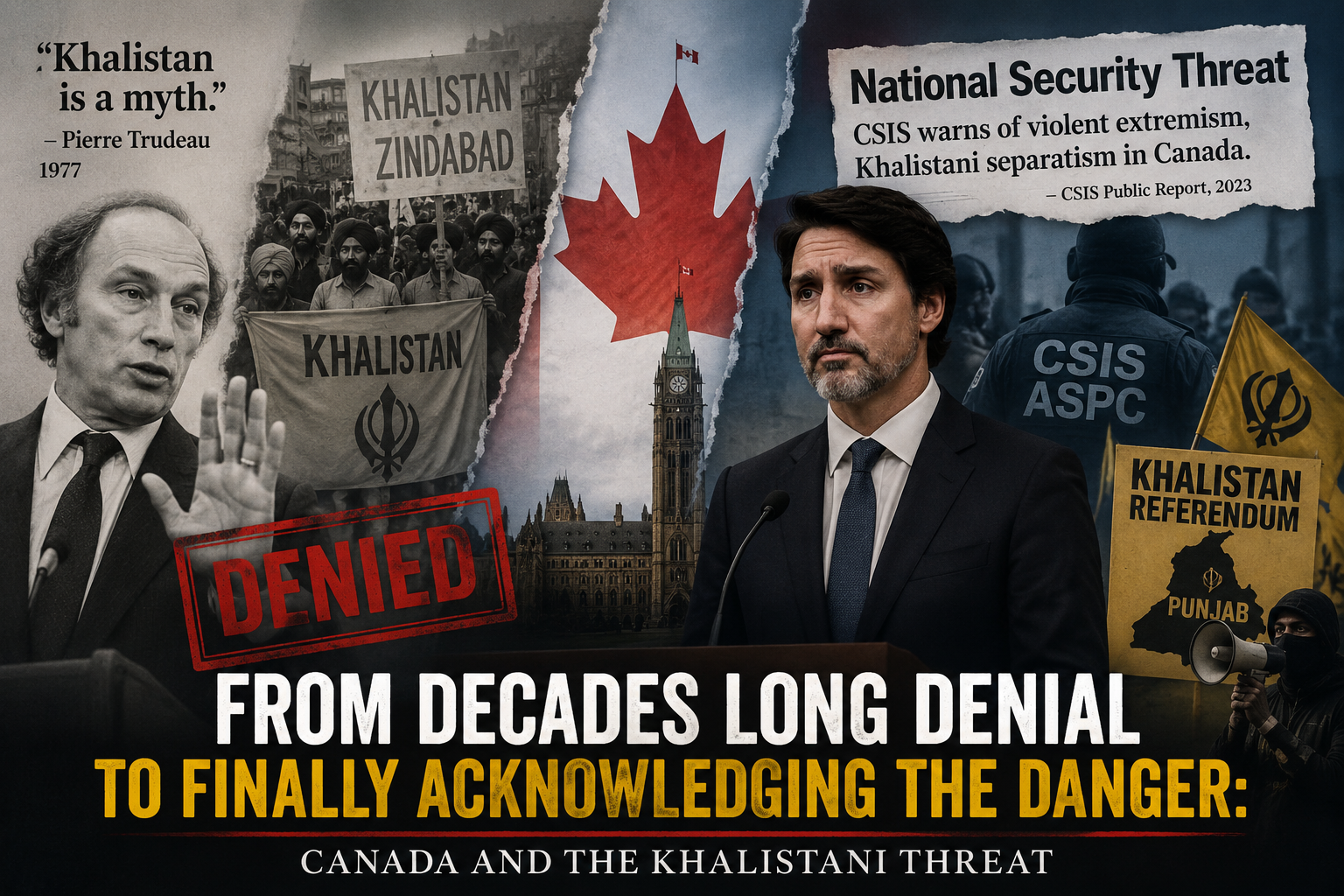
The Canadian Security Intelligence Service (CSIS) Public Report 2025, released on May 1, 2026, marks a notable evolution in Ottawa’s threat assessment matrix, particularly with regard to Khalistani extremism. The report categorizes such activity under Politically Motivated Violent Extremism (PMVE) and explicitly states that “ongoing involvement in violent extremist activities by Canada-based Khalistani extremists (CBKEs) continues to pose a national security threat to Canada and to Canadian interests.”
It further notes that a small cohort of individuals uses Canada as a base to promote, fundraise for, or plan violence, while some CBKEs exploit Canadian institutions and unsuspecting community members to channel funds toward violent extremist activities.
The report also makes direct reference to the 40th anniversary of the 1985 Air India Flight 182 bombing – the deadliest terrorist attack in Canadian history, which killed 329 people, most of them Canadians, and was linked to individuals associated with CBKE networks. CSIS invokes this anniversary not merely in a commemorative sense, but as a cautionary reminder that CBKE-linked violence has previously struck Canada itself, underscoring that the threat cannot be treated as entirely external.
However, the report carefully distinguishes peaceful advocacy for Khalistan – protected under Canadian law – from violent extremism, noting that it is “prohibited from investigating lawful advocacy, protest or dissent,” thereby preserving political sensitivities tied to Sikh Canadians. Only those who use Canada as a base to “promote, fundraise, or plan violence, primarily in India,” are categorized as Khalistan extremists. While this legal framework is normatively important, it also underscores a structural vulnerability: the space between protected speech and operational planning is precisely where extremist networks have historically been able to operate and adapt.
The report does not identify specific organisations or individuals, instead situating its findings within the broader framework of politically motivated violent extremism. In doing so, Canadian authorities signal a more transparent and direct acknowledgement of the issue, while seeking to avoid generalisations that could unfairly implicate entire communities.
In its 2024 annual report, released in June 2025, CSIS had, for the first time, explicitly confirmed that Khalistani extremists were using Canadian soil as a base to promote, fundraise for, and plan violent activities, primarily targeting India – marking a significant departure from earlier positions. This shift is particularly notable given that the Canadian government under Justin Trudeau had, in 2019, removed references to “Sikh (Khalistan) extremism” from its “Public Report on the Terrorist Threat to Canada,” released in December 2018, following pressure from pro-Khalistani elements within the country.
This shift is reinforced by Canada’s 2025 report on Money Laundering and Terrorist Financing Risks, which specifically identified banned (both in Canada and India) Khalistani groups – Babbar Khalsa International (BKI) and International Sikh Youth Federation (ISYF) – as recipients of funds originating in Canada, for extremist purposes. These findings have supported subsequent legislative action, including the Combatting Hate Act (Bill C-9), passed by the House of Commons on March 25, 2026. The law criminalizes the public display of symbols associated with listed terrorist entities when used to promote hatred, directly targeting the flags and imagery of BKI and ISYF.
As an immediate reminder of the complexity of the threat, on May 4, 2026, an Indian-origin bookie, Simranjit Singh aka Sam Canada, alleged to be an “accountant” in Canada for the Lawrence Bishnoi gang, was killed in a targeted shooting in the Newton area of Surrey. Investigators have indicated possible Khalistan-linked angles to the case. Shortly after the incident, Rohit Godara – a fugitive gangster who has split from the Bishnoi network – claimed responsibility via social media, identifying the victim as a “close associate” and “main handler” for rival elements, and alleging his involvement in cricket match-fixing and illegal betting operations in Canada. The episode underscores growing concerns over the convergence of organised crime, extremist Khalistani linkages, and international gang violence on Canadian soil.
Earlier, on March 3, 2026, Nancy Grewal – a Punjabi-origin social media influencer and outspoken critic of Khalistani extremism – was fatally stabbed at LaSalle within the Windsor region of Ontario. The case remains under investigation, with authorities examining possible Khalistani-linked motives. A social media account associated with extremist messaging claimed responsibility for the killing, explicitly citing her criticism of the Khalistan movement and warning that others would face “the same fate.” LaSalle Police Service and the Ontario Provincial Police confirmed that the attack was premeditated and targeted – “an intentional act against her personally.” However, no arrests have been made in the case, thus far.
Apart from these two fatalities, data from the Khalistan Extremism Monitor (KEM) indicates that three persons of Indian origin were killed in separate “targeted hits” across Canada in the first four months of 2026, with suspected links to Punjabi gang networks. In 2025, six persons were similarly killed in six separate gang-related violent incidents. Amid this rise in organised violence, the Canadian federal government, on September 29, 2025, formally designated the Lawrence Bishnoi gang a “terrorist entity” under the Criminal Code.
Additionally, there have been repeated attacks on Indian diplomatic missions and personnel, Punjabi musicians and their businesses, Hindu temples, and other community institutions, often accompanied by inflammatory propaganda.
Pro-Khalistani mobilization by fringe elements has frequently provoked counter-mobilization by pro-India and Hindu groups, leading to clashes during protests and parades that risk importing diaspora polarization into Canadian public spaces. Although often framed as defensive, such responses have at times escalated tensions, complicating law enforcement and heightening concerns over inter-community violence, while also contributing to the rise of anti-immigrant and racist sentiments within broader Canadian society.
India has long accused Canada of serving as a safe haven for Khalistani and Punjab-origin criminal networks. Despite repeated complaints and formal extradition requests, Ottawa has taken limited action. According to the National Investigation Agency (NIA), nine of the 28 most-wanted gangster–terrorist fugitives identified in 2023 were operating from Canada. These include Lakhbir Singh aka Landa, Arshdeep Singh aka Arsh Dala—both formally designated by India as individual terrorists in 2023—as well as Sukhdool Singh aka Sukha Duneke (killed in September 2023), Gurpinder Singh aka Baba Dalla, Satveer Singh Warring aka Sam, Snover Dhillon, Charnjeet Singh aka Rinku Bihla, Ramandeep Singh aka Raman Judge, and Gagandeep Singh aka Gagna Hathur. As of June 2025, India’s extradition requests for 26 individuals accused of terrorism and organised crime – many allegedly linked to Khalistani separatist networks operating from Canadian soil – remain pending.
Meanwhile, the CSIS report maintains a critical stance toward India, grouping it alongside countries such as China, Russia, Iran, and Pakistan on allegations of transnational repression and foreign interference. While the tone toward India appears somewhat moderated compared to 2024 – when the fallout from the killing of Hardeep Singh Nijjar dominated discourse – the 2025 report still underscores concerns about alleged Indian intelligence activities targeting Sikh activists on Canadian soil. This dual framing – acknowledging both Khalistani extremism and Indian interference – reflects Canada’s attempt to balance domestic priorities with geopolitical sensitivities.
The absence of any reference in the latest report, to the Hardeep Singh Nijjar case is particularly striking. His 2023 killing, followed by then-Prime Minister Justin Trudeau’s allegation of possible involvement of Indian agents, had triggered a sharp rupture in ties with New Delhi, including reciprocal expulsions of diplomats and a prolonged freeze in high-level engagement.
The report validates India’s long-standing concerns regarding CBKE operational networks, even if it remains critical of India’s alleged methods of addressing them. For India, it serves as a diplomatic asset – providing an authoritative basis to press extradition cases and to call for stricter enforcement of Canada’s own terrorist entity designations.
The CSIS Public Report 2025 marks a gradual shift toward a more balanced and realistic assessment of the Khalistani issue in Canada. The report’s ultimate significance lies in the fact that, after years of the Khalistan threat being interpreted primarily through the lens of India-Canada bilateral tensions, Canada’s intelligence community has now placed it squarely within a domestic national security framework. This reframing is a necessary precondition for any durable solution. The key question is whether the Carney government, navigating a complex diaspora landscape while seeking strategic convergence with India, possesses the sustained political will to act on what its own intelligence service has now made clear.
Author Nijeesh N is a Research Associate at the Institute for Conflict Management

