
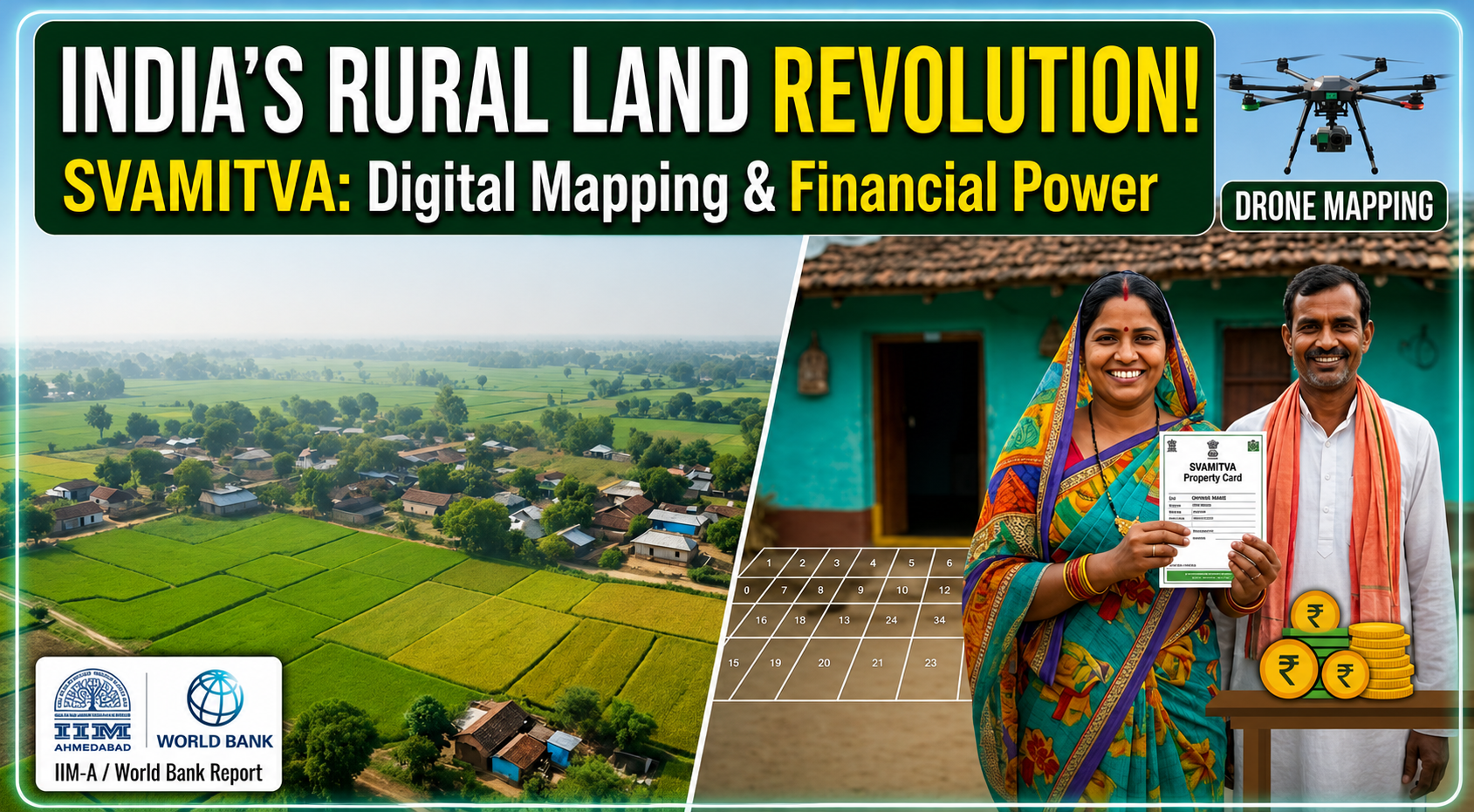
We previously did a video on the SVAMITVA scheme discussing its primary aim of digitizing land records in rural areas to grant more power to landowners. It is immensely proud, to see that the same initiative has been presented by the Indian Institute of Management, Ahmedabad (IIM-A) at the World Bank as a worldwide successful model.
Besides highlighting the scheme’s massive success in formalizing rural property rights, the study also indicates that the scheme’s effective framework could be used as a potential blueprint by other countries in the near future. You can read again about this scheme in our article on its changes here:
At its core, the SVAMITVA scheme is a technological revolution that has taken rural India by storm, combining drone-based aerial surveys with the advanced Continuously Operating Reference Station (CORS) network to achieve accurate land mapping.
The deviation from traditionally manual records to more reliable, digitally verified documentation has resulted into a successful mapping of over 3.30 lakh villages. This is more than just a logistic change, rather a significant development in rural governance, turning long and loosely claimed land rights into viable legally recognised rights through proper property documents. For millions of households, this also means finally having a secure, tangible document that declares their dignity and long-term security.
The economic impact of this digital transition is becoming more and more apparent as formalized property rights unlock a lot of value for those that need it most. This is evident in the economic impact themes that have come out following the digital transition, formalized property rights are unlocking trillions of values to those who need property the most.
The study highlighted that over 10,900 loans have been sanctioned using these property cards as collateral, amounting to about ₹1,679 crore. In unimaginably short periods, over 10,900 loans (~₹1,679 crore), using these property cards as collateral, have already been sanctioned.” By opening access to hitherto inaccessible financial services, the scheme is bridging the chasm between rural households and the formal banking sector, achieving financial inclusion on staggering scales.
NapThe scheme is thus crucial not just in monetary terms but also in terms of empowering women and utilizing data for planning community development. The scheme is thus helping in better developmental planning to reduce litigations related to land and in representing accurate data for planning community development.
It is this kind of overall, multi-dimensional accomplishment that has led the World Bank to look at the Indian case as a model for other developing countries that face similar obstacles in managing rural land.
As IIM-A and other policy experts continue to disseminate such knowledge, it can be said that India’s SVAMITVA experience is a major success to the world towards advancing sustainable rural development.

