
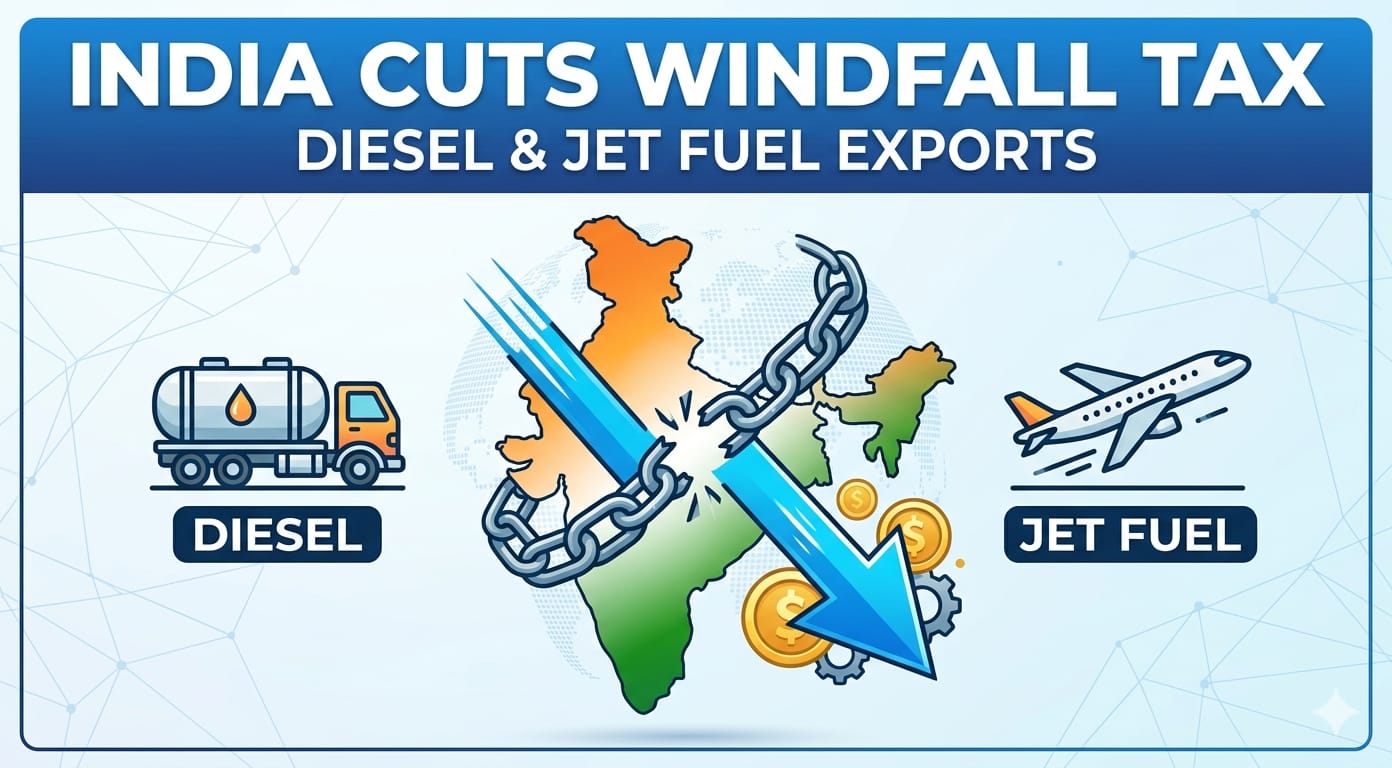
With world oil markets going up and down as a result of the current conflict in West Asia, the Indian government has made another move towards redefining its fuel export policy. In another major step, the Centre has cut drastically windfall tax on diesel and aviation turbine fuel (ATF), which is often referred to as jet fuel, in a bid to balance the availability in the country and export competitiveness.
The export duty on diesel has been reduced drastically to ₹23 per litre temporarily to the first fortnight of May 2026, according to a notification issued by the Finance Ministry, which previously was ₹55.5 per litre. Correspondently, export tax on jet fuel has been decreased by 10 per cent, 33 per litre. Such cuts are in the face of an environment where the global price of crude oil is still high, owing to various geopolitical conflicts involving major producers of oil.
To gain insight on this decision one should look at the background. The taxation levied by the government was a windfall tax as hike of extra excise duty commencing March 27 when international fuel prices were high and domestic prices were low. This price difference had rendered exporting oil more profitable to oil firms and there was a possibility that this would lead to a shortage in domestic supply in case the oil firms started exporting in large volumes. The idea behind the tax was that it would be a temporary action to reduce over exports and so that there would always be enough fuel in the country.
Nonetheless, with changing market situations in the world, a liberal approach has been taken by the government. The export taxes are discussed and updated at least once a fortnight, granting a rapid reaction of the policymakers to prices changes. This recent decrease is the second adjustment since the tax was established that indicates that the authorities are closely studying international trends as well as domestic supply processes.
This will encourage Indian refiners to export diesel and jet fuel once more as the export duty has been reduced. Margins renounced by exporters are low when taxes are high and this discourages them to sell the fuel in other countries. The government is reducing such duties and this way, the refiners are enabled to take the world advantage, yet still keeping a check on domestic supply. This is a fine walking wire, particularly in a highly unstable geopolitical landscape.
Surprisingly, the petrol export duty still remains at zero. This implies that the government does not believe that there is any threat to local petrol supply or price stability at the moment. It is also an indicator that pricing is distinct to petrol than diesel and jet fuel that are more directly affected by international trade and demand in the aviation sector.
In the case of the aviation industry; the decreased export duty in the form of ATF may have an indirect effect as well. Reduced taxes can enhance refining margins and possibly stabilize supply chains, which is significant when the global air travel demand is slowly getting back on its feet. In the case of diesel, which is both a transport and industrial fuel necessary commodity, ensuring that there is sufficient domestic supply is quite a concern, nevertheless, the reduced duty means that the supply situation is now comfortable.
This move, in general, is indicative of the flexible policy framework of the government with regard to fuel economics. The Centre is instead responding to market real time signals by reconfiguring duties other than adhering to a certain tax framework. This will not only help shield domestic consumers against the unpredictability of a shortage but also make Indian refiners stay competitive in the global market.
The prices of oil would not be predictable in different parts of the world as the conditions in West Asia keep changing. Such to-and-fro changes in windfall taxes will be instrumental in bringing about an equilibrium in balancing energy security of India and export interest. As of today, the recent reductions in duties presuppose the transition to their softening, supported by the assurance of the local fuel supply, and an attempt to unify with the world situation in the market.

