
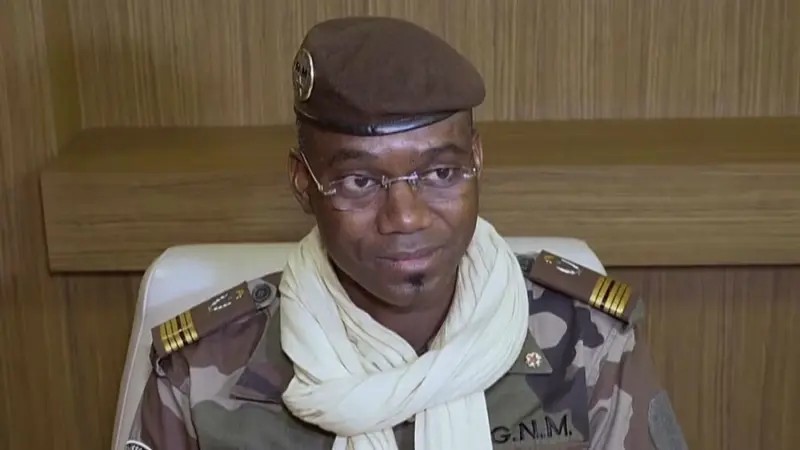
On April 25, 2026, Mali’s Defence Minister, Lieutenant General Sadio Camara, was killed during a coordinated series of attacks by armed groups across the country. A suicide car bomb (vehicle-borne improvised explosive device, VBIED) struck his residence in the heavily guarded garrison town of Kati, about 15 kilometres northwest of the capital, Bamako.
The powerful blast destroyed much of his home and killed Camara along with his second wife and two grandchildren. He was wounded in the initial explosion and ensuing firefight, before succumbing to his injuries in the hospital. The head of the junta, General Assimi Goïta, was reportedly moved to a safe location after his own residence in Kati came under attack.
The assaults were not limited to Kati. Simultaneous strikes hit Bamako’s international airport, military positions in Gao, Kidal, Sévaré, Mopti, Bourem, and other sites in central and northern Mali. Explosions, gunfire, and vehicle-borne attacks were reported, with fighting continuing into a second day. Official Malian statements reported at least 16 people (civilians and military personnel) wounded, with several militants killed. Sources suggested the casualty toll could be higher, though exact figures remained unclear.
Al-Qaeda-linked Jama’at Nusrat al-Islam wal-Muslimin (JNIM) claimed responsibility for the attacks and assaults. JNIM carried out the operation in coordination with the Azawad Liberation Front (FLA or ALF), a Tuareg-dominated separatist rebel group. This alliance marked a notable collaboration between jihadist militants and Tuareg separatists, united against the Bamako junta, with the FLA stating the operation aimed to “defend the people against the military regime.” JNIM described the attacks as among the most serious launched against the junta in years. JNIM primarily conducted attacks in central and southern areas, while FLA focused more on northern cities. In subsequent statements, FLA spokesman Mohamed Elmaouloud Ramadane stated: “An agreement was reached between the Azawad forces and the Russian elements of the Africa Corps with a view to ensuring their secure withdrawal from the fighting.” He added the Russian Forces were “permanently withdrawing from Kidal” and “Kidal is now free”.
FLA consolidated full control of Kidal after negotiating the departure of Russian Africa Corps personnel, escorting their convoy toward Gao, while Malian troops reportedly burned the camp before leaving the area. On April 27, 2026, Russia’s Africa Corps confirmed that its forces had withdrawn from the northern town of Kidal in Mali.
Kidal, a strategic desert town in northern Mali and the capital of the Kidal Region, is located approximately 1,500 km from Bamako and serves as a key transit hub toward Algeria. Predominantly Tuareg, it has long been a centre of separatist mobilisation and a flashpoint since the 2012 Tuareg uprising. Its reported recapture carries significant symbolic weight, suggesting a possible resurgence of separatist influence after the Malian junta and Russian-backed forces had seized the town in November 2023.
Camara, a key architect of Mali’s 2020 and 2021 military coups and a central figure in the junta led by General Assimi Goïta, had played a major role in expelling French forces from Mali and strengthening ties with Russian mercenaries (initially the Wagner Group, later the Africa Corps). His death is widely viewed as a significant blow to the junta.
Significantly, the attacks stem from Mali’s long-running crisis, which erupted with the 2012 Tuareg rebellion. Separatist groups briefly declared an independent state of Azawad in the north before jihadist factions overran the region, which triggered French military intervention and years of instability. The 2015 Algiers Peace Accords, intended to address Tuareg grievances and integrate former rebels, largely failed to deliver lasting peace. Violence resurged sharply after the 2020 and 2021 military coups that brought the current junta to power. Following the expulsion of French forces and the United Nations peacekeeping mission MINUSMA (United Nations Multidimensional Integrated Stabilisation Mission in Mali), Mali turned to Russian mercenaries – first the Wagner Group and later the Africa Corps – for security support. Despite this shift, large parts of northern and central Mali remain contested.
On the other hand, JNIM seeks to impose strict Sharia law across the region, expel all foreign military presence (now primarily Russian rather than French), and undermine the junta in Bamako. The group aims to expand territorial control, boost recruitment among marginalised communities, and weaken central authority through sustained guerrilla tactics. FLA and JNIM were previously rivals, with FLA seeking autonomy or independence for northern Azawad due to long-standing marginalisation and neglect by Bamako.
On March 22, 2026, a fragile truce formed between JNIM and Mali’s junta-led government to end JNIM’s fuel blockade on Bamako convoys since October 2025; it involved releasing over 100 JNIM prisoners linked to al Qaeda Sahel affiliate JNIM, for a pause in tanker attacks until Eid al-Adha in late May, though the junta later called the releases “unfounded.” The deal collapsed amid renewed offensives by Malian forces and Russian Africa Corps allies, including sanctioned arms deliveries, prompting JNIM and FLA’s tactical alliance, and coordinated attacks starting April 25 across Bamako, Kidal, Gao and other regions. The tactical alliance between FLA and JNIM against the junta is extraordinary in view of their opposing goals of ethnic autonomy versus Islamist governance.
The junta’s growing international isolation – marked by its withdrawal from the Economic Community of West African States (ECOWAS) and formation of the Alliance of Sahel States (AES) with Burkina Faso and Niger – increased its dependence on Russian support. Insurgents frequently portray this Russian presence as yet another form of foreign occupation, similar to the earlier French role.
Mali has faced jihadist insurgencies since 2012, when Tuareg rebels and Islamist groups (including JNIM precursors) overran the north amid a broader rebellion. Key historical incidents include: the 2015 Radisson Blu Hotel attack in Bamako by al-Mourabitoun (linked to al-Qaeda), which killed 20 hostages; repeated assaults on military bases in central and northern Mali by JNIM and Islamic State Sahel Province (ISSP); and high-profile kidnappings and ambushes on security forces throughout the 2010s and 2020s.
The direct attack on the defence minister starkly exposes the junta’s profound security failures, despite its heavy dependence on Russia after cutting ties with France and Western partners. His death will weaken command continuity and military morale, compounding the regime’s existing challenges of international isolation, economic hardship, and tensions with neighbours. Regionally, it will intensify pressure on the Alliance of Sahel States (Mali, Burkina Faso, and Niger). The Sahel remains the global epicentre of terrorism, fuelled by porous borders. Looking ahead, the junta must choose between intensified military repression with Russian backing – risking further alienation – or genuine political dialogue to address northern grievances. Without tackling regional grievances, cycles of coups and insurgencies will persist, with hybrid threats blending jihadism, separatism, and anti-foreign sentiment.
Author: Ruchika Kakkar :Research Assistant, Institute for Conflict Management

