
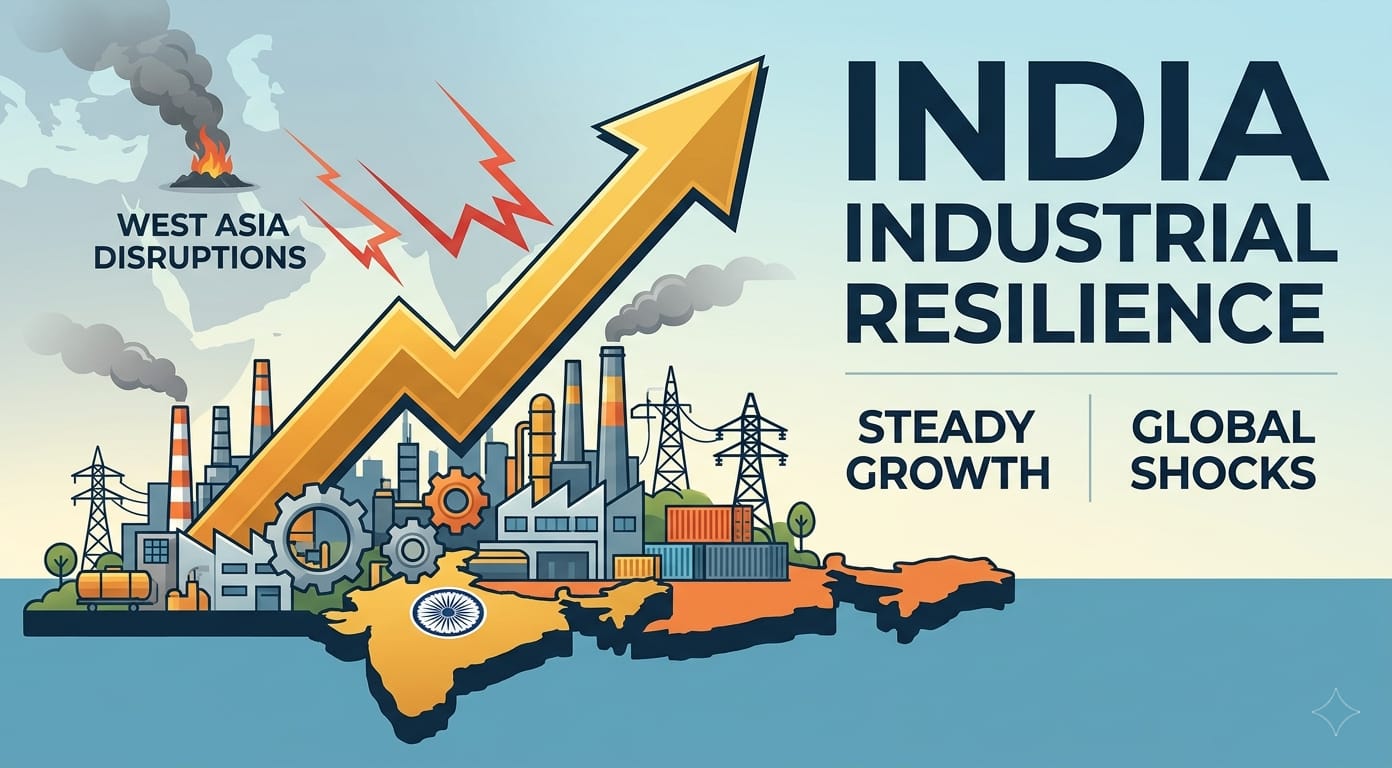
India’s industrial growth showed surprising resilience in March 2026, with output expanding by 4.1%, year-on-year, down only a notch from 5.1% logged in February, despite the ever-increasing global disruptions caused by the ongoing West Asia conflict.
The latest figures issued by the Ministry of Statistics and Programme Implementation (MoSPI) show that external shocks have only just started to appear, and their full impact on the industrial activity in India is yet to be seen. For the entire financial year 2025-26, industrial production growth stood at 4.1% against 4% recorded in the previous year, hinting at a broadly stable recovery trajectory, albeit under caution.
At face value, the March numbers contradict concerns emanating from contraction in the eight core infrastructure sectors, which had declined by 0.4 percent during the same period. These sectors include coal, crude oil, natural gas, fertilisers, steel, cement, and electricity and account for almost 40% of the Index of industrial production (IIP) and are considered to be the lead indicators of the industrial momentum. The steepest decline in fertiliser output registered 24.6%, reflecting supply disruptions and energy constraints tied to geopolitical tensions. However, the more comprehensive IIP figures indicate that for the moment, the downstream industries have been able to cushion the shock.
A sectoral performance analysis shows that manufacturing, which accounts for more than three-fourths of the IIP registered a growth of 4.3% in March, while output from the mining sector rose by 5.5%, thus underpinning industrial activity. Electricity generation however, decelerated considerably to 0.8% compared to 2.3% in February indicating emerging strain in energy supply. Within manufacturing, the supply bottlenecks have had limited impact so far as only the chemicals and chemical products segment has moderated its pace of growth. This means that the impact that input shortages and gas rationing have on some industries is starting to take effect, but the wider manufacturing industry has not experienced such effects yet.
From a demand perspective, capital goods were bright spots registering a sturdy 14.6% growth, pointing at continued investment activities and expansion of infrastructures. Construction goods recorded 6.7% growth too, reflecting ongoing public and private sector projects. Together however, these indicate that the investment cycle is still intact, atleast, in short term. Consumer demand however, is a mixed bag. Durable goods output grew by 5.3% while non-durable goods recorded a mere 1.1% growth, indicating a disparity in consumption across income brackets.
Economists are quick to point out that the data obtained represents only the first stage of the external shock. Geopolitical tensions’ lagged effects are, in particular, seen through higher energy costs, supply chain disruptions, less strong business sentiment and are expected to come to light more in the following months. Core sector contraction and electricity generation slowdown reinforce the fears of crumbling industrial momentum, with the situation expected to worsen in the first quarter of the new financial year. Besides, the domestic demand situation is also not robust. Urban consumption is likely to face obstacles due to high inflation and weak hiring constellations, particularly in the IT industry, while the rural demand is expected to be negatively impacted by the danger of below-average monsoon rainfall, associated with the developing El Nino circumstances.
Other important transitions in progress include the IIP base revision from 2011-12 to 2022-23, with the release of the new series slated for June 2026. This move will account for structural changes in the economy, including replacing obsolete or shuttered factories with those that are currently open and functioning, thereby providing a more accurate representation of India’s industrial landscape. Together with the recent revisions in data related to GDP and inflation, this particular move is part of the broader reforms aimed towards updating the statistical framework of India.
In essence; while India’s industrial sector has exhibited short-term resilience to global disruptions, the risks remain largely significant. However, the more critical test is likely to come when the production, investment and consumption dynamics are seen for more quarters after the full impact of external shocks and domestic constraints are felt and played out.

