
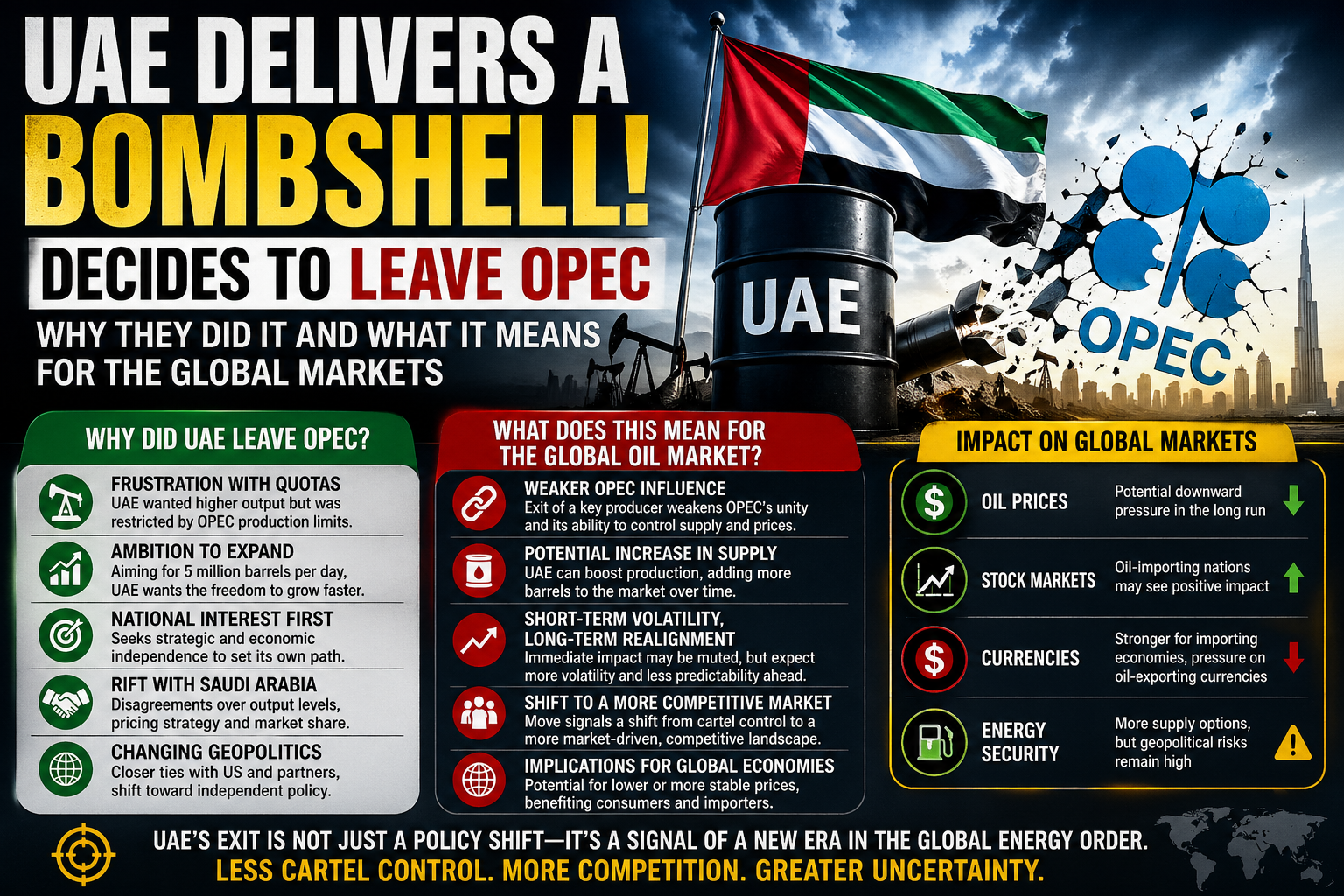
In a bombshell announcement on Tuesday, April 28, the United Arab Emirates (UAE) announced that it is exiting the Organisation of Petroleum Exporting Countries (OPEC) and the broader OPEC+ alliance. The exit will come into effect on May 1.
This decision by the UAE has sent shockwaves through the world. The decision by UAE comes amidst the ongoing war in neighbouring Iran which has already disrupted the global oil trade.
As per UAE’s state media, the decision to leave OPEC is part of UAE’s long-term strategic and economic vision and evolving energy profile.
The oil cartel that is OPEC is likely to be severely weakened by the decision of one of its key members to exit the cartel. Notably, OPEC countries produce 40% of the world’s oil and decide the international prices of the oil.
Why has the UAE left OPEC?
At the heart of the exit lies a long-standing dissatisfaction of UAE with OPEC’s quota system. OPEC members coordinate output levels to influence global prices, but this often means limiting production. For the UAE—one of the few producers with significant spare capacity—these restrictions became increasingly burdensome.
The UAE has the ability to produce far more oil than it is currently allowed under OPEC agreements. Leaving the cartel frees it to expand production in line with its own national interests rather than collective decisions.
The UAE is also pursuing an aggressive strategy to increase oil output, targeting around 5 million barrels per day in the coming years.
OPEC membership limits how quickly such expansion can translate into actual exports. By exiting, the UAE gains flexibility to ramp up production and capture greater global market share—especially as long-term energy demand remains robust.
UAE has framed the decision as part of a broader “national interest” strategy.
The UAE is no longer willing to subordinate its economic planning to cartel discipline. It wants the freedom to respond quickly to market dynamics, diversify revenue streams, and align its energy policy with long-term economic transformation goals.
Meanwhile, tensions within OPEC—particularly between the UAE and Saudi Arabia—have been building for years. Differences over production levels, pricing strategy, and geopolitical priorities have widened, which may have contributed to UAE’s decision.
Saudi Arabia has traditionally led OPEC with a preference for tighter supply and higher prices, while the UAE has increasingly favored higher output and market share.
The ongoing conflict involving Iran and disruptions in the Strait of Hormuz have exposed vulnerabilities in global oil supply chains.
At the same time, the UAE has strengthened ties with the United States and other global partners, signaling a shift toward a more independent foreign and economic policy—less tied to OPEC’s collective stance.
During the Iran war, UAE was also subjected to most missile and drone attacks from Iran. UAE has been left disappointed with the lack of support it received from its Gulf neighbours. That dissatisfaction may have also contributed to UAE’s decision to cut ties with OPEC and tread an independent path.
What does this mean for the global oil market
OPEC’s power lies in collective coordination. The exit of a major producer like the UAE undermines that unity and reduces the group’s ability to control supply.
This could mark the beginning of a more fragmented oil market where coordination becomes harder and compliance weaker.
Now, the UAE is free to increase production. Over time, this could add more barrels to the global market, putting downward pressure on oil prices.
Some estimates suggest that increased output could modestly reduce global crude prices if geopolitical disruptions ease.
In the immediate term, the impact may be limited due to logistical constraints and ongoing regional tensions.
The UAE’s move signals a shift from cartel-driven supply management toward a more competitive, market-based system.
What it means for India
For oil-importing countries like India, this development could be beneficial. More supply and weaker cartel control typically translate into lower or more stable prices over time.
With India’s good relations with UAE that have been strengthened during the Modi tenure, India is in a position to buy the excess oil from UAE that it can now produce away from OPEC. It will help India secure its energy needs through one of its main allies.
How the rest of the OPEC reacts remains to be seen but for now, UAE has changed the world oil market with their decision to quit OPEC and follow its own path.

