
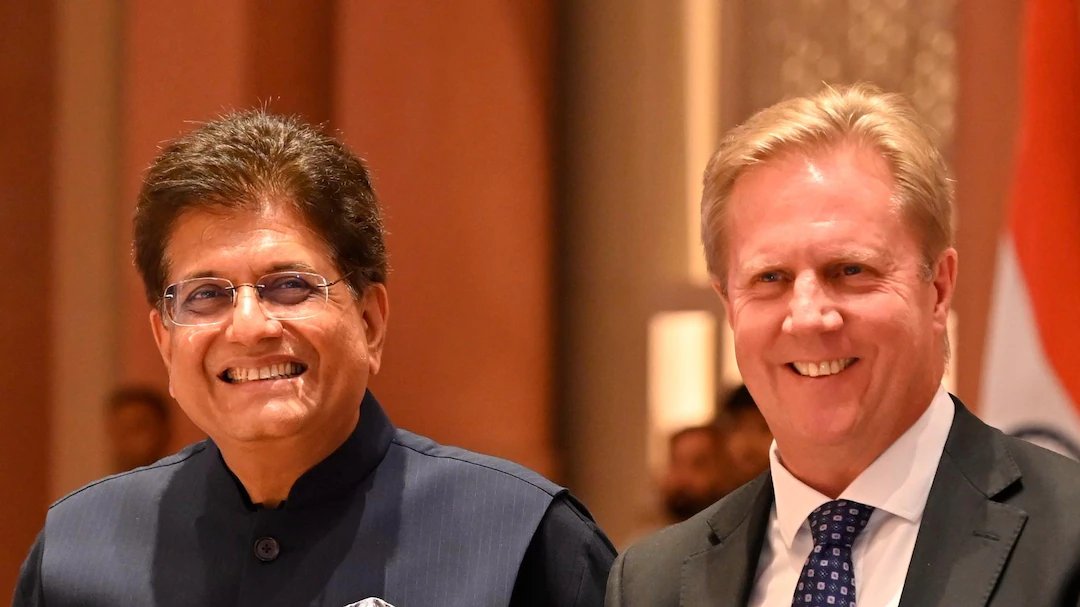
The signing of the India–New Zealand Free Trade Agreement (FTA) marks a decisive step forward in bilateral relations, opening a new phase of economic cooperation between the two countries. Formalized in the presence of Union Minister of Commerce and Industries, Piyush Goyal and New Zealand’s Trade and Investment Minister, Todd McClay, the agreement is designed to expand trade, attract investment and create opportunities across sectors.
A major boost for Indian exporters
At the core of the agreement is a transformative provision: 100 percent duty-free access for Indian exports across all tariff lines. This removes earlier tariffs of up to 10 percent on key products such as textiles, leather, carpets, ceramics, and auto components.
For Indian exporters, particularly in labor-intensive sectors, this significantly improves competitiveness. Manufacturing hubs like Agra’s leather industry are expected to benefit directly, as their products can now enter the New Zealand market without import duties. Lower costs and improved margins are likely to translate into stronger export volumes.
The benefits extend beyond traditional sectors. Pharmaceuticals, chemicals, engineering goods, plastics, and agro-processed products will now operate on a more level playing field, strengthening India’s export ecosystem.
Investment commitments and growth potential
A key highlight of the FTA is New Zealand’s commitment to invest $20 billion in India over the next 15 years. This long-term capital flow is expected to support manufacturing, infrastructure development, innovation, and job creation.
Currently, bilateral trade stands at approximately $1.3 billion (2024–25), with India exporting $711.1 million and importing $587.13 million. The agreement aims to significantly expand this volume, with a clear focus on doubling trade in the coming years.
Services and professional mobility
The agreement goes beyond goods to strengthen cooperation in services. India has secured access in high-value sectors such as IT and IT-enabled services, professional services, education, financial services, tourism, and construction.
A notable feature is the Temporary Employment Entry Visa pathway, which allows up to 5,000 Indian professionals to work in New Zealand for up to three years. This provision is expected to enhance mobility for skilled talent while strengthening people-to-people ties.
Balanced market access
While India gains full duty-free access to New Zealand’s market, it has also opened 70 percent of its tariff lines to New Zealand through a calibrated approach.
New Zealand will benefit from tariff concessions on agricultural products such as apples, kiwifruit, and manuka honey, subject to quotas and minimum import prices. Tariffs on certain industrial goods, including iron, steel, and scrap aluminum, will be phased out over a period of up to 10 years.
At the same time, India has protected sensitive domestic sectors by excluding items such as dairy products, key agricultural goods, sugar, edible oils, and select industrial products including copper, aluminum, and arms and ammunition.
A strategic framework for the future
The India–New Zealand FTA is not just a trade agreement; it is a strategic framework for long-term economic integration. By combining tariff liberalization with investment commitments and expanded services access, it creates a comprehensive platform for sustained growth.
As global trade dynamics continue to shift, this agreement positions India as a stronger and more competitive player, while reinforcing its commitment to building stable and mutually beneficial partnerships.

