
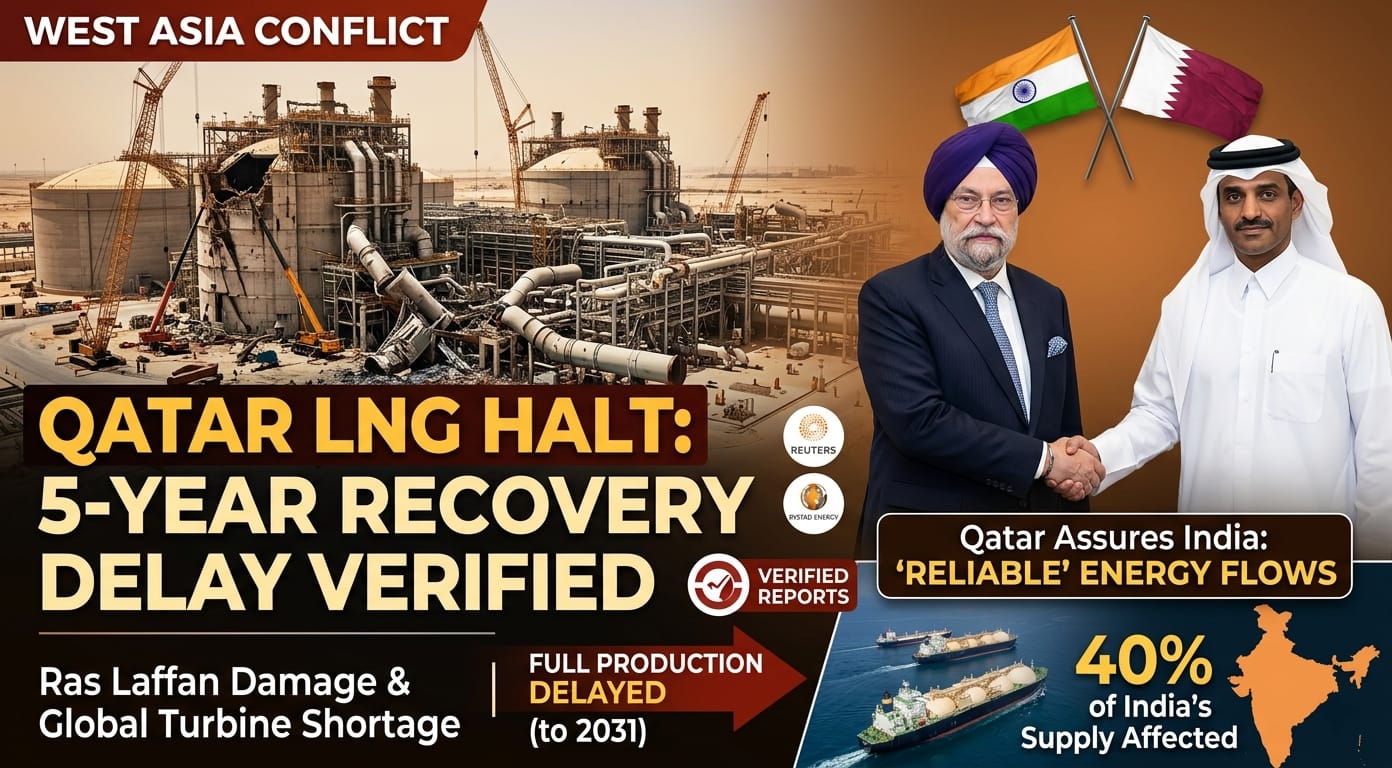
Qatar has reaffirmed its position as India’s most reliable natural gas supplier, assuring uninterrupted cooperation despite serious disruptions at its Ras Laffan Industrial City caused by the ongoing West Asia conflict.
The assurance came during Petroleum and Natural Gas Minister Hardeep Singh Puri’s visit to Doha on April 9–10, 2026, where he held wide-ranging discussions with QatarEnergy CEO Saad Sherida Al-Kaabi following the U.S.–Iran ceasefire announcement.
According to the Ministry of External Affairs, both sides underlined the strength of their long-standing energy partnership. Qatar conveyed its commitment to continue being a reliable and trusted energy partner for India, even as LNG operations face temporary setbacks due to regional instability.
Production at Ras Laffan and Mesaieed was suspended in March after attacks on Gulf energy infrastructure, knocking out nearly 20% of global LNG supply and prompting QatarEnergy to issue force majeure notices. Major Indian importers like GAIL and Indian Oil Corporation faced shipment delays and adjusted procurement volumes.
While two of three trains at QELNG North 1 have reportedly restarted as of early April, full recovery remains distant. Energy consultancy Rystad Energy estimates a 3-5 year repair window for damaged LNG trains, attributing delays to global shortages of large-frame gas turbines vital for LNG refrigeration systems. The loss of trains S4 and S6 alone has reduced Qatar’s output by nearly 12.8 million tonnes per annum (MTPA)—about 17% of pre-war capacity.
Analysts from Wood Mackenzie project limited recovery at the North site (41 MTPA) by July 2026 if restarts proceed in May, but significant delays are expected at the South facility. The timeline for Qatar’s North Field East expansion—earlier slated for November 2026—has now shifted to August 2027, keeping LNG markets tight until 2028. Regional repair costs are pegged between $20–26 billion, with equipment and engineering constraints slowing progress.
Despite supply disruptions, India has managed its gas and power systems effectively. Power Ministry officials said stability was maintained by deferring maintenance of 10 GW capacity and optimizing imports through direct contracts, including Torrent Power’s 10-year deal (0.27 MTPA) starting 2027.
Gas accounts for only 1.4% of India’s generation capacity, cushioning the impact. Meanwhile, India continues assisting regional partners—exporting 38 million tonnes of petroleum to Sri Lanka and signing a government-to-government oil and gas pact with Mauritius.
Domestically, the Bureau of Energy Efficiency projects that the ongoing transition towards induction-based cooking could boost electricity demand by 13–27 GW, aligning with additional 22 GW solar and storage projects set to come online by mid-2026.
Both New Delhi and Doha emphasized the importance of unimpeded navigation and regional stability following the ceasefire, recognizing the strategic significance of the Strait of Hormuz for India’s energy security as the world’s fourth-largest LNG importer.
While extensive repairs at Ras Laffan may take years, Qatar’s reiterated commitment underscores its enduring reliability as India’s key energy partner. For New Delhi, continued diversification—including new ties with Russia and expanded domestic resilience—will shape how it navigates an uneven but strategically vital global gas landscape.

