
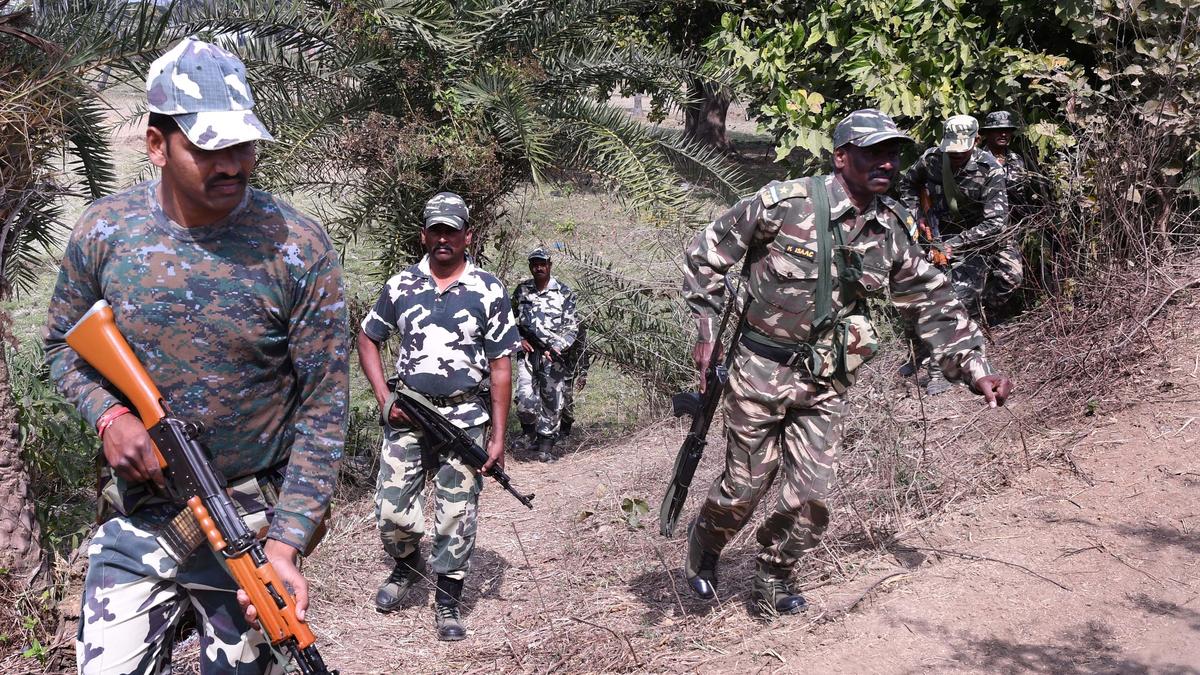
As India approaches the March 31, 2026 deadline set by Union Home Minister Amit Shah for the eradication of Left-Wing Extremism, Operation Kagar has emerged as a defining moment in this long-running conflict. It is widely discussed as a security campaign, and rightly so. But that description, while accurate, is incomplete.
India’s fight against Maoist insurgency has always unfolded on two fronts. The first is physical and kinetic: dense forests, remote hills, intelligence networks, patrol routes and coordinated operations that dismantle insurgent logistics. The second is narrative: a contest over how violence is defined, who claims moral legitimacy, and how global audiences interpret state action. Operation Kagar must be understood as a campaign being fought simultaneously on both these fronts.
Recent operations underline the scale and effectiveness of this effort. In the Karreguttalu Hills between April and May 2025, security forces neutralised 31 Maoists, including several senior cadres, without suffering casualties. Shortly after, in Narayanpur, another 27 Maoists were killed, including top leadership figures. These are not isolated tactical wins, they signal a deeper shift. Maoist leadership, once shielded by terrain and local networks, is increasingly vulnerable to coordinated state action.
However, as these gains have mounted, so too has a parallel information warfare, so to say. Various international and digital platforms have attempted to recast these operations as a “genocide” of Adivasis, framing counter-insurgency efforts as indiscriminate state violence. Such narratives deliberately blur the distinction between armed Maoist cadres and the tribal communities among whom they operate.
This framing is not accidental. It seeks to achieve three objectives: to merge tribal identity with insurgent structures, thereby giving it legitimacy, to portray the state as the sole agent of violence and third, to erase the long record of Maoist actions, including assassinations, extortion, landmine attacks and coercive recruitment. By doing so, it shifts the burden of proof entirely onto the Indian state while insulating the insurgency from scrutiny.
Yet the response to such narratives cannot be rhetorical alone. It must rest on facts, transparency, and clarity. The Indian state must continue to provide verifiable data on operations, casualties and legal oversight. At the same time, it must consistently reinforce a critical point: protecting Adivasi rights and dismantling Maoist violence are not contradictory goals, but they are mutually reinforcing.
Development data further strengthens this argument. Thousands of kilometres of roads have been built in Left-Wing Extremism-affected areas, mobile connectivity has expanded, residential schools have been established and banking access has increased significantly. Significant efforts have been made to mainstream these areas. These measures reflect a broader strategy: integrating historically neglected regions through infrastructure, governance and opportunity.
None of this suggests that the state is beyond criticism. Allegations of excess must be investigated, and civilian protection must remain paramount. But it is equally important to reject the false binary that equates counter-insurgency with persecution. An armed insurgency cannot claim moral immunity simply by operating within vulnerable communities.
Operation Kagaar also highlights a broader reality of modern conflict: no campaign remains local. Every encounter is instantly globalised, every casualty subject to competing interpretations. In this environment, success is not measured only in territory regained or leaders neutralised, but also in controlling the narrative space.
As India moves toward its 2026 target, the challenge is clear. It must not only defeat Left-Wing Extremism on the ground but also prevent a familiar inversion – the one where insurgents position themselves as victims and the state as the sole aggressor. That inversion has sustained Maoist politics for decades.
Defeating it is not separate from the mission. It is central to it.
And the time is now.

