
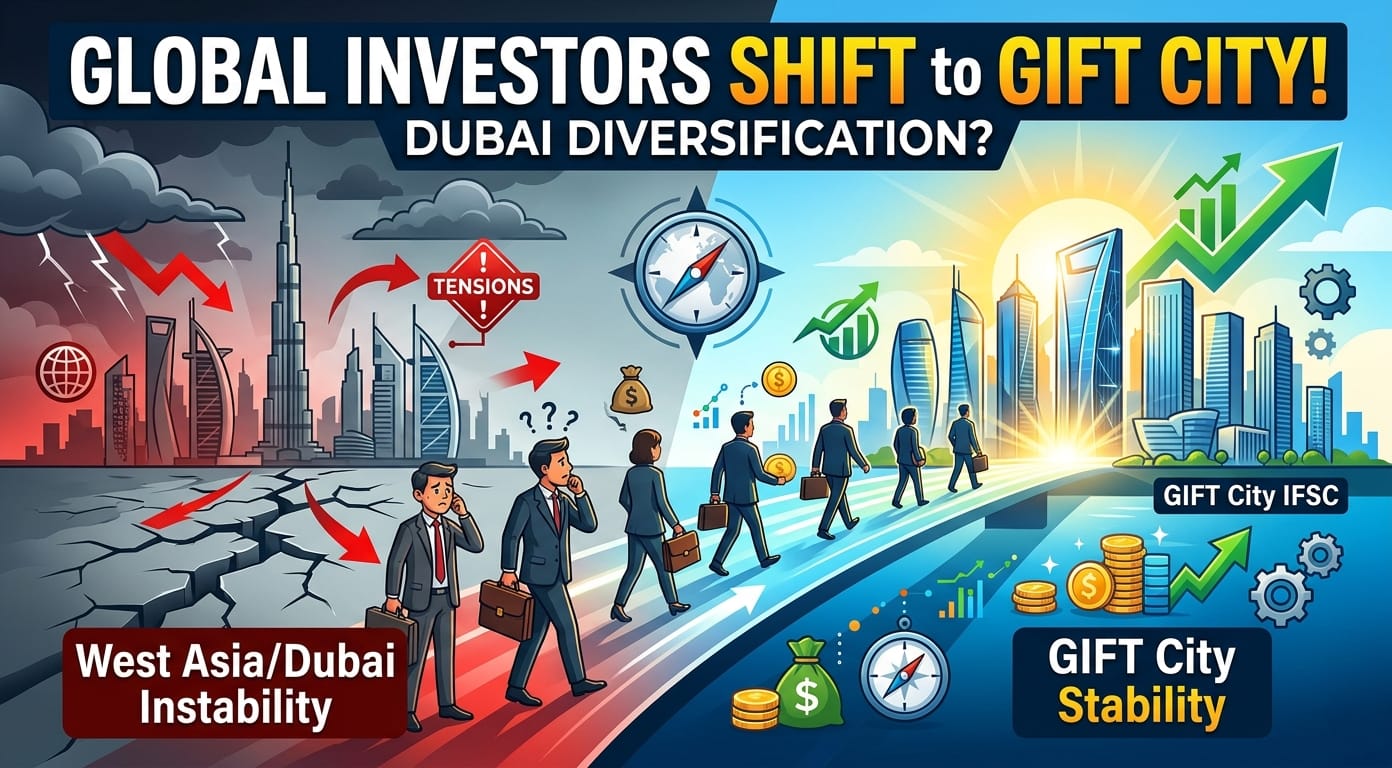
According to reports published in economics times recent instability in West Asia has encouraged more investors from around the world, as well as Non-Resident Indians (NRIs) to reconsider their heavy reliance on Dubai, which has therefore led to a renewed interest in India’s Gujarat International Finance Tec-City, or what is better known as the GIFT City.
As tensions ripple through the region investors are increasingly looking at safer and more stable alternatives nearer to India’s fast growing economy. This change represents a strategic shift toward having a “dual-hub” presence – to maintain Dubai as a central base while adding the GIFT City as an India-linked foothold.
While Dubai still reigns as a financial powerhouse in the Middle East, unrest from on-going geopolitical strains has put a diversification drive into gear. Experts say this trend is not about deserting Dubai but finding more jurisdictions which provide long-term security, predictable regulation and proximity to India, which is still one of the fastest-growing major economies in the world.
According to Aaryan Shah, associate director at Savvy Group, enquiries for office space in GIFT City have been on the rise in recent months due to institutions and fund managers assessing the option to set up their operation in the International Financial Services Centre (IFSC). He said the nature of discussions has changed – investors are not just comparing costs when they discuss the terms – they now are looking at the long-term regulatory stability and attractiveness of India’s reform-driven environment. The shift is still gradual, but does indicate increasing faith in the potential of the IFSC to anchor off-shore investments into India.
The 2026-27 Union Budget has also given a big boost to GIFT City’s attractiveness by extending major tax benefits. IFSC units can now allow 100% tax deduction on eligible income for 20 years continuously in a 25-year period, which is a major increase over the previous 10-year cap. After this period business income will be taxed at the concessional level of 15% as compared with the regular rate of 35% which is applicable for foreign entities elsewhere in India.
These measures make GIFT City one of the most tax-efficient jurisdictions for global firms looking for long-term operations in India. Anuranjan Mohnot, managing director of Lumos Equity Advisors, noted that the development of GIFT City is much faster. The kinds of infrastructure improvements, connectivity and social amenities have given the hub a modern face over the past six months. Liberalised policies, the coming of international universities, the growing number of skilled workforce, and the competitive real estate prices are making it a good destination for financial companies and investment houses.
Mohnot added that the ongoing tensions in the Middle East have only accelerated this interest as investors look for a way to spread out geographic risk, as well as maintain operational continuity. Property consultants also confirm growing interest from Gulf-based clients, especially among clients who are managing cross-border assets. A senior executive of an international property consultancy, said that more investors from the UAE were now considering hedging the risks by setting up a secondary financial base in India.
The goal is not to move out of Dubai but to ensure flexibility in business and protection from unexpected regional disruptions.
The allure of GIFT City is in its foreign currency denotations ecosystem, single point of regulation under the International Financial Services Centres Authority (IFSCA) and a slew of benefits in terms of taxation, policies etc. The city is also positioning itself steadily as a window for global capital to enter India – not merely only for fund management but also for leasing, structured finance and other international financial activities.
Unlike the past perceptions where GIFT functioned mostly as a place of tax optimization, now this is beginning to be perceived as a tool of geopolitical risk management. Investors truly see India as a generally steady and developing economy and then the GIFT City is exactly the bridge to link the worldwide capital with the Indian market without the absence of complete relocation.
However, experts caution that Dubai’s mature financial ecosystem, liquidity and global trust in the legal system, continues to make Dubai the destination of choice for large scale investments from around the world. Indian investors, in particular, are still important players in the property and financial markets of Dubai.
Yet, the growing curiosity and restrained lean towards GIFT City shows India’s surging credibility as a stable and efficient financial center that can complement, rather than compete with, the established global financial centers.
A deeper look at why global investors are gravitating toward India — and GIFT City in particular — points to something more fundamental than just tax incentives or geographic proximity.
Government’s appeal, at its core, is rooted in institutional stability: a democratic framework, a functioning judiciary, a clear regulatory architecture, and a government that has consistently signalled its intent to attract and retain foreign capital through structural reforms.
The IFSCA, which acts as a unified regulator for all financial services within GIFT City, has been instrumental in creating a predictable and investor-friendly environment. Unlike multi-regulator jurisdictions where compliance can be fragmented and opaque, GIFT City’s single-window regulation reduces friction and provides a degree of certainty that institutional investors increasingly demand. Coupled with progressive policies — from allowing foreign universities to set up campuses to permitting offshore derivative instruments — the policy environment signals long-term commitment.
The government’s macro-economic fundamentals further reinforce this narrative. As one of the world’s fastest-growing major economies, with demographic tailwinds, expanding domestic consumption, and a deepening capital market, the country offers a compelling risk-reward proposition. For investors already exposed to India through equities or private equity, GIFT City provides a regulated, efficient gateway to consolidate and expand that exposure — without the complexities of onshore regulatory requirements.
What is emerging, therefore, is not just a story about geopolitical hedging, but about India actively building the conditions for financial credibility — infrastructure, policy clarity, human capital, and institutional trust — that make it a genuine long-term alternative hub for global finance.

