
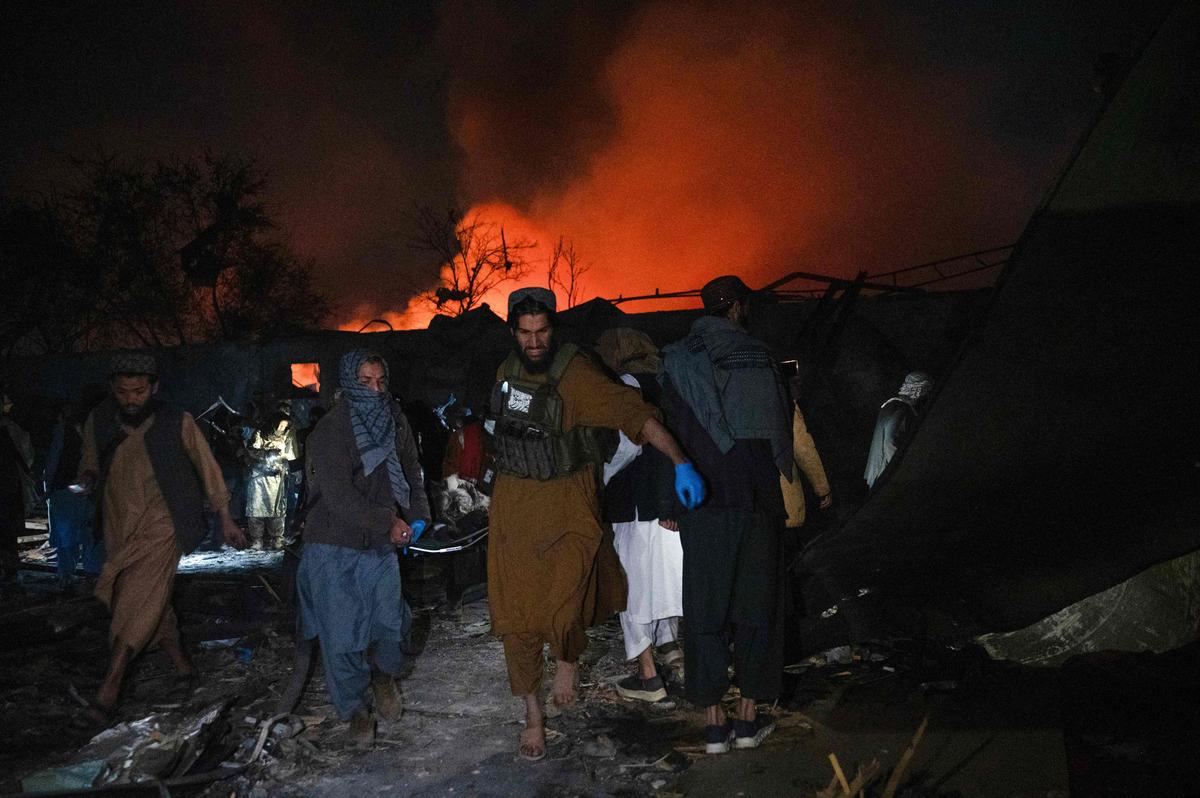
Mujahid says the addiction hospital in Kabul was targeted, resulting in many civilian casualties, mostly addicts under treatment, who were killed or injured.
Afghanistan’s Taliban government deputy spokesman, Hamdullah Fitrat, reported on X that on March 16th, around 9 PM, Pakistani military warplanes bombed a drug addiction treatment hospital in Kabul, killing 400 people and injuring 250. He said 2,000 people were being treated at the “Ameed” hospital.
A source from the Kabul Forensic Medicine Department told, that 98 bodies have been brought in, some of which have been handed over to families, while others remain unidentified.
The UN political mission in Afghanistan has expressed “deep regret” over the Pakistani forces’ attack on the addiction treatment center in Kabul.
Cricketer Rashid Khan has condemned Pakistan’s latest attacks on Kabul, urging the international community to investigate the incident.
Taliban officials state that many people have been killed or injured in the attack on the addiction hospital in Kabul.
The UN High Commissioner for Human Rights says there should be a “prompt, independent and transparent investigation” into the “explosion” at the addiction treatment center in Kabul, and those responsible should be held accountable according to international standards.
The statement adds that the findings should be shared with the public, and victims and their families should receive compensation.
It emphasizes that under international humanitarian law, civilians and civilian objects are fully protected, and attacks must adhere to principles of distinction, proportionality, and precaution. Medical facilities have special protection under international humanitarian law.
The statement says that in the past month, “289 Afghan civilians, including 104 children and 59 women, have been killed or injured” amid escalating violence between Afghanistan and Pakistan. The agency adds that tens of thousands have been displaced, particularly in the southern and southeastern regions of Afghanistan.
India has also condemned the attack, with its Ministry of External Affairs spokesperson calling it a “cowardly and unjustified act” that targets innocent civilians. Pakistan, however, denies the allegations, claiming it targeted militant groups in Afghanistan.
Hundreds of people were killed in a Pakistani military attack on a drug addiction treatment hospital in Kabul, Afghanistan.
However, Pakistan’s Information Minister, Attaullah Tarar, claimed on X on March 17th that the military targeted “military installations and terrorist centers” in Kabul and Nangarhar provinces, operating under the support of the Taliban government in Afghanistan.
The Taliban government’s spokesman, Zabihullah Mujahid, condemned Pakistan’s attack as “an inhumane act against all accepted principles,” stating that “Pakistan’s military regime targets hospitals and civilian areas, creating terror.”
The UN statement on March 17th said, “Eyewitnesses described a scene of utter destruction at the hospital compound, with hundreds of people milling around searching for their relatives.”
According to the UN Office of Human Rights, since the escalation of tensions between Pakistan and Afghanistan last month, at least 289 Afghan civilians, including 104 children and 59 women, have been killed or injured, and tens of thousands displaced due to the conflict.
The conflict between Afghanistan and Pakistan started on February 21st after Pakistan’s military launched air strikes and heavy weapon attacks on several areas in Nangarhar and Paktika.
The Pakistani government has repeatedly accused the Taliban over the past four years of providing safe havens to anti-Islamabad militants, including the Tehreek-e-Taliban Pakistan (TTP). The Taliban government has repeatedly stated that Afghanistan’s soil won’t be used against any neighboring country, including Pakistan.
The TTP itself says its militants are in Pakistan and don’t need safe havens in another country.
Meanwhile, the UN and several human rights organizations have stated that civilians were killed in Pakistan’s bombings. Pakistan denies this, claiming it targeted militant centers.
Meanwhile, leaders of the Pashtunkhwa Milli Awami Party, National Democratic Movement, and Pashtunkhwa National Awami Party have issued a joint statement demanding that Pakistan stop its attacks on Afghanistan.
In a statement issued on March 16th, they said both sides should negotiate as soon as possible and resolve their differences through dialogue.
The bombing of a hospital in Afghanistan, resulting in 400 Afghan casualties, has been condemned by international media and human rights organizations, who view it as an act of terrorism perpetrated by Pakistan’s military. The incident has been widely criticized, with many calling it a brutal and inhumane act.
PTM leader Manzoor Pashteen has condemned the Pakistani airstrike on Kabul’s addiction hospital, stating, “We stand with our Afghan people against this painful incident.
In a Facebook post, he said Pakistan carried out a “terrorist aerial bombing” on the hospital, killing hundreds of innocent civilians undergoing treatment and injuring many more. Pashteen added, “PTM will mobilize globally to raise the voice of these oppressed people.”
In a Facebook post, he said Pakistan carried out a “terrorist aerial bombing” on the hospital, killing hundreds of innocent civilians undergoing treatment and injuring many more. Pashteen added, “PTM will mobilize globally to raise the voice of these oppressed people.”
Former Afghan High Council for National Reconciliation leader Abdullah Abdullah has condemned Pakistan’s airstrikes on Kabul, saying they are a “clear violation of international laws” and contradict good neighborly relations. He emphasizes diplomatic solutions to resolve issues. Pakistan’s military has been accused of attacking Kabul’s addiction treatment hospital, causing significant casualties.
By- Laiba Yousafzai

