
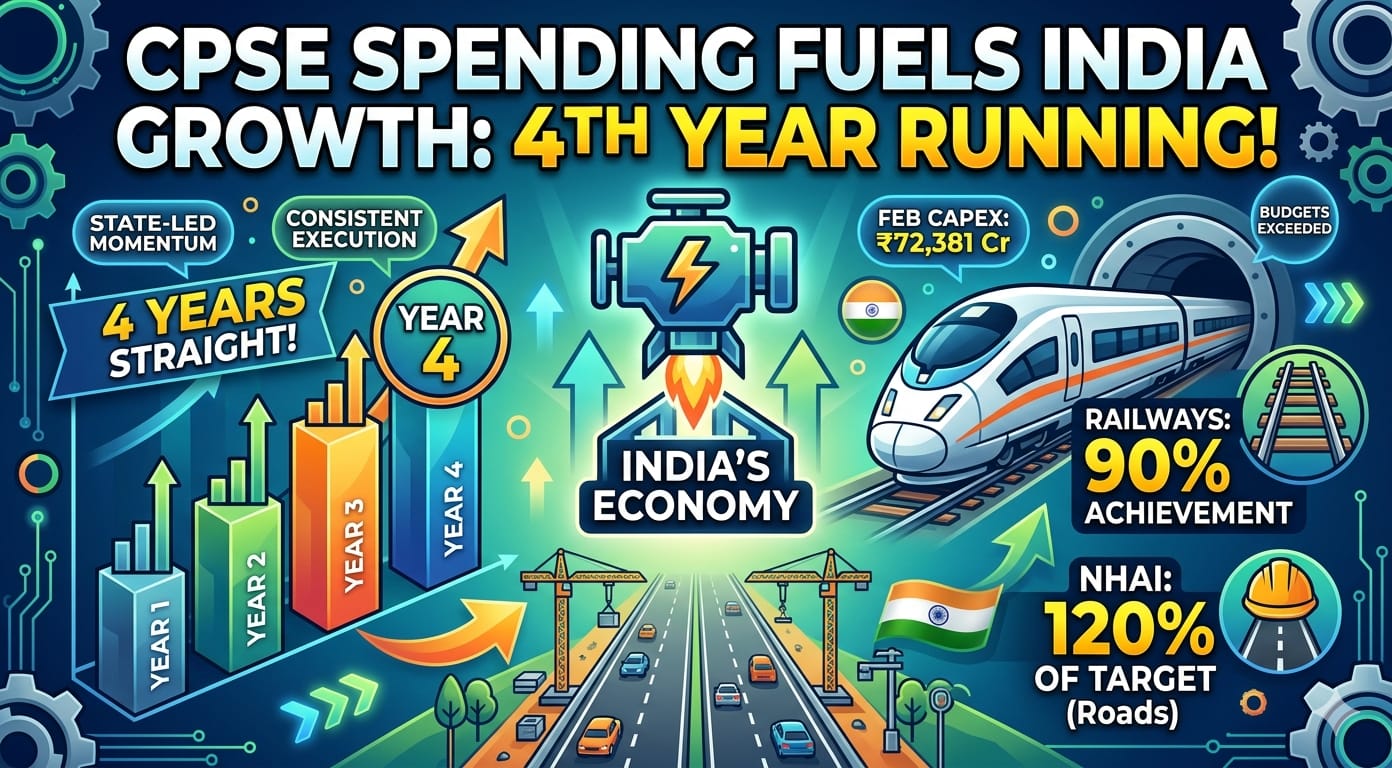
There is a quiet confidence embedded in India’s capital expenditure data for FY2024-25, and it deserves more attention than it typically receives. With cumulative spending by Central Public Sector Enterprises and four key government entities the Railway Board, NHAI, Delhi Metro Rail Corporation, and Damodar Valley Corporation reaching Rs 7.39 lakh crore by February, the country is on the verge of surpassing its annual target of Rs 7.47 lakh crore for the fourth year in a row.
That consistency is not an accident. It is a deliberate policy choice, and one that has arguably become the most reliable engine of India’s economic momentum.
What makes this achievement particularly significant is the context in which it has been delivered.
The global economic environment in FY25 has been far from benign. US tariff uncertainties, the ongoing Russia-Ukraine war, and a general tightening of global financial conditions have weighed heavily on business sentiment and suppressed domestic private investments for most of the year. Against this backdrop, the government’s decision to keep the public investment pipeline flowing and to hold its agencies accountable for delivery is not just commendable; it is strategically shrewd.
The headline numbers are strong, but the sectoral story is even more telling. NHAI has spent approximately 120% of its annual target, an extraordinary feat for any large infrastructure agency in any country. The Railway Board has reached 90%, a number that reflects years of institutional reform in procurement and project execution. Together, these two entities are reshaping the physical sinews of India’s economy building roads that reduce logistics costs and railways that expand freight capacity.
When other major spenders such as NTPC, Indian Oil Corporation, ONGC, Bharat Petroleum Corporation, and Coal India are added to this picture, the breadth of the public investment drive becomes clear. India is not just building roads and railways; it is simultaneously investing in energy security, fuel distribution, and industrial capacity.
The February alone figure Rs 72,381.55 crore, up 9.69% year-on-year, is particularly important as it signals that the investment momentum has not tapered off towards the year-end, a pattern that has historically plagued government spending cycles. This sustained pace, combined with the total central government capex of Rs 8.42 lakh crore as of February according to CGA data, paints a picture of an administration that has learned to spend not just ambitiously but also efficiently.
While critics have often warned of the risks of excessive public funding in capital-heavy projects, the present trajectory shows such investment has been strategically disciplined, outcome-oriented, and geared toward sectors with clear multiplier potential. If sustained through timely execution and transparent project management, India’s public capex surge could help crowd in private investors once macroeconomic confidence improves. In essence, CPSEs are not just meeting fiscal targets—they are reinforcing the very backbone of India’s infrastructure-driven development narrative.

