
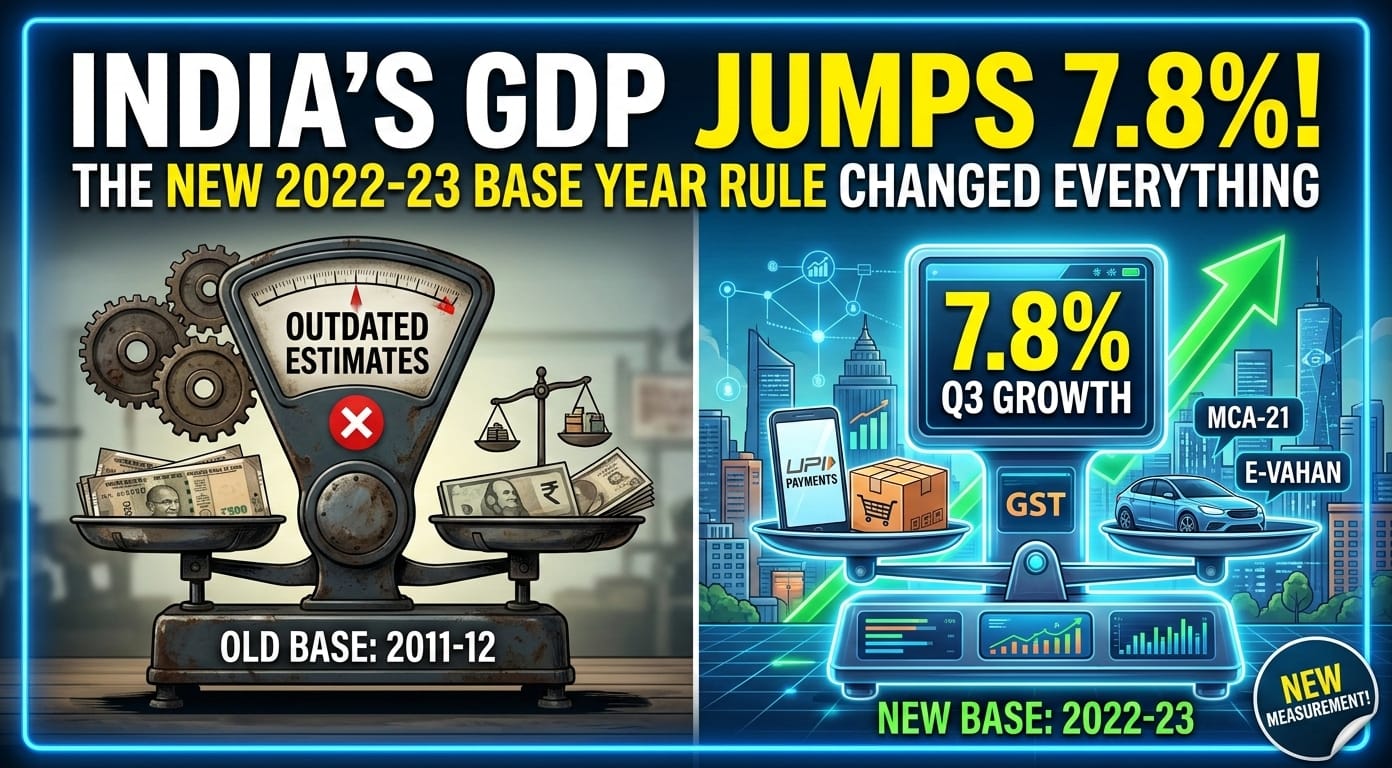
India’s economy grew by 7.8% in the December quarter or Q3 of 2025-26, according to fresh data released by the Ministry of Statistics and Programme Implementation (MoSPI) on February 27, 2026. The number beat market estimates and came higher than the 7.4% growth recorded in the same quarter a year ago. More importantly, this was the first GDP reading under a completely new measurement system — one that changes how India calculates its economic size and growth for years to come.
To understand why this matters, think of it this way. Imagine you last calibrated your weighing scale in 2011. Over the next 14 years, your diet changed, your lifestyle changed, but you kept using that old scale to track your health. Naturally, the reading would be off. This is exactly what was happening with India’s GDP. The country was measuring a 2025 economy using price structures and sectoral weights from 2011-12 as the base year — a time before Zomato delivered your dinner, before UPI transferred your rent, and before GST brought crores of small businesses into the formal economy. The new base year of 2022-23 fixes this by using a post-pandemic, modern benchmark that reflects how India actually earns and spends money today.
Under the revised framework, India’s full-year GDP for FY26 is now projected at 7.6%, up from the 7.4% estimated in January’s advance figures. Real GDP for FY26 is estimated at Rs 322.58 lakh crore. The second quarter (July–September 2025) growth was also revised upward to 8.4% from the earlier 8.2%, meaning India’s economy was actually performing better than we thought. There is, however, one trade-off: Q1 FY26 (April–June 2025) was revised downward from 7.8% to 6.7% — not because the economy did worse, but because the new measurement tools drew a more honest picture of that period.
The new series is not just a number change — it is a fundamental upgrade in how India counts its economic activity. The old system relied heavily on benchmark surveys and outdated proxies to estimate the informal sector, which employs the vast majority of Indians. Think of your local kirana store owner, the autorickshaw driver, or the tailor in the market. Their contribution to the economy was often estimated loosely. The new system uses real-time administrative data from GST filings, e-Vahan vehicle registrations, MCA-21 corporate database, and the Periodic Labour Force Survey to track these activities far more precisely. It also introduces “double deflation” in manufacturing — meaning it now separately accounts for price changes in both what a factory buys as raw material and what it sells as finished goods, giving a far more accurate picture of real output.
The manufacturing sector emerged as a major engine of growth under the revised series, clocking double-digit growth in FY24 and FY26. The services sector, which now includes digital commerce and the gig economy more accurately, also gained prominence. Agriculture, while still vital, carries relatively lower weight in the updated framework, reflecting how India has structurally shifted from a farm-led economy toward industry and services over the past decade. Capital expenditure by the central government contracted by 23.4% in Q3, largely due to a high base effect from last year, which acted as a slight drag on growth.
The broader significance of this data overhaul goes well beyond quarterly numbers. Economists are watching to see whether the revised GDP series will push India’s headline economy closer to overtaking Japan — currently sized at around $4.4 trillion — to become the world’s fourth-largest economy. The rupee’s depreciation against the dollar has been the main hurdle in dollar-denominated comparisons, but a stronger GDP baseline from the rebasing exercise could narrow that gap. A similar revision in 2015, when India shifted its base year from 2004-05 to 2011-12, had boosted India’s estimated GDP by roughly $120 billion and raised the growth rate for 2013-14 from 4.7% to 6.9% overnight, showing how powerful these methodological changes can be.
For ordinary citizens, the most direct takeaway is that India’s economy is growing solidly — at a pace that very few large economies in the world can match right now. Global growth is projected at just 3.3% for 2026. Against that backdrop, 7.8% quarterly growth is a strong signal. But as many economists rightly point out, the real test is whether this growth is translating into jobs, better wages, and lower prices at the market. The GDP number tells you the size of the pie is growing — the harder question is whether the slices are reaching everyone. With Q4 FY26 data expected on May 29, 2026, the next few months will be closely watched to see if India can sustain this momentum and close the year on a high.

