
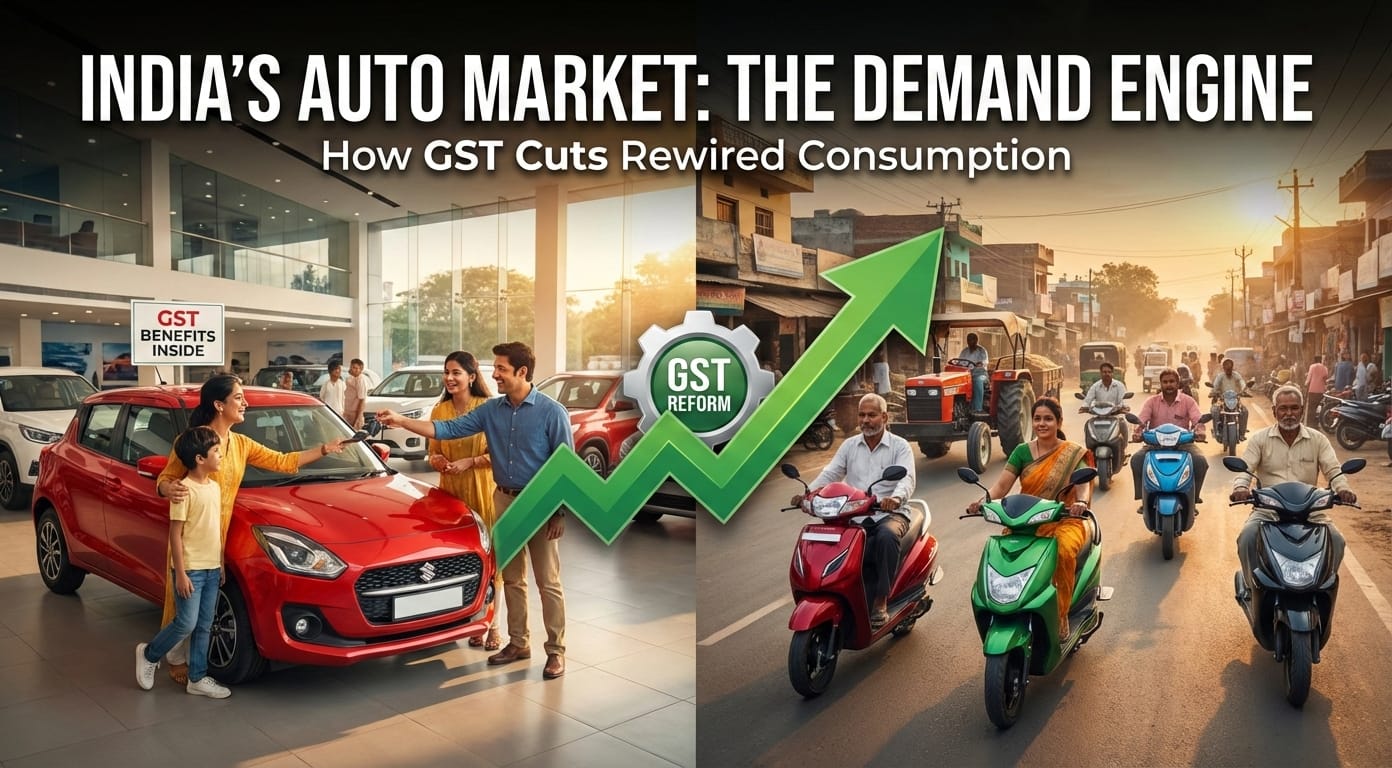
In January 2026, India’s auto showrooms were anything but quiet: total vehicle retail sales crossed about 27.2 lakh units, roughly 17–18 per cent higher than a year ago, with two‑wheelers alone accounting for 18.5 lakh units and passenger vehicles 5.13 lakh units, all growing in healthy double digits year‑on‑year.
The same month also saw tractors at around 1.15 lakh units, three‑wheelers at 1.27 lakh and commercial vehicles at over 1.07 lakh, each rising between 15 and 23 per cent versus last year, according to the Federation of Automobile Dealers Associations (FADA).
On the surface these are just big numbers, but they are really a snapshot of how tax policy, rural incomes and aspiration have come together to push India’s consumption engine into a higher gear.
Look at two‑wheelers first, because they are the most direct mirror of everyday Bharat. FADA data show that calendar year 2025 closed with about 2.03 crore two‑wheelers sold at retail, up 7.24 per cent from roughly 1.89 crore in 2024, signalling a clear recovery after a long, uneven post‑pandemic phase.[4] Within that year, volumes moved from about 13.5 lakh units in February 2025 to 15.08 lakh in March, then surged to a massive 25.46 lakh units in November before normalising to 13.17 lakh in December as the festive and pre‑GST‑cut rush faded.
By January 2026 the market had settled into a higher plane at 18.53 lakh units, almost 21 per cent higher than the previous January, with rural India contributing roughly 56 per cent of these sales and growing close to 20 per cent year‑on‑year. When households in villages and small towns are confident enough to keep buying and financing bikes and scooters at this scale, it usually means farm incomes, non‑farm jobs and bank credit are all moving in the right direction.
Passenger vehicles tell a similar but slightly more urban story. FADA’s November 2025 data show car and SUV retail sales at about 3.94 lakh units, nearly 20 per cent higher than the 3.29 lakh units a year earlier, while dealer inventories eased from 53–55 days to about 44–46 days, indicating that cars were moving off lots faster than before.
December 2025 kept the momentum going with around 3.8 lakh passenger vehicles sold, up more than 26 per cent year‑on‑year,[4] and January 2026 pushed the figure to 5.13 lakh units, a 7.22 per cent annual rise with rural car sales growing far faster than urban ones.
Over the full calendar year 2025, passenger vehicle retail volumes touched about 44.75 lakh units, up 9.7 per cent from 40.8 lakh in 2024, with FADA noting that rural PV demand grew over 12 per cent compared to around 8 per cent in cities, proof that small cars and compact SUVs are no longer a metro‑only aspiration.
When entry‑level hatchbacks from brands like Maruti Suzuki and compact offerings from Hyundai or Tata keep finding new first‑time buyers outside big cities, it usually means incomes are rising enough for families to graduate from bus and bike to their first four‑wheeler.
Commercial vehicle retail in January 2026 reached about 1.07 lakh units, roughly 15 per cent higher than a year earlier, with both light and heavy trucks growing in mid‑teens percentages.
Dealers link this directly to more goods moving on highways, stronger infrastructure work and better freight rates, all of which only happen when factories are producing, stores are stocking and consumers are buying. Three‑wheeler sales – over 1.27 lakh units in January with nearly 19 per cent yearly growth – capture both last‑mile logistics and mass people movement, from e‑rickshaws in tier‑3 towns to shared autos around industrial clusters.
Tractors, too, at around 1.15 lakh units in January and nearly 10 lakh across 2025 with more than 11 per cent annual growth, suggest that farmers are investing in equipment instead of merely surviving, which then feeds back into rural purchasing power for two‑wheelers and small cars.
So where do the Modi government’s GST decisions fit into this picture? In 2025 the Centre and GST Council rolled out what many commentators describe as “GST 2.0”, cutting the effective GST rate on small cars from the earlier 28 per cent slab (plus hefty cesses) to about 18 per cent and pruning taxes on mass‑market two‑wheelers, tractors and key commercial vehicle categories.
NDTV, for instance, calculated that popular models like the Maruti Swift and Dzire would become cheaper by roughly ₹60,000 after the new rates, while ClearTax notes that bikes, small cars and goods vehicles saw their tax burden reduced even as luxury cars were put in a higher slab.
A detailed analysis by tax experts argues that these cuts directly lowered showroom prices and EMIs, encouraging first‑time buyers and middle‑income families to advance purchase decisions rather than postponing them. In a price‑sensitive market where even a ₹500 monthly EMI difference can make or break a deal, such relief has a powerful psychological effect.
FADA’s own reading of the year underlines how this tax shift translated into behaviour on the ground. In its calendar‑year 2025 report, the dealers’ body calls it a “two‑half” year, saying that January to August remained muted despite earlier support measures like income‑tax relief in the Union Budget and RBI rate cuts, but that there was a clear upshift from September to December “after GST 2.0 improved affordability and lifted sentiment”, particularly for small cars, two‑wheelers up to 350cc and important commercial vehicle segments.
November 2025, for instance, saw total retail sales rise just over 2 per cent year‑on‑year but with a 19.7 per cent jump in car sales as buyers responded to tax‑led price cuts and offers, while two‑wheelers dipped 3.1 per cent that month before roaring back in the following weeks.
By December, the same FADA report showed auto retail up 14.6 per cent year‑on‑year, with passenger vehicles growing over 26 per cent and commercial vehicles nearly 25 per cent, a pattern dealers explicitly attribute to post‑GST 2.0 enthusiasm and year‑end offers. January 2026’s broad‑based double‑digit growth, led by two‑wheelers but backed by tractors and trucks, looks more like the continuation of this chain reaction than a random spike.
Economists often say that big policy moves work with a “lag”, and what we are seeing in autos captures that idea in a very human way. When GST was first launched in 2017 it disrupted supply chains before it simplified them, and it has taken years of filing, e‑invoicing and compliance tweaks for firms to fully reorganise how they source, stock and sell – changes that naturally take four, five or even six years to show up as smoother logistics and lower embedded taxes.
That groundwork meant that when GST 2.0 cut the headline tax on mass‑market vehicles in 2025, manufacturers could quickly reprice models, dealers could recalibrate inventory and financiers could redesign loan products in a matter of months instead of years. Even within that single year, FADA’s comment that direct‑tax relief and lower interest rates in early 2025 did not immediately lift sales, while GST rationalisation from September onwards clearly did, shows how one policy domino can take several quarters to knock down the next in the chain. The same lag is visible in November’s modest overall growth followed by December and January’s strong surge, underlining that behaviour does not flip overnight just because a law or notification changes.
A shop‑floor worker who finally stretches for a financed scooter after years of using a crowded bus, a young family in a tier‑3 town that trades its second‑hand bike plus savings for a small hatchback, a transport contractor who adds another light truck because orders are steady – all of them are reacting to lower tax‑inclusive prices, easier credit and the confidence that their next month’s income will cover the EMI.
FADA’s data on rising rural shares in both two‑wheeler and passenger vehicle sales, alongside the jump in commercial vehicles and tractors, suggests that this confidence is not limited to enclaves of prosperity but is slowly diffusing through the real economy. In that sense, the current spike in auto consumption is not an accident; it is the visible part of a long chain reaction where tax cuts, infrastructure spending, credit growth and rising aspirations reinforce each other every time a new bike rolls out of a village dealership or a small car leaves a semi‑urban showroom.

