
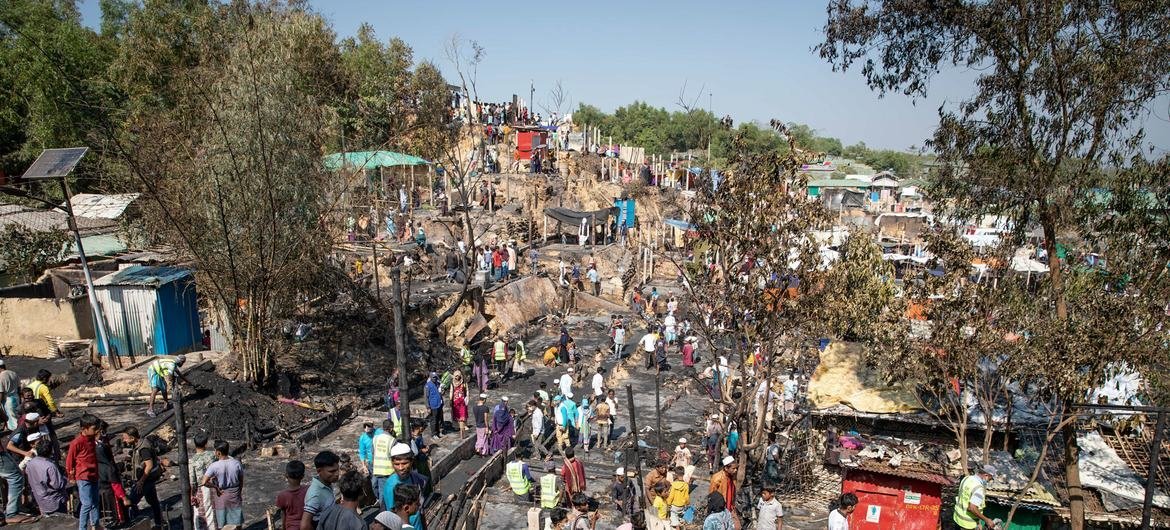
On February 5, 2026, joint forces, including the Police, Border Guard Bangladesh (BGB) and the Army, detained 345 Rohingyas, including 176 men, 86 women, and 83 children and adolescents, during a late-night operation in Burma Colony under the Dohazari Municipality of Chandanaish Upazila (Sub-District) in Chittagong District.
They were taken into custody as part of a collaborative effort by the joint forces ahead of the 13th parliamentary elections. Authorities reported that, during an operation initiated after midnight, searches were carried out in over 100 houses in Burma Colony.
Police added that the citizenship status of the detainees and their addresses in the Rohingya camp are being verified, and they would be moved to the Rohingya camp via representatives from the Refugee Relief and Repatriation Commission (RRRC). This operation highlights Bangladesh’s fraught security position amidst election pressure, as undocumented Rohingyas reside outside the formal camps at this sensitive juncture.
Around 1.3 million Rohingya refugees from Myanmar’s Rakhine State currently live in camps in Ukhiya and Teknaf of Cox’s Bazar District, making the situation near the border areas more complicated. Over the years, reports have surfaced of some Rohingyas spreading to other parts of the country and obtaining fake national identity cards and passports.
At a meeting in early January 2026, a Home Ministry report warned of the presence of armed groups and illegal weapons inside Rohingya camps, and that Rohingyas using Camp-in-Charge (CiC) outpasses or illegally crossing barbed-wire fences into Ukhiya-Teknaf localities could worsen the law and order situation. Later, on February 4, 2026, the Election Commission (EC) instructed relevant departments and returning officers to take action based on special reports from different agencies highlighting potential risks linked to Rohingya involvement in election activities.
This security-driven approach aligns with earlier institutional actions taken in the lead-up to the elections. On January 28, 2026, Bangladesh’s Foreign Adviser Touhid Hossain acknowledged longstanding administrative lapses that allowed Rohingyas to travel abroad using Bangladeshi passports, while stressing that holding a passport does not make them citizens.
Since many Rohingya went to Saudi Arabia with Bangladeshi passports, Bangladesh later faced diplomatic pressure to renew passports for approximately 69,000 Rohingyas. Despite these renewals being made in consideration of broader national interests, Hossain stressed that the government’s position on citizenship remains unchanged. Reinforcing this stance, especially at the international level, on January 23, 2026, Bangladesh strongly rejected Myanmar’s submission to the International Court of Justice (ICJ) that referred to the Rohingya as “Bengali.”
In a statement issued by the Ministry of Foreign Affairs, Bangladesh argued that such terminology distorts historical realities, undermines Rohingya identity, and attempts to justify atrocities committed during the 2016-17 violence in Rakhine State. Bangladesh asserted that Myanmar’s portrayal of the Rohingya as illegal migrants in Myanmar before the ICJ was aimed at framing the crisis as an internal security issue to divert attention from atrocity crimes.
Authorities have repeatedly expressed concern that the presence of unregistered Rohingyas in urban and semi-urban areas of Bangladesh might interfere in the electoral process, including the possible use of Rohingyas by candidates for local campaigning, staffing polling centres, and casting fake votes in exchange for money, or suppressing rival candidates. Additionally, armed groups such as the Arakan Rohingya Salvation Army (ARSA), the Rohingya Solidarity Organisation (RSO) and the Arakan Army (AA) could engage in clashes in border areas during the election period, creating a worrisome situation for the authorities.
The EC and the Home Ministry have been informed about a series of steps to mitigate risks involving the Rohingya during the election period. Ahead of the elections, authorities will impose a comprehensive set of security and movement restrictions in and around Rohingya camps to prevent any involvement in the electoral process and to mitigate security risks. Rohingya refugees will not be permitted to leave the camps during the election period. BGB patrols will be strengthened, with heightened surveillance on armed groups along the Myanmar border. All political parties will be warned against involving the Rohingya in any election activities. Security is to be reinforced inside the camps through coordination between the Armed Police Battalion (APBn) and CiC offices.
These developments illustrate the multidimensional challenges Bangladesh faces in managing the Rohingya crisis amid elections. Bangladesh continues to host a large displaced population of Rohingyas on humanitarian grounds, while simultaneously facing security concerns, questions of electoral integrity, documentation irregularities, and international legal narratives. The situation of unresolved refugee management intersects with national security and electoral governance in Bangladesh.
Author: Shivangi Sharma – Research Assistant, Institute for Conflict Management

