
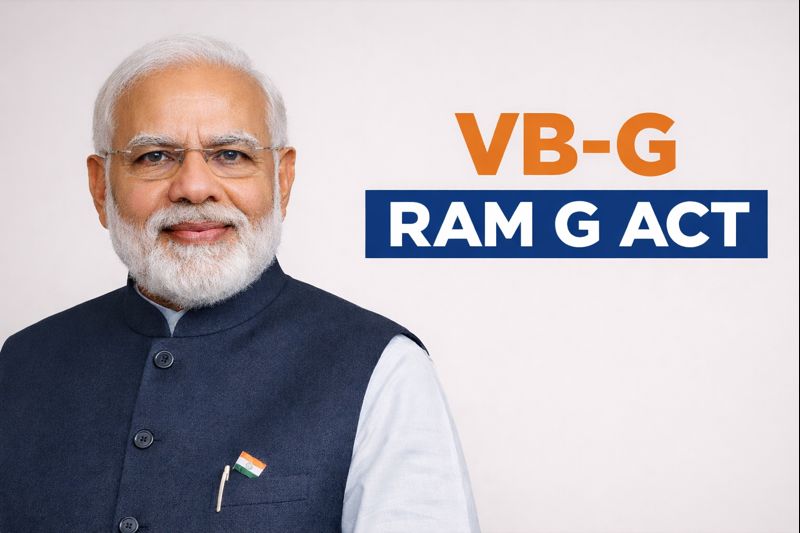
Public policy must be assessed by outcomes, not by sentiment or symbolism. The replacement of MGNREGA with VB–G RAM G (Viksit Bharat–Guarantee for Rojgar and Ajeevika Mission Gramin Act, 2025) has provoked protests claiming that the new law dilutes rights, burdens states financially, centralises power of the Union and disrespects Mahatma Gandhi’s legacy. These criticisms, however, reflect political positioning more than policy substance.
The claim that VB–G RAM G weakens a rights-based framework assumes that legal entitlement alone guarantees empowerment. Experience over the past two decades suggests otherwise. Chronic wage delays, unmet demand, poor-quality assets and uneven implementation turned what was meant to be a justiciable right into an administratively fragile promise. A right that cannot be reliably delivered ceases to function as a right. VB–G RAM G does not withdraw the State’s responsibility to provide employment support; it restructures that responsibility by embedding clear timelines, outcome metrics and institutional accountability. This is not dilution, but correction.
More importantly, the Act reflects a necessary shift in developmental thinking. MGNREGA was conceived as a relief mechanism during a period of acute rural distress. Treating such distress employment as a permanent feature of India’s rural economy risks normalising stagnation. VB–G RAM G explicitly integrates short-term employment with livelihood creation, skilling and productive asset formation. The move from a narrow focus on days of work to a broader conception of ajeevika recognises that dignity comes not merely from employment, but from income stability and economic mobility. A welfare state that does not evolve with structural changes risks entrenching dependency rather than alleviating poverty.
Concerns about increased financial burden on states also deserve a closer look. Under the previous regime, states frequently faced uncertainty due to delayed central releases, unplanned liabilities and retrospective cost-sharing disputes. VB–G RAM G introduces clearer fiscal roles, medium-term planning and outcome-linked funding. Predictability, not ad hoc transfers, is the cornerstone of genuine fiscal federalism. States gain the ability to plan rather than react, which strengthens, rather than weakens, their administrative autonomy.
Similarly, allegations of excessive centralisation confuse national standard-setting with micromanagement. In a programme of this scale, minimum national benchmarks for transparency, eligibility and monitoring are indispensable. Local institutions continue to play a central role in identifying works, implementing projects, and supervising delivery. What has changed is the emphasis on accountability and performance. Decentralisation without oversight has often benefited intermediaries more than workers. VB–GRAM G attempts to correct that imbalance.
Perhaps the most emotive criticism concerns the removal of Mahatma Gandhi’s name from the legislation. This argument substitutes symbolism for substance. Gandhi’s economic philosophy emphasised productive labour, self-reliance, decentralised growth and moral responsibility. Preserving his name while tolerating systemic inefficiencies does little to honour that legacy. A programme that prioritises durable community assets, local entrepreneurship and livelihood sustainability arguably aligns more closely with Gandhian principles than one that treats subsistence work as an end in itself.
Reforms inevitably generate resistance, particularly when they challenge established political narratives. But social policy cannot remain frozen in time. India’s demographic pressures, fiscal constraints and development aspirations require instruments that deliver measurable results. VB–G RAM G represents an attempt to move rural employment policy from an input-driven entitlement to an outcome-oriented guarantee. The transition will require vigilance, course correction and robust implementation, but resisting reform altogether would be the greater disservice.
The real choice before policymakers is not between compassion and efficiency, nor between rights and reform. It is between a welfare architecture that adapts to changing realities and one that clings to legacy frameworks long after their limitations are evident. VB–G RAM G signals an evolution in thinking—one that seeks to convert public expenditure into lasting rural prosperity. That ambition, rather than political nostalgia, should frame the national debate.

