
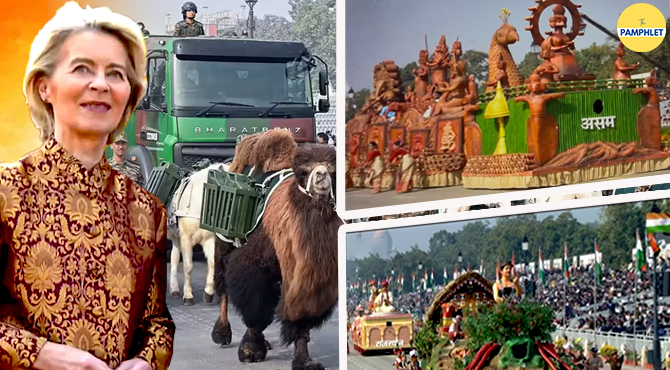
On Kartavya Path, The ‘Republic’ asserts and articulates its continuity in the linear progression of upward growth. A glimpse of its essence was seen on 26/01/26. Every time the historical culture of India is challenged by politics, global or domestic, or prompted by policy shifts, people’s response to the Republic, their inherent creativity, commitment to cultural persistence, and innovation, launches a campaign of multifarious power in the directness and simplicity of expressions and visual communication.
Many people who watched this year’s Republic Day Parade, have said on social media that it was “different”. The Indian Army flag of “Operation Sindoor” fluttering in the ‘Parhar Formation’ over the Kartavya Path, the 61st Cavalry Contingent, the Bishma Tank T-90, the Randhwaj (Rugged Terrain Tactical Transport System), the Dhanush Gun System, Shaktibaan, Divyastra, Akash – the nation’s indigenously-designed surface to air missile system, the brilliance of India’s air defence architecture, signifying India’s policy dynamics, under the theme of “Operation Sindoor”, made it different. The manifestation of destruction the theatre of India’s defence infrastructure can unleash, along with numerous creations that empower it, made it different. The “different” is an entire evidence of the revival of policy shifts that bring the “different”.
The “different” is the congruence of cultural policy and defence policy – visible on the Kartavyapath. The “different” is the breaking of silos in the two domains on the Kartavyapath – which takes place every year on January 26, but underlines this year India’s capabilities to weaponise the sequence of destruction, creation, and sustenance.
The debut march of the elite Bhairav Battalion on the Kartavya Path is not the only elemental representation of India’s valiant efforts to respond to the swiftly evolving warfare and geostrategic scenario. Never before in India’s history has the Republic Day Parade exhibited a cross-generational and cross-discipline confluence of civilisational glory and pride, the celebration and commemoration of India’s freedom, a march to the future reflected in the display of India’s continuing upsurge is carving military preparedness, celebrating innovation — military, scientific, industrial and developmental, massive resolve in defence against enemy’s aggression and terrorism, combined efforts of the Triservices, and soft power in manifestations characteristically local in their geographical cradles but global in appeal, context and quality.
The presence of animal strengths empowering India’s defence for the Him Yodhas, such as the Bactrian camels named ‘Galwan’ and ‘Nubra’, members of the indigenous breeds of dogs, raptors, and the mighty camels of the Border Security Force, in this year’s Parade, has introduced and reiterated the role of these valiant natives protecting India’s tough environments. The power of the native has echoed in this year’s Parade. The echo doesn’t seem hollow. It announces purpose — in creation, protection, preservation, and offence for defence. It speaks to the audience – domestic and global – about what it takes to build, sustain and protect freedom through a journey of 100 years, civilisation of thousands of years and a nation state serving as a cradle for heritage that can keep the world engrossed for thousands of years.
The 77the Republic Day Parade was a meaningful reinforcement of the profuse traditional and cultural multifaceted richness of India’s soft power. The Parade of 2026 will be known and remembered for the world’s largest democracy enunciating every component of heritage — living, human, architectural, floral, faunal, artisanal, musical, of produce and textile, handicraft, of human effort for the intangible and spiritual, prevailing the upward spiral of hard power. The vocalisation of the Assam Regiment’s song Badlu Ram Ka Badan marked a transition, sifting into the larger theme of this Year’s Parade – Vande Mataram — the song created by Bankim Chandra Chattopadhyay – in the celebration of its 150th year. The Republic Day Parade at the Kartavya Path, formerly known as Rajpath, itself has seen performative accentuation in the combined attributes of India’s ministry and cultural strengths, the confluence of vigorous creation from the defence ministry at the helm, other ministries, the participation of states and other attendees.
With this year’s Parade, India has upped creation and creative. The courage of including the minutest of elements in story-telling and the local at the heart of the local, while displaying the richness in artistry and tradition, has been a remarkable achievement of the 2026 Parade. The intersections of history and spiritual nuance have been redefined and each glimpse has turned into an event within the larger event of national significance. It has reinstated the glimpse of the native and local as national.
For example, in the tableau of Uttar Pradesh. The depiction of the Kalinjar Fort emerging from behind the marching contingents, with the Ekhamukha Linga depiction ebbing in singular focus against the backdrop and foreground of carved pillars and figurative sculptures, represented the undaunted cultural resilience of the people of Bundelkhand. Compact but impactful, the Uttar Pradesh tableau is an impressive introduction to the region to the uninitiated. The dash of colour and life in human presence in this tableau is of Bundelkhandi nritya and the specific stamping of identity with the depiction of the handicraft tradition and heritage of Bundelkhand that gets overshadowed by expressions within the state and outside, in pan-India audience perception.
The eternity of Shiva as the unifying symbol of India and India’s freedom, days after the Somnath Swabhiman Parva celebrations held in Somnath Gujarat, appeared as a recurring theme at the Kartavyapath in the tableau from Uttar Pradesh. The contours of history and Bundeli breeze can be felt in the carvings and the Ekamukha Linga.
The sense of smell, touch, the wetness of terracotta, its impressionable surface, the deftness of fingers shaping characters in terracotta, come into play in another specimen of creative victory. This – in Assam’s tableau. The underlying theme of Aatmanirbhar Bharat has moved several stories into motion at the Kartavya Path this year. There is no going back, from this point in creation, in what the theme has been able to compel in form in the tableaus from the North East. Assam went impressively local with how it pulled out the story set in Asharikandi in Dhubri district – of granting the GI tag to the terracotta crafts practised here. Thinking out of the box, it mounted the depiction of the different figurative creations in the terracotta crafts in Asharikandi. I recently wrote in detail on how Assam is redefining the celebration of culture and cultural policy uniquely, and like no other state. Its Republic Day tableau is a massively deserving extension to that story, and as an attribute to that theme.
The underlying theme of Aatmanirbhar Bharat has moved several stories into motion at the Kartavya Path this year. There is no going back from this upgrade in expression. There should be no under-stepping from this high mark in performance of the ‘visual’ for depicting living heritage through the depiction of traditional crafts from this point in creation, in what the theme has been able to compel in form in the tableaus from the North East. Traditional crafts as the representation of the people in the ‘Republic’ and traditional crafts as an offshoot of local economies serving culture in a circular movement of creation is a strong statement on India as a civilisational state – a whole new perspective for the global audience and a message in the sustenance of Indic pride, belief and faith in indigenous expressions, for fellow Indians.
Considered an outcome of the fusing of ancestral-knowledge systems into Assam’s culture, the tradition represents an overlay of soil on soil in the symbolic sense — where a craft steeped in soil has been preserved on the soil of Assam, securing the visual narratives of Sanatan’s symbolism from a different cradle of culture that now breathes in the region. The lending of symbolic leitmotifs represented in the art have been absorbed in Assam’s visual language. Their journey from Assam to Delhi also corresponds to the journey undertaken by Hindu ancestors with resilience to protect their identity, faith, artistic expression, aesthetic and heritage that celebrates the Devis and the family of Shiva.
The Manipur tableau presented a narrative of economic transformation in synergies with nature and tradition. Bringing an economic turn around with cultural symbols associated with agriculture produce and the bounty of flora in the state, Manipur has made forays into international markets with Chak-Hao the aromatic black-rice, which was the central flavour of the tableau with other gifts of nature from the geography — the Sirarakhong Hathei Chilli and Tamenglong Orange. The Manipur tableau assimilated the symbols of life and local craftsmanship while bringing the story of self-reliance and socio-cultural prosperity through women-empowerment. The state and central governments have shown the creative bandwidth to instil the liking for Chak-Hao in the international markets of China, Japan, Korea and the European Union with a vibrant story-telling on women’s participation in agricultural activity, cultural dimensions attached to harvest, the intricacies involved in strengthening economic growth with an inside view on the state and its heritage. Even more rewarding and creative would be turning the Manipur story of success to an audience in the Himalayan states.
The Hornbill Festival is now fairly well-known in India, yet the Nagaland Tableau chose to portray the audience that the festival already has to its natural, cultural and traditional heritage. This was a great move. India does not need to learn how to pitch its own growth to the world through geopolitical shifts, where winning matters, but winning impressively matters more. The opportunity to harness the intersections and cross-sections of soft power, in the same window and space as hard power, cannot be tossed aside.
The tableaus of Madhya Pradesh, Odisha, West Bengal and Tamil Nadu — convincing specimens of traditional craftsmanship moulding dharma, spirituality, journeys for Bharat, culture and India’s freedom struggle, into a single cast of state representation, future aspirations and cultural roots. Boundaries have been pushed in the use of space.
Case in point is the visual display of panels depicting the figurative portrayal of the lyrics of Vande Mataram. The expansion of expression – musical, in art and craft, in movement and ensembles (curated by shehnai artiste Lokesh Anand) – of Vande Mataram on Republic Day and marking the culmination of the 150 years of celebration of Bankim Chandra Chattopadhyay’s creation. It is a humble beginning in the use of iconic public space that’s is in focus nationally for one of the two big events of national importance and the only celebrated on this scale.
Sections of the media were thrilled about the Banarasi brocade bandghala outfit worn by European Commission President Ursula von der Leyen at India’s 77th Republic Day parade. It was a fashion and diplomatic statement in appreciation for India’s traditional wisdom, artistry and craftsmanship. However, it is a symbol of the credence of visual communication that’s unique to India and has defined India’s global language of culture and cultural symbols. The appreciation of these symbols should enrich the lives of younger generations in education and daily lives.
Critics of the Republic Day Parade who often look down upon tableaus and the idea of tableaus need to remember that the younger generations need visual clasps to events of national importance, their meanings and symbols. These tableaus allow the fluidity of visual language in a scenario where they relate to states or hear about states in reference to divisive language disputes and other controversies.
India discovered the depiction of INS Kaundinya – the 5th Century stitched ship that recently sailed to Oman, in the Indian Navy’s tableau for the Republic Day Parade in the theme ‘Strong Navy for a Strong Nation’ alongside the depiction of the aircraft carrier INS Vikrant. The momentum for rediscovering the glorious past in battle readiness of the present must be sustained.
This year, as citizens, we must compel policy makers and politicians to secure the cultural components of what makes us unique as one whole unit in our own diversity. Any GI tag, the culmination of the 150 years of Vande Matram, Aatmanirbhar Bharat, without that security — of standing as one single unit — will be meaningless and hollow within India and of no value to the world. The ensemble that began the Republic Day Parade this year featured wind instruments and percussion instruments from the different states. The concept was brilliant. Its execution aesthetic. The performance was compact and compressed owing to time limitations. Once and if expanded, it would narrate what made this Parade “different” this year, the creative intent behind it “different” this year. It is the realisation of national unity, which is ours to own as the people of this Republic.

