
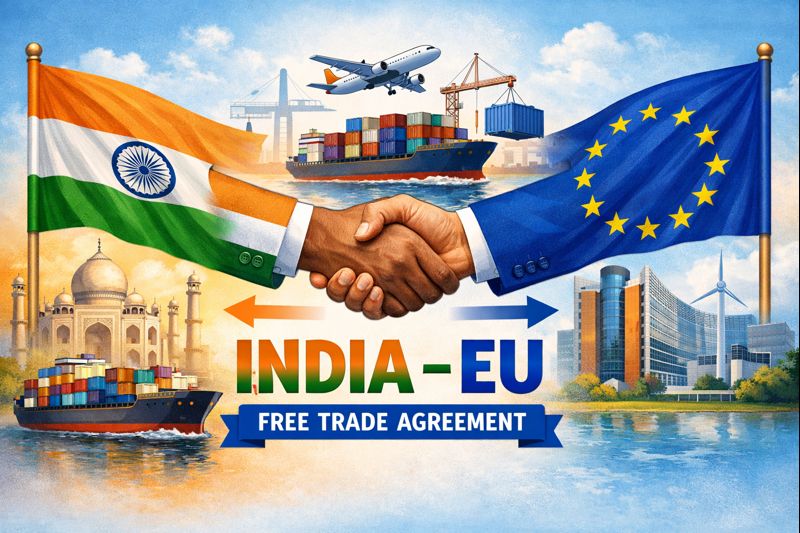
For 18 years, Europe dragged its feet on a comprehensive trade agreement with India. Talks stalled over tariffs, climate conditionalities, labour standards and what New Delhi saw as Brussels’ regulatory overreach. India was expected to open its markets, while Europe clung to its comfort zone of rules written for a different world.
That hesitation has vanished almost overnight.
Today, the European Union is in a visible rush to seal an ambitious Free Trade Agreement with India – which some call the “Mother of all deals”. The sudden urgency is not because India has changed. It is because the world around Europe has.
And at the centre of this shift sits Donald Trump. Trump’s return to the American political centre stage has forced Europe to confront an uncomfortable reality. The trans-atlantic safety net it relied on for decades is no longer guaranteed. Tariffs can return. Strategic commitments can weaken. Mood swings in Washington can translate into economic shocks in Brussels, Berlin and Paris.
Europe’s answer is not confrontation with the United States, but hedging against it. And that hedge leads directly to India.
Trade as the doorway, not the destination
The India–EU Free Trade Agreement is being sold publicly as an economic deal. Lower tariffs. Better market access. Stronger supply chains. All of that is true, but it is also incomplete.
Trade is merely the opening move.
For Europe, this deal is about anchoring itself to a large, stable and growing economy that is not the United States, not China and not Russia. India fits that bill uniquely. It offers scale without coercion, growth without volatility, and strategic autonomy without unpredictability.
Europe’s earlier objections to Indian tariffs or regulatory divergence now appear secondary. In a world fractured by protectionism and weaponised trade, perfect alignment is a luxury Europe can no longer afford.
What matters is resilience. And India offers that.
The security pillar quietly taking shape
Beyond trade lies the second pillar of this pivot – Security.
Europe is living through its most serious security crisis since the Cold War. Russia’s war economy has upended assumptions about peace, energy dependence and military preparedness. NATO remains relevant, but European leaders increasingly recognise the need for diversified strategic partnerships beyond the Atlantic framework.
India is not a military ally in the traditional sense, but it is something equally valuable – a stabilising power in the Indo Pacific with its own interest in balancing China and preserving open sea lanes.
For Europe, deeper engagement with India strengthens its hand in a multipolar world. It creates space to hedge against Russian aggression, Chinese coercion and American unpredictability without being forced into binary choices.
Defence cooperation, maritime security, cyber resilience and supply chain security are already part of quiet conversations. The FTA creates the trust architecture on which these discussions can rest.
People: Europe’s silent crisis
There is another dimension where Europe needs India far more than it openly admits: people.
Europe is ageing. Its workforce is shrinking. Its critical industries, from healthcare and manufacturing to technology and green energy, face acute skill shortages. This is not a temporary challenge but a structural one.
India, by contrast, is young, skilled and increasingly global in outlook.
Indian engineers, healthcare professionals, researchers and technicians can plug gaps that Europe cannot fill internally. Managed mobility, mutual recognition of qualifications and legal migration pathways are becoming as important to this partnership as tariff schedules.
For Europe, today’s India is not just a market or a strategic partner. It is a demographic stabiliser.
Hedging against three uncertainties
At its core, Europe’s pivot towards India is driven by three anxieties.
First, uncertainty about the United States. Trump’s tariffs, transactional diplomacy and scepticism towards alliances have forced Europe to rethink overdependence on Washington.
Second, fear of China’s economic coercion. Europe has experienced supply chain vulnerabilities and political pressure from Beijing and is actively seeking alternatives.
Third, the reality of Russia’s war economy, which has permanently altered Europe’s security calculations.
India sits at the intersection of all three. It is large enough to matter, independent enough to be reliable and aligned enough on rules based order without demanding ideological conformity.
A shift on display
When leaders sit down for talks, what will be on display is beyond negotiation over trade clauses. It is a strategic realignment.
Europe is acknowledging that the world it was comfortable with no longer exists. India, long treated as a difficult partner because it refused to bend, now appears indispensable precisely because it did not.
For New Delhi, this moment offers leverage and opportunity. The challenge will be to convert Europe’s urgency into balanced outcomes without diluting India’s strategic autonomy or developmental priorities.
The India-EU FTA is not the end goal. It is the gateway to a deeper relationship shaped by economics, security and people.
Trade may open the door. But it is geopolitics that is pulling Europe through it.
Author Kritant Mishra is Public Policy Consultant and Director of an NGO. His areas of Interests include Socio-Anthropology, Socio-Economy, Health, and associated policies.

