
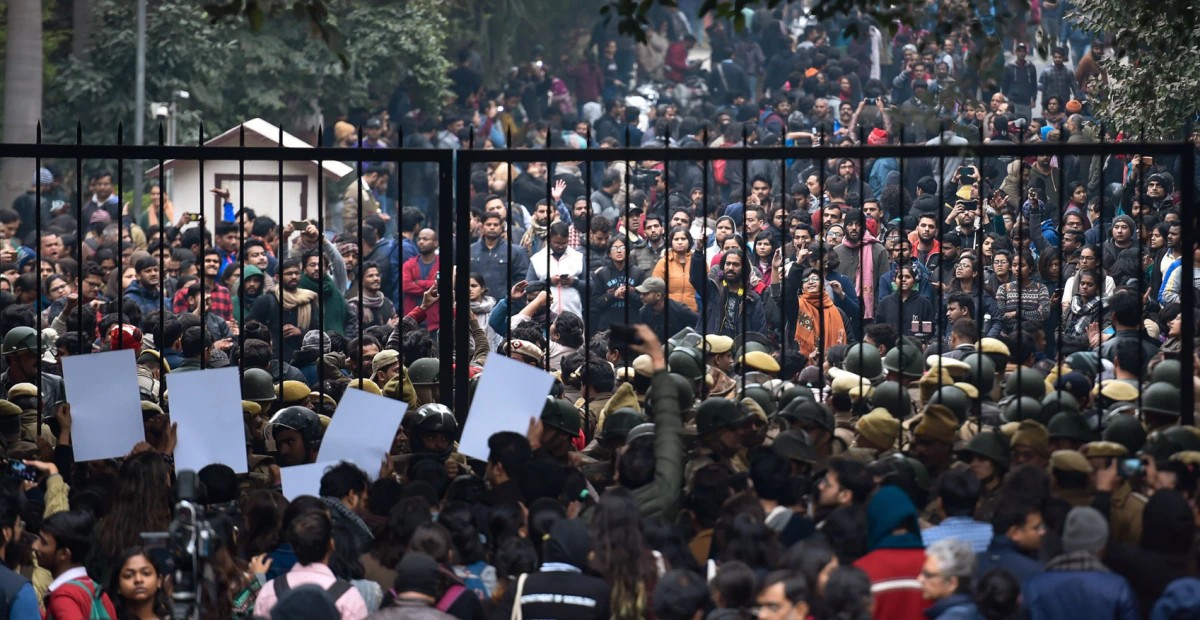
On 5th January 2026, the Supreme Court of India rejected the bail pleas of Umar Khalid and Sharjeel Imam – The main accused in the 2020 Delhi riots ‘larger conspiracy’ case, while also granting bail to five other accused in the same case, some sort of protest, thereafter, by the left-wing activist groups was inevitable and mostly anticipated in the streets of Jawaharlal Nehru University (JNU).
Pertinently, on the evening of 5th January, a gathering was organized by JNUSU (JNU Student Union), currently led by an alliance of left-wing activist groups – AISA, SFI and DSF, ostensibly to observe the sixth anniversary of the violence that occurred in JNU on 5th January 2020. However, soon after the gathering was called, provocative sloganeering was made that called for the ‘death’ of Prime Minister Narendra Modi and Union Home Minister Amit Shah.
In no democratic set-up does the law protect calling for ‘death’ of constitutional dignitaries such as the Prime Minister and Home Minister, who are elected representatives of over 140 crore Indian citizens, in the guise of ‘dissent’ and ‘criticism’ of the government. While such gatherings and aggressive protests therein by these activists in JNU is a regular sight for many and have lost their relevance outside the walls of JNU, the gathering of 5th January was not just distasteful, but also criminally offensive.
All kinds of sloganeering and protest in a democratic society cease to be what is being portrayed as ‘dissent’ and ‘free speech’ when they enter the realm of what actually is a call for violence and hate-speech, rendering it to be utterly undemocratic and unconstitutional.
Hate-filled youth politics in top University
While JNU has been one of the topmost universities of India in terms of their academic credibility, unfortunately, over the years it has made headlines in the national (and sometimes international) media only for wrong reasons, mostly attributed to anti-national activities by the left-wing activists studying there. Pertinently, both Umar Khalid and Sharjeel Imam, whose continued incarceration has been validated by the Supreme Court in the 2002 Delhi riots conspiracy case, are also alumni of JNU. On an earlier occasion in February 2016, JNU had garnered national attention when its student activists, including Umar Khalid, allegedly raised slogans in support of terrorist Afzal Guru.
In the present case of sloganeering which was reportedly made by a group of about 30-35 people, some nine activists were identified against whom JNU administration sought an FIR on 6th January. Pertinently, four out of these nine activists hold topmost positions in JNUSU, namely – Aditi Mishra (JNUSU President), K. Gopika Babu (JNUSU Vice-President), Sunil Yadav (JNUSU General Secretary) and Danish Ali (JNUSU Joint Secretary). Notably, all four activists are pursuing PhD from JNU – which, as a matter of fact, is considered to be one of the most elite academic universities for pursuing PhD in the country. Generally, the life of a PhD scholar involves high intensity research, which demands loads of dedicated work hours in labs, libraries and on fields to produce quality research which is supposed to contribute to the development of the country. However, a simple google search on these activists reveals that they have contributed nothing substantial to their academic credit so far.
Even for someone who is a political aspirant, it is expected of them to have published a few, if not multiple writings, articles or blogs, presenting policy and political opinions that are more academically sound and shaped by reason. However, except for K. Gopika Basu who also has one propaganda article trying to take away the ‘Hindu’ character of Onam festival published on controversial web portal ‘NewsClick’, others do not even have any other publication of articles, blogs or academic research notes available in open source. The sorry state of affairs in JNU may be simply explained by how the students, who make their place in the limited available vacancies of a prominent university like JNU for which thousand others compete every year, spend most of their energy in performative activism through regular protests that are aggressive, hateful and often turn inflammatory, rather than engaging in quality study and research.
Death is not ‘dissent’
The right to freedom of speech and expression, including rightful dissent and criticism against the government is fundamental to functioning of any free society, and Article 19(1)(a) of the constitution of India provides this right to all the citizens of India. However, on the discourses around the constitutional right to ‘free speech’, the reference to Article 19(2) of the Constitution, to which Article 19(1)(a) is subjected, is largely missed by stalwarts of ‘free-speech’ and constitutional values. Article 19(2) subjects the right to freedom of speech and expression to “reasonable restrictions” which include not just “public order”, “defamation” and “incitement to an offence,” but also “decency” and “morality”. It is historically significant that the constraints within Article 19(2) originated from the First Constitutional Amendment, enacted under Prime Minister Jawaharlal Nehru’s interim administration.
Ideally, JNUSU leaders gathering to observe the sixth anniversary of an event that took place in their university five years ago should have no reason to invoke sloganeering against the topmost constitutional dignitaries in the first place. Nevertheless, they were free to deviate from the theme of their gathering to actually ‘question’ the government over its policy issues or otherwise, as Article 19(1)(a) provides. However, the moment their gathering undertook a shift in its tone and started to raise provocative slogans calling for ‘death’ of the Prime Minister and Union Home Minister, it fell beyond the scope of ‘free speech’ and went right within the realm of reasonable restrictions enshrined under the Constitution. In no world making such grave and provocative sloganeering wishing death for elected representatives, who also occupy constitutional positions, is considered as ‘questioning’ the government or expressing ‘dissent’.
While such statements are per se violent and inflammatory in nature, the defenders of such sloganeering present them as part of their ‘fundamental right to dissent.’ They, however, miserably fail to explain what ‘question’ they were posing before the government or against what action or policy of the government they were expressing their ‘dissent’ by calling for death of the topmost executive of the country.
Conclusion
The sanctity of a public university lies in its pursuit of knowledge and the constructive contestation of ideas, not in becoming a breeding ground for visceral hatred disguised as political activism. Therefore, the FIR filed by JNU administration against left-wing activists is morally appropriate and legally warranted. It is high time, our socio-political discourses realize that invocation of ‘free speech’ cannot serve as a permanent shield for those who weaponize speech to incite violence against the highest offices of the land.
As the Supreme Court has rightly emphasized the gravity of conspiracies in the 2020 riots case, it is imperative that the legal system now takes a firm stand against this verbal extremism echoing within university campuses. When PhD scholars, funded by public resources to contribute to the nation’s intellectual capital, pivot from research to raising murderous slogans, it is a betrayal of both their academic mandate and their constitutional duties. ‘Dissent’ is sine qua non in a democracy, but calling for the ‘death’ of democratically elected representatives is a death knell to democracy itself.

