
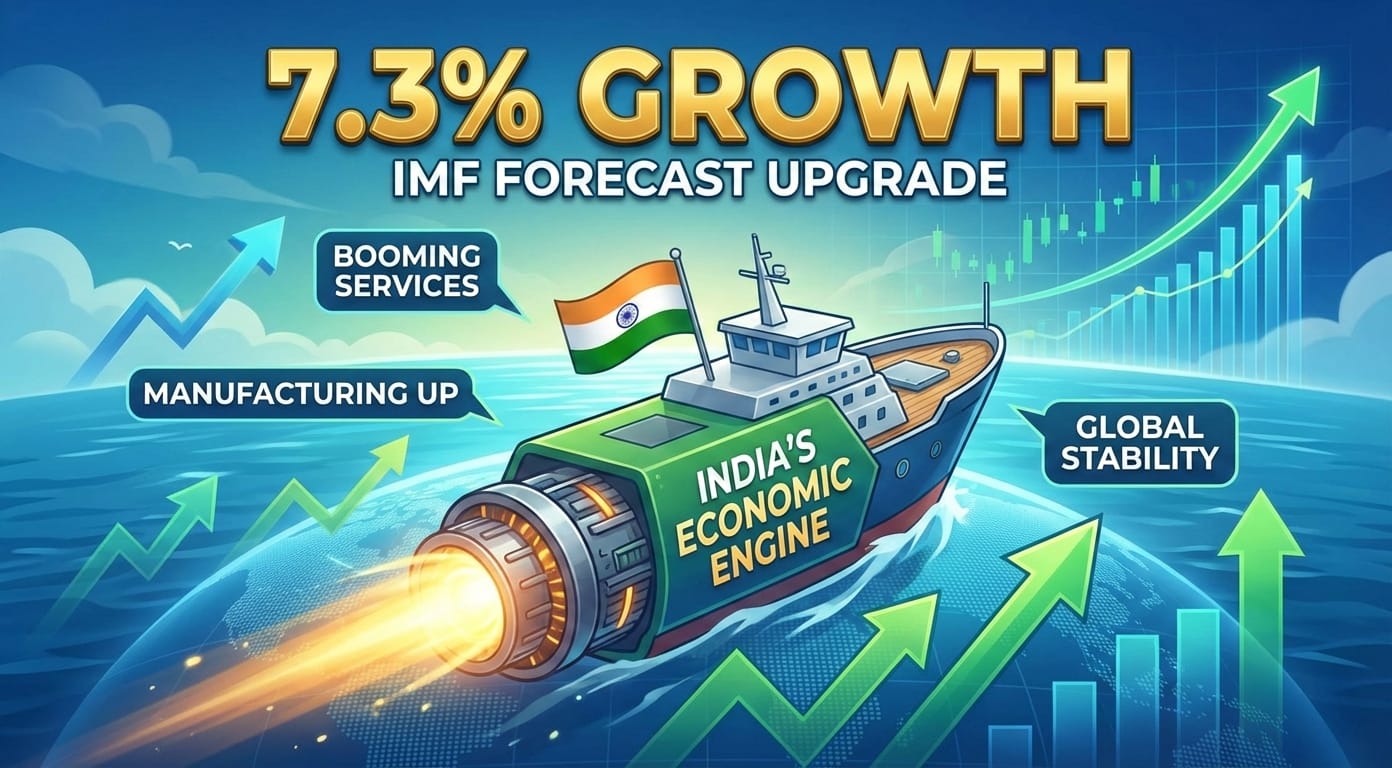
India’s economy is like a strong engine pushing a ship forward. The International Monetary Fund (IMF) said on January 19, 2026, that it now expects India to grow by 7.3% this financial year (2025-26), which is up from the 6.6% it predicted in October 2025.
This increase comes after India’s economy grew by 8.2% in the third quarter of 2025 (July-September), which was higher than previously anticipated. The fourth quarter is also looking good because of increased spending, investments, and a booming services sector. People are buying more homes, cars, and other goods; factories are running at full speed; and tech services are exporting a lot. This positive surprise was reported by the IMF team, led by Chief Economist Pierre-Olivier Gourinchas.
The 7.3% prediction is similar to the Indian government’s estimate of 7.4% for FY 2025-26, according to the Ministry of Statistics and Programme Implementation (MoSPI) on January 7, 2026. The government and the IMF agree that the economy is growing fast, driven by services (9.9%), manufacturing and construction (7%), and agriculture (3.1%).
The IMF suggests that growth may slow down to 6.4% in 2026-27 and remain at that level in 2027 as the short-term boosts from low food prices and recovery from the COVID-19 period fade. For a country of 1.4 billion people, this means more jobs, higher wages, and a better standard of living, surpassing competitors like China (around 4.5%).
Globally, things are steady, with the IMF forecasting global growth to stay at 3.3% in 2026 and dip slightly to 3.2% in 2027. This is similar to 2025’s 3.3%, with a small increase from October forecasts.
Trade tensions and new tariffs are slowing things down, but they are balanced by the tech industry growing, especially investments in artificial intelligence (AI) in North America and Asia.
AI is helping companies invest in technology, which offsets challenges from changing trade rules. Indian businesses are adapting well, keeping the global economy moving.
For Indian consumers, prices for everyday goods like food and fuel decreased in 2025 because of stable food markets and are going back to the Reserve Bank of India’s (RBI) 4% target.
RBI Governor Sanjay Malhotra is likely pleased, as this allows the RBI to keep interest rates favorable for loans without causing prices to rise. Global inflation is also decreasing, although the US may take longer to achieve its goal due to tech industry growth and political changes.
Now the question is what this means for everyone? So as we know that India’s strong performance means more job opportunities in IT and manufacturing, increased exports despite trade issues, and protection against global problems like geopolitical tensions or fears of an AI bubble. There are potential issues: if trade wars get worse or the tech industry declines, growth could slow down. Policymakers, from Finance Minister Nirmala Sitharaman to the RBI, need to prepare for these possibilities, simplify rules, and promote reforms to maintain growth.
For those who follow India’s economic progress, this IMF update from January 19, 2026, shows why India is seen as a key driver of global growth. With the government and IMF in agreement, 2025-26 is expected to bring positive changes for many people.

