
“Normality; show me normality, and I will show you an exception to the abnormal order of the universe; show me a normal event and I shall call it miraculous because it is normal.”
The celebrated Mexican diplomat and author Carlos Fuentes in his book Terra Nostra sought to establish chaos as the unmissable, essential ingredient of how the world conducts its business.
Terra Nostra was published in 1975. It was the same year when the real estate business of Fred Trump was transitioning from Brooklyn and Queens in New York to Manhattan, led by his feisty son Doland Trump.
Donald Trump had just negotiated a deal for the redevelopment of the derelict Hotel Commodore, getting massive tax breaks from the state. It was the same year when the Trump Organization settled a federal lawsuit on discriminatory practices in its apartment rental business, but without admitting any guilt. Both the negotiations mixed politics with business, the lines of propriety blurred by the euphoria of the “deal”.
Fuentes would have not known then that Donald Trump, President number 45 and 47 of the United States of America, will live by his immortal lines half a century later, where a normal, no-news day raises doubts on the well being of the world.
It has taken President Trump less than a year into his second term to reveal the irrelevance of the global rules-based international order (GRBIO). What had not been clear but is now fully revealed, is that the GRBIO was not worth the paper it is written on unless guaranteed and indeed backstopped by the “power of the last resort”. The GRBIO existed only because the “power of the last resort” – the United States – suo moto agreed to create an illusion that every child in the playground had equal time to play.
The big boy is now back and wants to reclaim the playground and then some more. While we still don’t know if the world is his oyster or not, we certainly know that the western hemisphere is the physical definition of the Great American Empire.
Is this madman politics – a term and a characterization made popular by Richard Nixon – or there is a strategy behind President Trump’s “logical landgrab” in Venezuela and his demand of the “physical landgrab” in Greenland?
Donald Trump will wear it as a badge of honour
There is a consensus around the world, that President Trump is pursuing as a badge of honour, what Lenin proposed as a warning – “imperialism, the highest stage of capitalism”.
If Louis Dalrymple were to recreate his famous 1905 Uncle Sam cartoon, no doubt a few changes will be required. Uncle Sam would be decidedly President Trump. The stick will be bigger and sharper, with the word “Tariffs” woven on the laces. Most certainly, the inscription on the stick will say “Donroe Doctrine”.
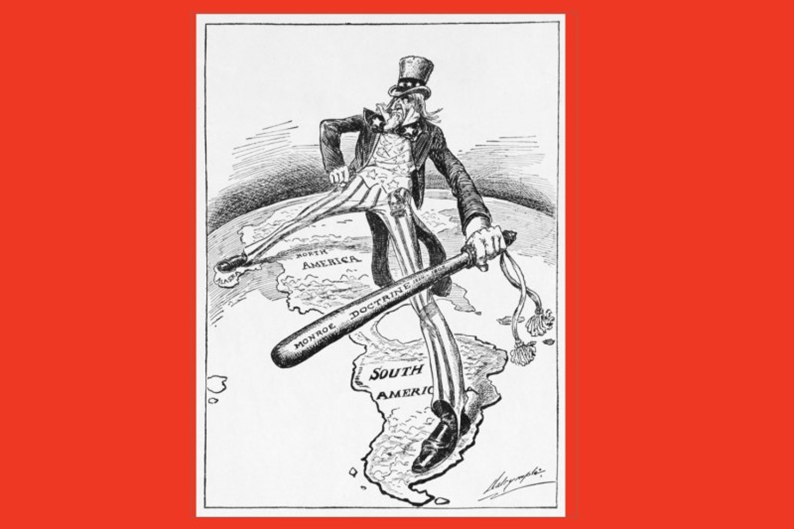
This part of the doctrinal shift in the Trump 47 era is well established. But what if there was more to President Trump’s actions and he had a plan beyond personal aggrandizement? What if President Trump’s expansionist actions in Venezuela, Iran and Greenland and his ire on Colombia and Panama had a common thread, which went beyond words and rhetoric and solidified the future powerplay for the United States? The global commentary on the Donroe Doctrine touches the symptoms, of which there is no shortage. The cacophony and the proliferation of TruthSocial posts, media interviews, constant news bytes given by Trump acolytes and the endless podcast and X. Posts by MAGA, Groyper, Heritage Americans, Restrainers or other categories of Trump supporters with less appealing labels have taken away the art and even the necessity of piecing together events. Rather than the consumers consuming news, the news is consuming a perennial online global community, on which the sun never sets.
But there is a plausible hypothesis.
The Hypothesis
President Trump seems to be pursuing a dual strategy – his own deification, alongside long-term Chinese containment. There are three aspects to his China containment plan:
First, President Trump seeks to weaponize oil against China the way China has weaponized rare earths against the United States and the rest of the world.
Second, President Trump seeks to seize control of the Arctic trading route before its full commercialization, which is a question of when and not if.
Third, President Trump seeks to discredit China’s role as a global political actor and its potential as a geopolitical backstop, relegating its international perception to an extortionist economic player.
Venezuela, Iran and earlier Panama were about the first objective. Greenland obviously fits the second. Venezuela, Iran and as a bonus from Venezuela – Cuba with a domino collapse – the third.
Strategy, Morality and Success
Simply because President Trump may be working on a concerted strategy of containing China, it can’t be implied that his individual actions are primed for moral conformance to the generally acceptable diplomatic practices.
In fact, they may not even conform to the sensibilities of those who still consume news from the prime-time news bulletins on television or tune in to local radio stations while driving. President Trump’s individual actions may come across as abhorrent, unpresidential and cocky.
His actions may not even guarantee success. The grand strategy may work or it may fail – we don’t know yet. It is too early to deduce either way, for President Trump has only played the break-off shot of the opening frame on the global geopolitical table. However, he has powered his cue ball with a ramjet engine, which has disturbed all the red balls, which are currently traversing cushions, but none have been potted yet. We may get a foul and a resultant penalty, but we can be certain that the cue ball is not going to return behind the baulk line as would be the case with a conventional break.
The point of the hypothesis is that chaos is the only way to change a world, that is far too intertwined and complex for a soft landing. No one individual around the world may have the gumption, authority and imagination or a combination thereof to create a world of tomorrow.
Adopting a step-by-step structured approach and hope that there will be on unforeseen consequences of individuals actions which pass through the global trade architecture, monetary system, national security considerations and the social-media ire of the democracies is not a luxury available today.
In 1940s and 50s, President Roosevelt and President Truman had the six wise men to make a new world. In 1970s, President Nixon could devalue the US dollar unilaterally assembling a crack team at Camp David. In the 1980s, President Reagan dealt with a ‘friendly’ Japan in pushing the Plaza Accords. However, President Trump’s world represents peak globalization and hence peak geopolitical complexity, where economic interdependence is not a sobering call for restraint, but has morphed into weaponization of industrial chokepoints.
Chaos, uncertainty, unpredictability and an intense sense of dislike for the methods used to force a global unwinding is fait accompli. Hence, it’s important to weave patters rather than limit one’s imagination due to the seemingly obnoxious nature of President Trump’s daily decisions.
China’s Rise
China’s position in the world is an oft-debated subject. The jury may be out on whether China is in the same league as the United States in a comprehensive manner.
However, the juries do not always have reliable data to base their judgment on, because almost no one – including perhaps the Chinese themselves – trust any socioeconomic data coming out of the official Chinese channels.
But a look at anecdotal data can be instructive where numbers are fickle.
Critical and Emerging Technologies
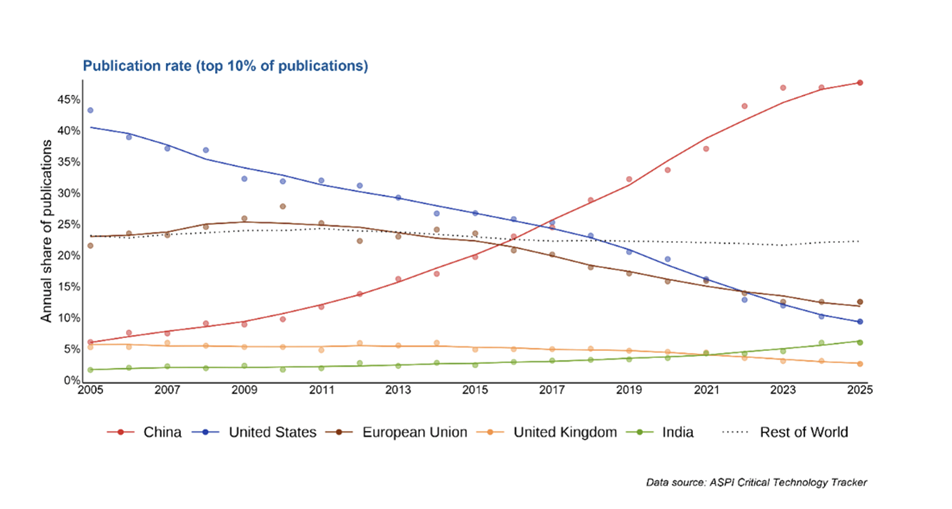
The Australian Strategic Policy Institute (ASPI)’s annual Critical Technology Tracker, which covers 74 existing and emerging critical technologies lists China in lead in 66 of these 74 technologies. The 10 new areas which were added to the tracker in 2025 have China leading 8. The ASPI estimates that China is not just leading its tracker, the gap between China and others is also increasing with time.
China’s annual share in global publication of repute related to these critical technologies has skyrocketed in the last two decades.
The progress is not just limited to industrial research and development. Even in consumer technologies, China is equalling or beating its United States peers. When the Chinese research Liang Wengfeng’s firm DeepSeek released its R1 artificial intelligence model in January 2025, it was dubbed as the start of the third world war. The model was judged to have the potential to challenge the United States global monopoly in consumer technologies.
Manufacturing and Trade dominance
China has also been amassing massive trade surpluses, which are driving its current account surpluses. China posted a trade surplus of $1.2-trillion in the calendar year 2025. China has undoubtedly become the world’s manufacturing leader in terms of scale as well as scope. They can do what others can’t and this realization seems to be frustratingly irreversible for economy after economy.
China is flush with money and actively manages its currency, showing outflows against its massive trade surplus to “maintain” a “peg” to the US Dollar.
Imagine a country routinely making a trade surplus of $500 billion to $1 trillion a year, and its currency barely moving against the US Dollar. In fact, instead of strengthening, it appears that the Chinese Renminbi, the popular feeling has been that it keeps depreciating in real terms. Only in 2026, the currency has seen some meaningful appreciation, leaving its 7-handle to explore the 6-handle territory.
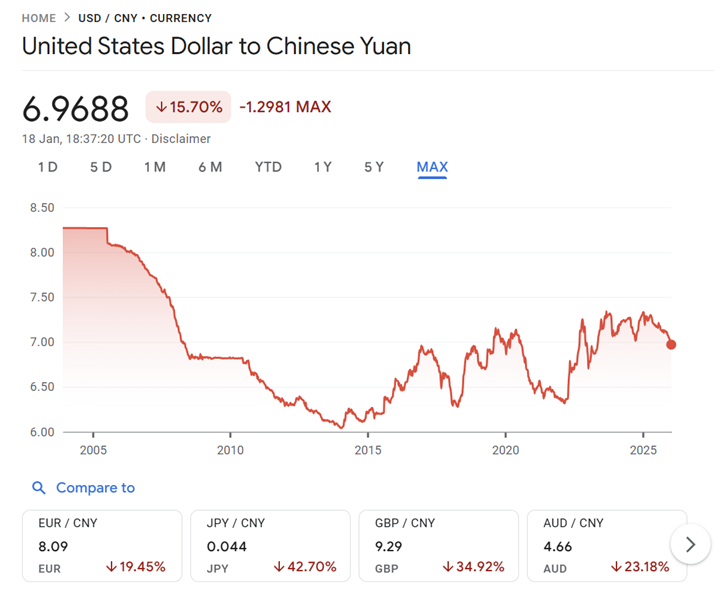
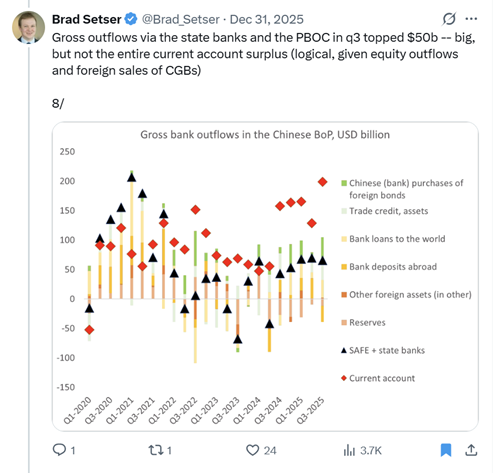
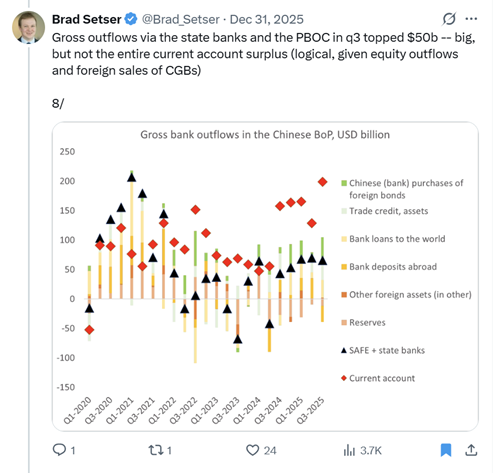
But we know that China has actively allowed Dollar outflows for several years through its complex network of state-owned or state-affiliated banks and financial institutions. These outflows are parked elsewhere in the world and make for a good current to capital account conversion as China pursues its global Belt and Road Initiative (BRI) strategy.
Belt & Road Initiative
The Belt and Road Initiative was launched in 2013, soon after President Xi assumed power. China’s announcement of “Made In China 2025 (MIC2025)” plans launched in 2015, it’s not a coincidence that the BRI became the chosen platform for Renminbi adjustments. China showcases BRI as a “global good” initiative, which is apparently bringing shared prosperity to global south. The BRI is apparently solving problems like high inflation, energy transition and building economic resilience. Essentially, the trade surplus that China makes is “stored” or “shunted” out of the country so that China’s customs surplus never matches its balance of payments surplus. This phenomenon has been explained vividly by Brad Setser, Council on Foreign Relations Senior Fellow.
Peaking Power?
While there is significant data on China’s unquestionable rise, there is another hypothesis suggesting the opposite, but at the margin.
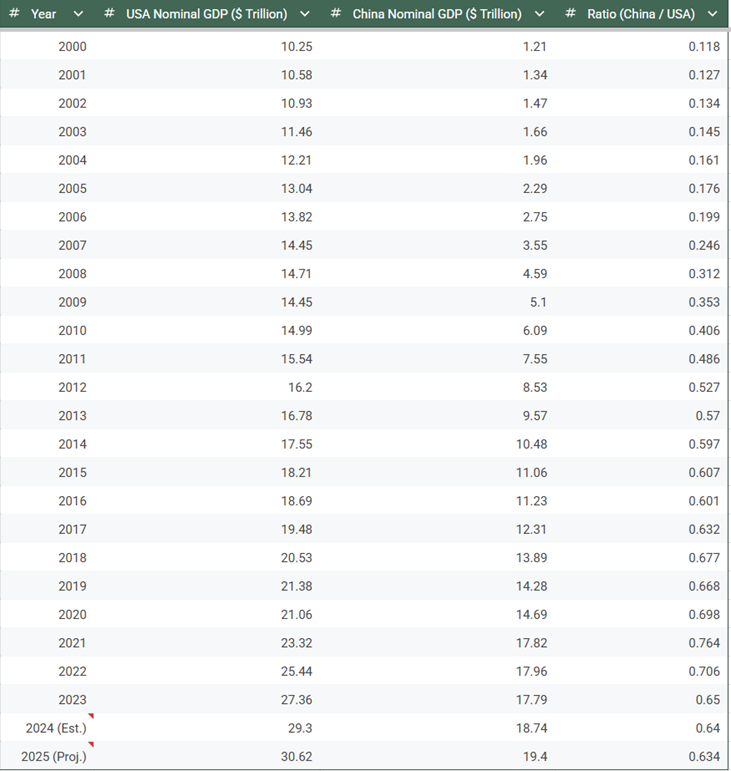
The below table shows how the Chinese gross domestic product (GDP) has evolved in the century in relation to that of the United States. The Chinese GDP reached a high of 76% of the US GDP in 2021, but has since regressed to 63%, which places 2025 at the same level as 2017.
This is a counterfactual argument on China’s rise. It can be reasonably implied that while China has raced ahead in leading a range of scientific and engineering disciplines, it may be losing its relative economic ability to deploy this leadership to pursue its geopolitical objectives. Of course, this change is happening at the margin – a stock of $20 trillion GDP produced year after year is nothing to mock or dismiss.
The BRI is also China’s chosen vehicle for converting economic dependence of participant countries on China to their political and strategic relationships with China. Presented as a “21st century silk road”, China has undertaken massive infrastructure investments in participating countries since the launch of the initiative. Glistening highways and expressways, metro trains, high speed rails, power plants, water pipelines, railway lines, urban infrastructure improvement projects and manufacturing sites – the capital expenditure has not left any avenue of asset creation.
However, China has not always believed in casting bread upon the waters in undertaking these programs. Massive funding has taken the shape of sovereign borrowing, long duration low interest loans for projects and debt to equity and ownership conversion agreements for key physical assets.
China’s debt-trap diplomacy and wolf warrior diplomacy operating styles are increasingly demonstrating how China wishes to trade its economic control of the BRI participants into political control. China has worked relentlessly in creating global new regional and global institutions like the BRICS initiative, the Shanghai Cooperation Organization, the Asian Infrastructure Investment Bank and the New Development Bank are all tools in China’s quest for its revisionist hegemony.
Oriana Skylar Mastro, leading exponent on China’s strategy, has called for differentiating between what China wants (outcome intentions) and how it plans to achieve those goals (process intentions). Often, China has hidden the former using benign forms of the latter, selling a dream of economic upliftment.
This is where countries like Cambodia, Cuba, Iran, Pakistan and Venezuela become important. These are some of the most enthusiastic participants in China’s BRI largesse and over the years, had gravitated from becoming economic partners to deeply aligned political actors, if not outright vassal states. If they had not yet traversed the path, they were certainly way down that journey. And on the strength of this growing influence, China had been positioning itself as the imminent geopolitical benefactor of these countries, in contrast to the similar dominance which the United States has enjoyed since the second world war on many global countries.
This anecdotal analysis demonstrates why President Trump would be motivated to slow down China’s rise on the global stage.
China rising
The below table shows how the Chinese gross domestic product (GDP) has evolved in the century in relation to that of the United States. The Chinese GDP reached a high of 76% of the US GDP in 2021, but has since regressed to 63%, which places 2025 at the same level as 2017.
This is a counterfactual argument on China’s rise. It can be reasonably implied that while China has raced ahead in leading a range of scientific and engineering disciplines, it may be losing its relative economic ability to deploy this leadership to pursue its geopolitical objectives. Of course, this change is happening at the margin – a stock of $20 trillion GDP produced year after year is nothing to mock or dismiss.
United States vs China
This detailed perspective of where China is today and where it wants to go tomorrow, puts in perspective the actions United States and especially President Trump is taking in his second term.
Oil Dependence
China has been increasingly using its newly crafted export control regulations, to deploy its near monopoly in rare earth minerals refining to choke the global supply. This has been a concerted effort and not a sudden field trial of a new weapon. China started to work on an export controls framework in 2017 itself, just a couple of years after MIC2025 launch. Conceivably, China knew that its manufacturing and exports success can be weaponized at a later stage and was readying the grounds to do so through a global legal standard.
This chokehold that China has on the modern industrial and consumer economy via the control of the global value chains in indispensable intermediate goods was the key reason President Trump sounded caution at the Busan summit with President Xi. A truce of sorts followed with the agreement to negotiate further, but it brought rival trade war ratcheting to a temporary standstill.
President Trump’s actions in Russia, Venezuela and Iran may seek to build a similar chokehold on China and much of the emerging energy hungry world via the control of the global oil supply.
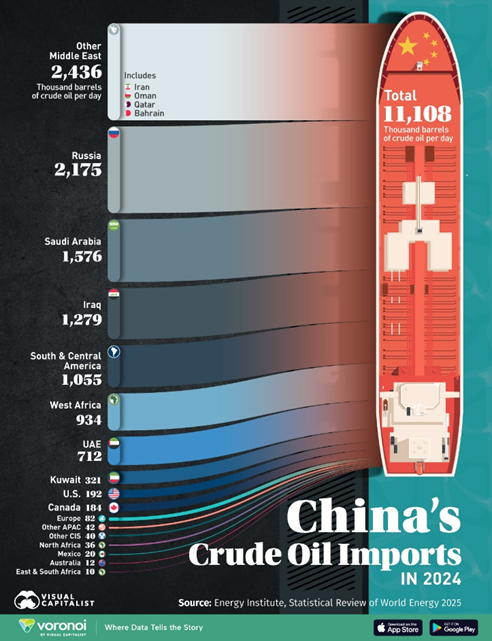
Despite the gains made in renewable energy, China’s dependence on crude oil has climbed up. In 2025, China’s crude oil imports went up 4%. By the end of the year, China was using between 11 and 13 million barrels of crude oil every day.
While China’s sources of crude oil imports are quite diversified, it has been importing oil from all three countries – Russia, Venezuela and Iran. Much of this activity has gone abated despite the price caps on the Russian oil and sanctions on Venezuela and Iran. Dark fleets from all these three destinations have made way to China regularly as tracked by oil industry analysts using open-source shipping data.
If the United States controlled the global oil supply, either through actual physical control or through sanctions, it could potentially become a lever to hold China hostage. Unlike in the case of rare earths, where various global actors can coordinate or come together to increase some supply over a reasonable time investing in extraction and refining, the dependency on crude oil is absolute and immediate.
Crude oil is needed every day to run countries and societies and factories and daily lives. Even a temporary prolonged shortage – say lasting a month – can give rise to social, economic and hence political problems for the government suffering the shortage. So, President Trump is effectively propping his own commodity to apply export controls on. China can of course import more from the OPEC block. But a change in China’s import volumes can destabilize the global oil supply chains and pricing thresholds. That may create friction for the OPEC countries with respect to their other trading relationships. China can tap Russia, but the current dedicated pipeline capacities are not very easy to expand in a short timeframe. There may also be geographic limitations to new expansion, given China needs most energy for its eastern and southern seaboard megacities, which would necessitate ramp up of production and shipping from the Siberian sources. This in turn may require fresh investments and engineering work, which may be unattractive in the short term. Essentially, Russia may not be an immediate crisis management fallback option.
China, much like all the Asian developing countries, would prefer all three supply sources – Iran, Russia and Venezuela – to remain available. President Trump has targeted all three. He has sanctioned vast quantities of Russian oil. He now controls the world’s largest proven oil reserves in Venezuela, although the extent of both his control and the ease of extracting from the Venezuelan reserves remains to be tested. President Trump has also been seeking a regime change in Iran, though he seems to have dithered in making a direct intervention after aggressive initial posturing.
Control of Greenland
Contrary to the popular belief, President Trump’s obsession with Greenland does not have a second term origin. He was looking towards the Arctic even in 2019.
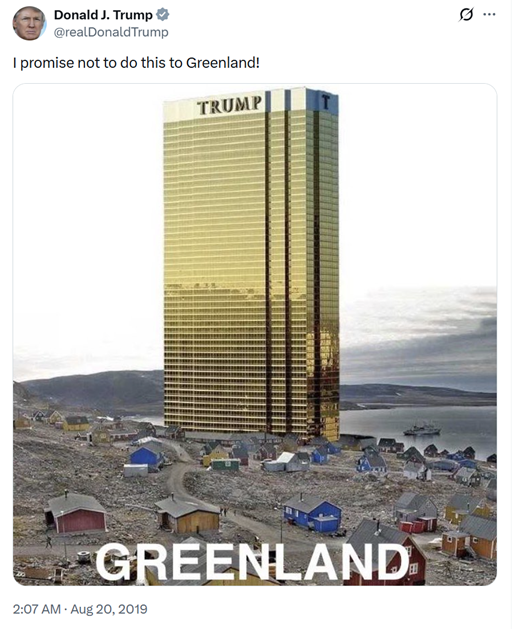
However, this time he looks serious about taking Greenland for the United States. He has issued a thread of tariff imposition on 7 European countries, which he believes are standing with Denmark in not ceding the territory to the United States.
Seemingly, the control of Greenland is about the reserves of various useful commodities in the Arctic. That is an obvious proximate impulse, making for an easy motive attribution. Similarly, applying the Donroe Doctrine – only the United States influences and controls the western hemisphere, with no role for any other extra-hemispheric player – is natural. But Greenland is much more than that.
The Arctic region matters because of four other reasons.
Firstly, control of Greenland gives the United States the control of the Greenland – Iceland – United Kingdom or the GIUK gap. Any Russian or in the future Chinese submarines moving towards North America from the Arctic path must cross the GIUK gap. The best point of interception of these submarines will be away from home in distant international waters. A full control of Greenland makes the United States the policeman of the GIUK gap.
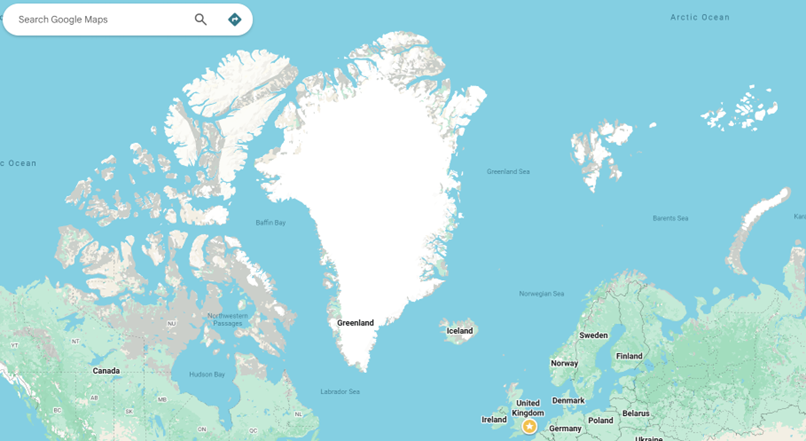
Second, while the Arctic shipping routes for trade are in their infancy, their expansion and use are a matter of when and not if. Commercial shipping is already exploring northern routes and Russia is quite keen to use that option to connect with North and South America. The United States seems to be targeting the physical access to this route ahead of its widespread opening, creating new vulnerabilities for Chinese and Russian shipping. This is equivalent to the quest of the control of Panama Canal, the Suez Canal and the Malacca Straits – other important global shipping chokepoints.
Russian shipping. This is equivalent to the quest of the control of Panama Canal, the Suez Canal and the Malacca Straits – other important global shipping chokepoints.
Thirdly, Arctic is a great control, orchestration and modulation territory for space economy as well as warfare. It is perhaps the best global location to build space domain awareness capabilities, tracking and monitoring objects in polar low-Earth orbit, studying and conducting Anti-Satellite (ASAT) tests, developing and testing co-orbital weapons and correcting satellite manoeuvre anomalies. Additionally, it is a great location for tracking space force and obtaining early missile warnings.
Fourthly, the Arctic region can be used to deploy long-range radars to track Chinese and Russian intercontinental ballistic missile launches, track any hypersonic glide vehicles and establish a continental missile shield. ICBMs and hypersonic weapons fly over the Arctic, not the equator. The ballistic missile flight time via Arctic could be as short as 15–25 minutes and hence polar orbits are where the United States would like to receive early warnings and even deploy active air defence capabilities.
Much to the consternation of a rattled European bloc, the United States will use Greenland to detect and potentially delete Chinese scientific advancements and any direct adversarial action.
China’s Geopolitical Ambitions
The third objective of President Trump’s grand strategy looks to be to cut China’s geopolitical wings.
In every international forum from United Nations to World Trade Organization to BRICS, countries like Cuba, Iran and Venezuela have repeatedly presented a united political face to “anti-imperialist” policies of the United States, aligning closely with China. These countries have regularly and increasingly backed Chinese initiatives, resolutions and ideas in global forum, signalling the emergence of a political bloc against the West, especially the United States.
Irrespective of what finally transpires in Iran and Venezuela, the United States actions have made it clear that China has no capability to projects its geopolitical stature much beyond its immediate territory. By not being able to provide any credible and actionable intelligence on the United States, forget deterrence and with Chinese weapon systems easily manipulated by the United States in Venezuela, the United States has achieved a demonstration effect of its strategic and battlefield supremacy over China.
The Venezuela domino may also soon gobble up Cuba as well. Cuba has been intricately linked with Venezuela during the Castro / Diaz-Canel – Maduro regimes. In fact, a big number of Cubans died protecting President Maduro of Venezuela during the United States military action.
Cuba needs around 100,000-barrel equivalent of crude oil every day, of which Venezuela was supplying 35,000 barrels every day. Now, the United States has cut Cuba from the Venezuelan oil. Unless countries in the neighbourhood like Brazil and Colombia help Cuba, the country may be facing a bleak future, without any alternative supply of energy available. Even if oil is made available to Cuba, there are serious questions on its ability to pay for it, with its economy in doldrums.
If the Cuban government falls, it will be another blow to the Chinese political ambitions. It will make clear to the distantly located countries that it is easy to be sucked into the Chinese economic promises, but if another hegemon comes objecting, they will be on their own dealing with the bullying tactics.
This does not mean that African, Asian and South American countries will suddenly find new reserves of American endearment. But it may certainly make them cautious about their dealings with China and may prevent open economic as well as political alignment. This would diminish Chinese ambitions to avenge the century of humiliation and may deal a blow to China’s 100-year marathon – its secret strategy to replace America as the global superpower.
Back to strategy, morality and success
Given the consistent “contain China” theme running through President Trump’s actions, there is plausible deniability that he is acting randomly and only on whims.
Perhaps his use of crudeness and directness is simply a veil, which attracts and absorbs all the global attention, while his strategic actions take shape, completely ignored by the world. Perhaps that is not the case and there is no strategy. Either way, it will hold the thinkers and the analysts in good stead by not getting blindsided on a grand, pieced narrative, simply feeling a sense of disgust for the methods employed by President Trump. Occasionally, President Trump does let appreciation for history tumble out in the open. Recently, when asked why he did not nominate the opposition leader Maria Corina Machado to run Venezuela, he went back to the lessons of Iraq. He recalled that the monster of ISIS was created out of the act of crushing and obliterating the Baath Party in Iraq. Such moments should appeal to the commentariat to be careful about the big picture and not get too distracted by the daily TruthSocial or X discourse.
That said, there is nothing to say that the methods adopted by President Trump the best way to achieve what he wants to achieve. Perhaps he just does not believe enough in the existing methods, which involve complex international legalities and draw upon the salience of the global governance organizations like United Nations.
It is also not clear if President Trump will in fact succeed in achieving any of the three aforesaid objectives in relation to containing China. This will be determined in time, and the result will reward or penalize President Trump politically. The process as well as the eventual result will also place a huge burden on the rest of the world, with possible outcomes covering a big gamut from collapsing countries to new trade and security partnerships to new regional conflicts.
However, our bounded rationality in not being surefooted on the morality of the actions and their eventual impact should not stand in the way of our recognizing that a new great geopolitical game is being played in front of our eyes.
What about India?
President Trump’s foreign policy has had a clear dichotomous impact on India. In everything that is direct and bilateral, the United States is drifting away from the last 25 years of ‘blow hotter than blow cold’ diplomacy.
Every geopolitical action that President Trump has taken directly in relation to India or indirect Indian interests has been unreservedly negative for India. However in stark contradiction, his global playbook outside the West Asian region, opens new opportunities and creates new fault lines for India to exploit to its advantage. A weakened China in any form is good for India in long term.
India is not the main actor of this essay. But India is struggling to balance immense and certain bilateral downsides with small and uncertain multilateral upsides. That’s perhaps the subject of an entirely different story.
In Conclusion
Carlos Fuentes also said in his book Terra Nostra – “Power does not alter a man’s character. It merely reveals it.” President Trump the 47th has been revealed as a great disruptor.
Long after his political career ends, he may be recalled as a hero or as a villain depending on what impact his action leave on the commentator. But he will not leave the world in the same state in which he inherited it. And almost no one is going to partake in the new steady state unscathed.
Author: Team TerraCogent Insights
Team TerraCogent Insights writes on contemporary issues of geopolitics. See: https://www.terracogentinsights.com/

