
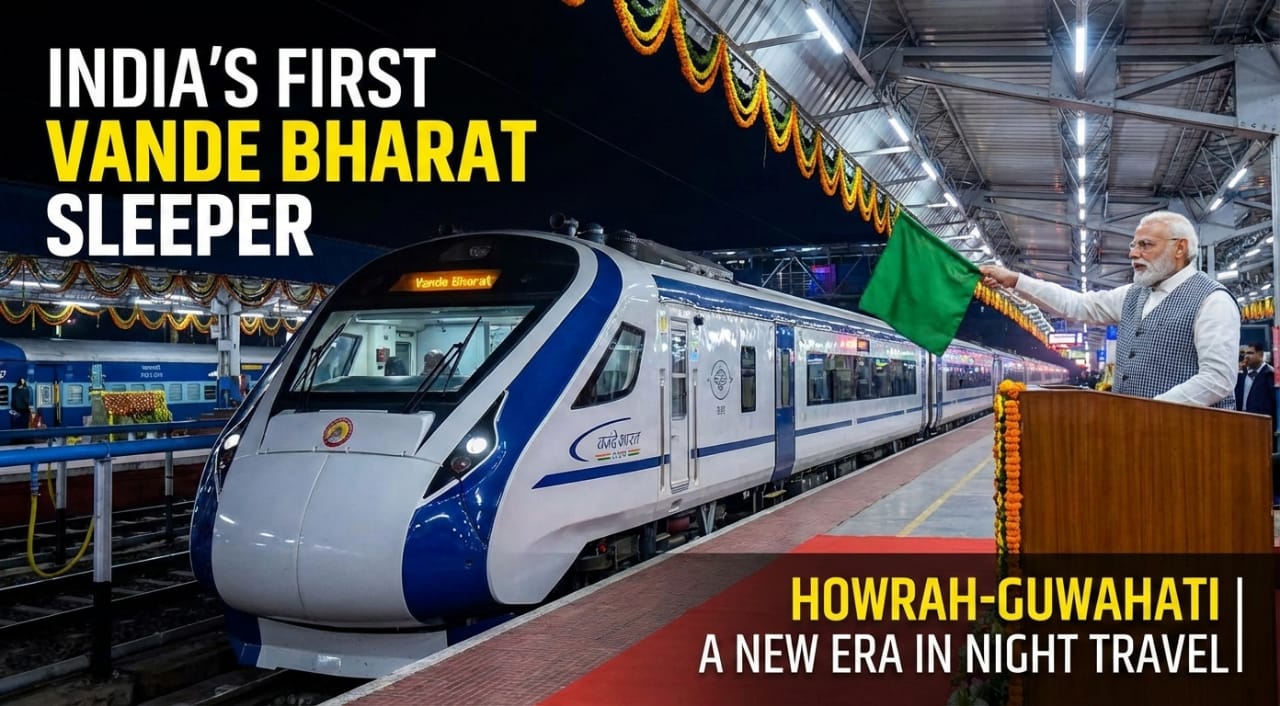
As dawn broke over North Bengal, Malda Town railway station became the stage for a historic moment in Indian Railways. Prime Minister Narendra Modi arrived to flag off India’s first Vande Bharat Sleeper Train, a launch that quietly redefined how the country will travel long distances at night. From this point forward, the familiar overnight rail journey between Howrah and Guwahati would no longer be the same. Faster, safer, and far more comfortable, the new Vande Bharat Sleeper signalled a shift from traditional travel to a more modern rail experience built for the aspirations of a changing India.
The Howrah–Guwahati corridor is not just a railway route; it is a lifeline connecting Eastern India with the North-East. Every day, thousands of passengers—students chasing education, workers seeking livelihoods, traders moving goods, families returning home, and pilgrims travelling to sacred destinations—depend on this line. For decades, the journey meant long hours, fatigue, and limited comfort. With the introduction of the Vande Bharat Sleeper, Indian Railways has reimagined this overnight passage, reducing travel time from nearly 17 hours on the Saraighat Express to around 14 hours, while offering an experience that rivals modern air travel in comfort.
The Vande Bharat Sleeper is designed as a complete long-distance travel solution rather than just a faster train. Comprising 16 fully air-conditioned coaches with a total capacity of 823 passengers, the train offers AC First Class, AC Two-Tier, and AC Three-Tier accommodations. Inside, the emphasis is on calm, safety, and rest. Ergonomically designed berths, bio-vacuum toilets, CCTV surveillance, emergency alarm systems, and passenger–crew communication units ensure a secure and dignified journey. At the heart of its safety framework lies KAVACH, India’s indigenously developed automatic train protection system, which continuously monitors train movement to prevent accidents and overspeeding.
Beyond speed and comfort, the train carries a deeper regional significance. The Vande Bharat Sleeper strengthens cultural and economic ties between West Bengal and Assam, making access to important pilgrimage centres such as Kalighat Temple in Kolkata and Kamakhya Devi Temple in Guwahati easier and safer. Faster connectivity is expected to encourage tourism, stimulate regional trade, and create new employment opportunities, particularly in the North Bengal and North-Eastern regions that rely heavily on rail transport for mobility and commerce.
The launch of the Vande Bharat Sleeper was part of a broader infrastructure push unveiled during the Prime Minister’s visit. From Malda Town, PM Modi also flagged off four new Amrit Bharat Express trains aimed at providing affordable and reliable long-distance connectivity, along with two new Express services equipped with modern LHB coaches. These trains will connect North Bengal with major economic and IT hubs such as Bengaluru, Mumbai, Nagercoil, and Tiruchirappalli, expanding opportunities for students, professionals, and migrant workers.
The Prime Minister further laid the foundation stone for four major railway projects in West Bengal, including a new rail line between Balurghat and Hili, next-generation freight maintenance facilities at New Jalpaiguri, the upgradation of the Siliguri Loco Shed, and the modernisation of Vande Bharat maintenance facilities in the Jalpaiguri district. These projects are expected to improve logistics efficiency, strengthen freight operations, and generate employment across North Bengal. Electrification of key rail sections and the foundation stone for the four-laning of the Dhupguri–Falakata stretch of National Highway-31D were also announced, reinforcing the government’s focus on integrated transport development.
As the day progressed, the Prime Minister travelled to Guwahati to participate in Bagurumba Dwhou 2026, a landmark cultural celebration of the Bodo community. With more than ten thousand artists performing the Bagurumba dance in a single synchronised presentation, the event echoed the larger message of the day—development that moves forward while honouring cultural identity and regional heritage.
The flagging off of India’s first Vande Bharat Sleeper Train is more than the launch of a new service. It represents a vision where rail travel becomes faster without losing accessibility, modern without losing affordability, and advanced without losing its human connection. As the train begins its nightly run between Howrah and Guwahati, it carries not just passengers, but a promise of a more connected, comfortable, and confident journey into India’s railway future.

