
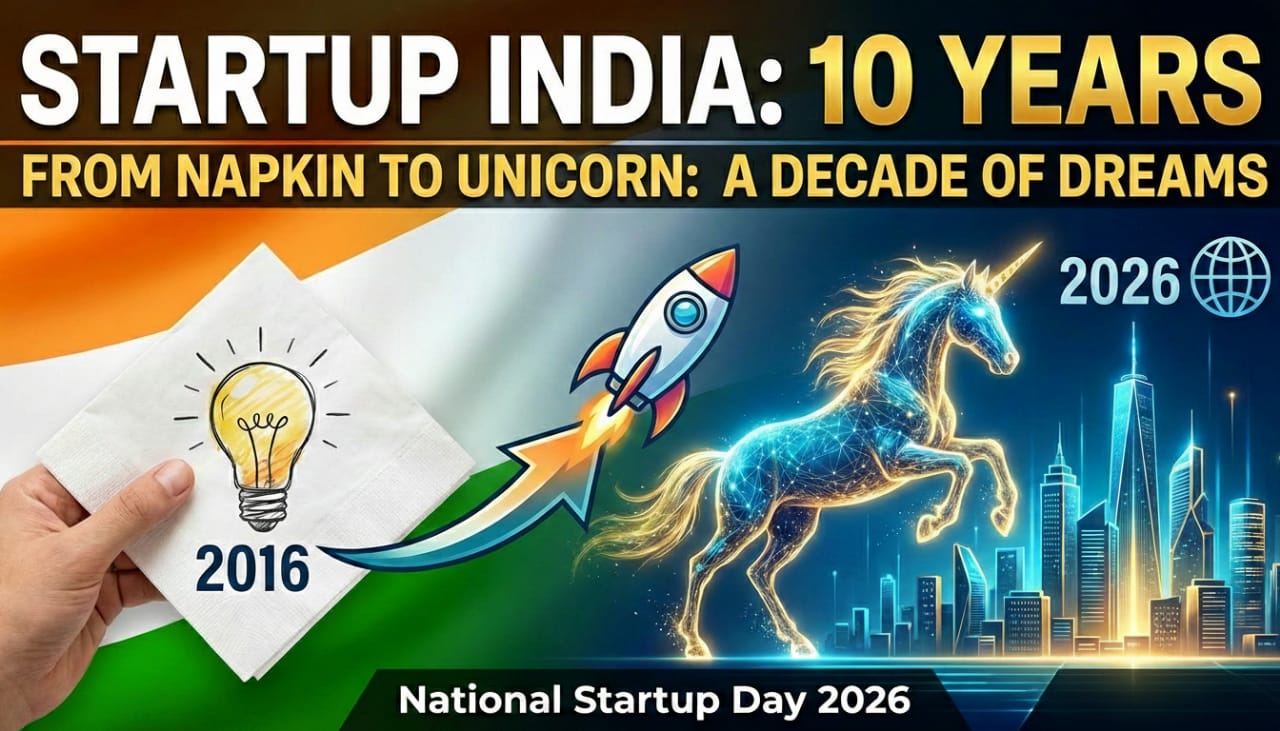
Back in 2016, someone in a Tier-II city like Jaipur might have been sketching ideas on a napkin. That same year, the government changed the game for entrepreneurs with Startup India. Launched on January 16 by the Department for Promotion of Industry and Internal Trade (DPIIT), this initiative wasn’t just about paperwork. It kicked things off by cutting through bureaucracy, opening up funding, and sparking something big. By early 2026, over 200,000 officially recognized startups had turned India into the world’s third-largest startup scene.
On National Startup Day, January 16, 2026 – ten years later – Prime Minister Narendra Modi pointed out that India has moved from a nation of job seekers to one of job creators and that these startups have created over 2.1 million direct jobs and are helping to achieve inclusive growth by 2047.
Think back to 2014: India only had four unicorns – private companies worth over $1 billion. But by 2025, that number jumped to 119, with a total value of over $354 billion, according to trackers like Startup Guru Lab. The Hurun Global Unicorn Index says there are 64 such giants worth over $380 billion, counting companies like Swiggy and Dream11, each valued at $8 billion.
This rapid growth is thanks to government backing. The Fund of Funds for Startups (FFS), managed by SIDBI with about Rs 10,000 crore, has supported 82 Alternative Investment Funds. These funds have put over Rs 25,500 crore into over 1,370 startups, creating over 200,000 jobs and backing 22 unicorns.
The fund has also prioritized businesses run by women (Rs 3,547 crore in 184 firms) and tech-focused ventures in Tier-II/III cities (Rs 2,145 crore in 185 startups). Now, about 40-50% of startups are in Tier-II and III cities, giving people more opportunities with lower costs and a steady workforce, and reports are estimating over half by 2035.
Women are also playing a big role, changing the narrative of empowerment. Around 48-50% of startups recognized by DPIIT have at least one female director, breaking barriers in tech, fintech, and other areas. Initiatives like the Credit Guarantee Scheme for Startups (CGSS) have helped, approving loans without collateral totaling Rs 601.86 crore across 257 ventures (75% for working capital), creating 20,871 jobs with no bad loans as of late 2024.
The Startup India Seed Fund Scheme (SISFS) has also disbursed Rs 945 crore to over 215 incubators for grants up to Rs 20 lakh for initial proof of concept and investments up to Rs 50 lakh to help startups get from the idea stage to the market. Online platforms like the Startup India Hub, MAARG Mentorship Portal, and Investor Connect make it easier to connect mentors and investors, while the States’ Startup Ranking Framework encourages competition.
Other organizations are contributing to the startup scene. NITI Aayog’s Atal Innovation Mission (AIM) has established over 10,000 Atal Tinkering Labs in 733 districts since 2016, teaching 11 million students about AI, robotics, and IoT, spending Rs 2,750 crore till 2028; AIM 2.0 is planning more centers in 22 languages and 2,500 new labs in J&K, the Northeast, and other up-and-coming districts.
The MeitY Startup Hub (MSH) supports over 6,148 startups, 517 incubators, and 329 labs, while its GENESIS platform is scaling 1,600 tech companies in smaller cities with Rs 490 crore; TIDE 2.0 is boosting ICT in healthcare, agriculture, and clean technology.
The DST’s NIDHI has helped create over 12,000 startups, 130,000 jobs, and 175 incubators, along with supporting rural micro-businesses through the Startup Village Entrepreneurship Programme. These efforts are connecting startups with corporations, tech transfers, and global markets.
By 2026, the focus is on keeping this growth going, connecting startups with India’s economy, which is projected to reach $7.3 trillion by 2030. From those early napkin sketches in Jaipur to unicorns changing the world, the last ten years of Startup India shows that having the right policies and a lot of passion can lead to big progress and a plan for innovation-driven success.

