
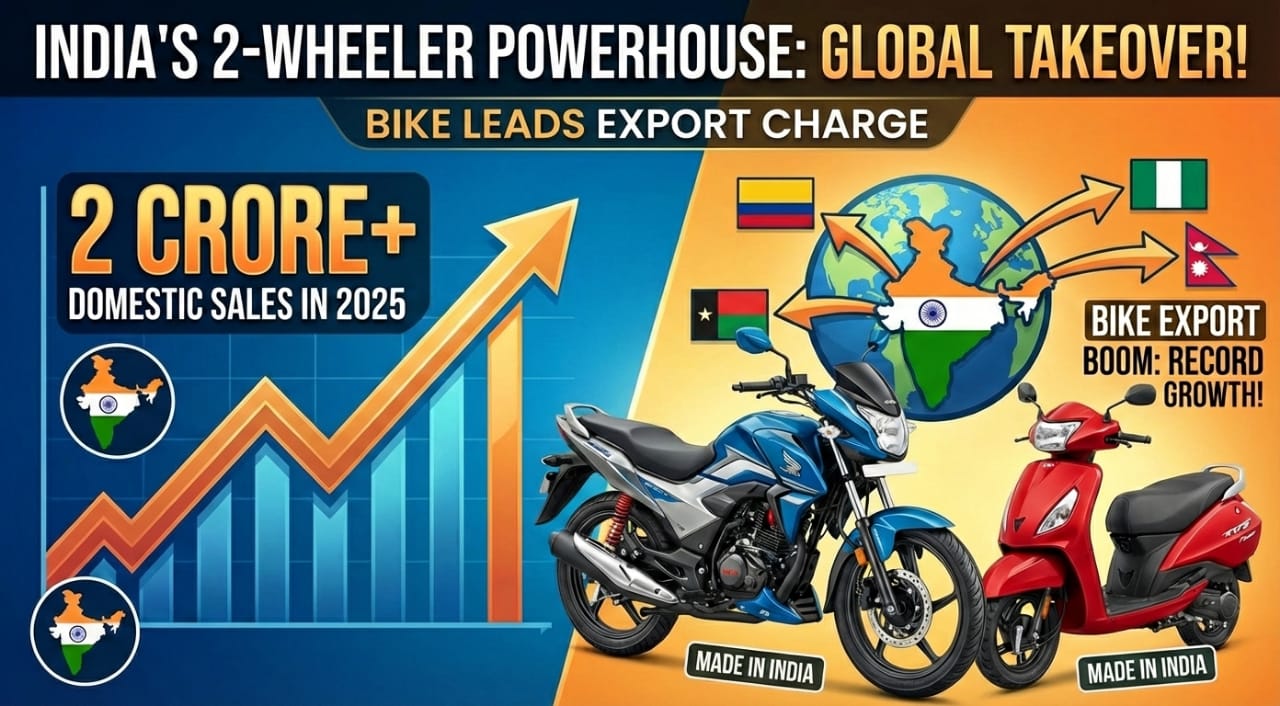
Picture this: it’s a regular Monday morning in 2025, and somewhere in Colombia, a delivery guy fires up his brand-new Hero motorcycle. In Nigeria, a college student zips through traffic on her TVS scooter. In Nepal, a farmer loads his Hero bike with supplies for the weekly market run. What connects all these stories? They’re all riding Indian-made two-wheelers, and they’re part of a much bigger story that’s unfolding back home—a story of ambition, smart moves, and a massive export boom that’s quietly reshaping India’s automotive industry.
Let’s rewind to the beginning of this tale. India’s two-wheeler market just crossed a milestone that might sound like just another number to most people, but it’s actually a pretty big deal. Sales zoomed past the 2 crore mark in 2025, climbing about 5% from around 1.9 crore units sold in 2024. Now, before you start celebrating too hard, here’s the twist: we’re still not back to our glory days. The all-time record? That was 2.1 crore units way back in 2018, according to data from SIAM, the Society of Indian Automobile Manufacturers. So yes, we’re doing better, but there’s still some road to cover before we can say we’ve truly bounced back.
But here’s where the story gets really interesting, and honestly, this is the part that should have everyone sitting up and paying attention. While domestic sales were doing their steady climb, something absolutely explosive was happening on the export front. Indian two-wheeler manufacturers shipped out a jaw-dropping 49.4 lakh units to international markets in 2025—a massive 24.2% jump from the previous year. To put that in perspective, that’s nearly half a million more bikes and scooters finding homes in countries across the world. What’s driving this surge? African markets that had been struggling are bouncing back with vengeance, South Asian neighbors keep placing solid orders, and there’s a general revival in motorcycle hunger happening across the globe.
Now, let’s talk about the players in this game. Hero MotoCorp, the company that’s been India’s two-wheeler king for years, held onto its crown by selling 57.5 lakh units with a respectable 2% growth. Steady, reliable, like that friend who always shows up on time. But the real showstopper? That was TVS Motor Company, which came roaring in with a spectacular 15.7% sales leap to 39.8 lakh units. These guys clearly pressed the accelerator hard and didn’t let up.
Back home in India, the growth pattern tells its own fascinating story. Both cities and villages saw more people buying bikes and scooters, but cities were clearly leading the charge. How do we know? Look at what’s selling. Scooters, which are the darlings of urban riders navigating congested city streets, grew faster than motorcycles, which traditionally rule in rural areas where roads are longer and less crowded. Why the buying spree? Well, the government played fairy godmother with a bunch of moves that made bikes more affordable. GST 2.0 streamlined taxes, income tax breaks put more cash in people’s pockets, and the Reserve Bank cut repo rates, making vehicle loans cheaper. All of this came together beautifully during the festive season—that magical period from September to November when Indians love to shop—and dealerships were practically humming with activity, especially in cities.
But let me take you deeper into the export story, because this is where things get absolutely fascinating. Remember that 24-25% export growth we mentioned? It’s not just about selling more bikes—it’s about where those bikes are going, and this is the part that deserves a standing ovation. Hero MotoCorp’s journey is the perfect example to understand what’s really happening here.
Cast your mind back to FY22, which is April 2021 to March 2022. Hero was exporting to 43 countries. Decent number, right? By FY23, they’d nudged it up to 47, adding cool new markets like the Philippines and reviving old relationships with places like the Democratic Republic of Congo and Liberia. Now jump to 2025, and watch the magic happen: by mid-year, they’re in 48 countries. By October? They’ve hit 52 countries spread across five continents, with over 11,000 retail touchpoints worldwide. That’s not just growth, that’s strategic empire-building.
Why does this matter so much? Because the world of international trade isn’t exactly smooth sailing right now. Tariffs—those pesky import taxes countries slap on foreign goods—have been popping up like uninvited guests at a party. Take Mexico, for instance, a massive market in Latin America. From January 2026, they hiked duties on Indian products to a brutal 50%, up from 20%. This hits hard because India sends about $390 million worth of two-wheelers to Mexico every year through companies like Hero, Bajaj, and TVS. Ouch.
So what did Hero do? They didn’t panic, they pivoted. Before August 2025, Hero was already strong in their top 10 markets: Bangladesh, Colombia, Turkey, Mexico, Nepal, Guatemala, Nigeria, DRC, and the Philippines. But they saw the tariff storm clouds gathering and started spreading their bets way before it hit. Latin America became a key focus, with dispatches jumping a stunning 51.8% in FY25, powered by Colombia, Mexico, Guatemala, Argentina, and Peru. Africa fell in love with their Hunter series bikes. South Asia remained rock-solid reliable. And then came the really bold move: entering Europe, one of the world’s toughest and most quality-conscious markets, with Euro5+ compliant bikes heading to the UK, France, Spain, Germany, and Italy by late 2025.
Here’s where it gets even smarter. Hero didn’t just export from India and hope for the best. They set up manufacturing plants in Colombia and Bangladesh to produce bikes locally, cutting costs and avoiding some tariffs. They opened a new assembly facility in Nepal and have plans brewing for Brazil. This isn’t just selling bikes—this is planting roots, building local presence, and creating long-term relationships with these markets.
Let’s throw some more numbers at you to really drive this home. Hero’s exports shot up 44% to nearly 2.9 lakh units in FY25. Their global business grew 43%, and here’s a cool detail: premium bikes now make up 38% of their export shipments, showing they’re not just selling budget options but competing on quality too. From 40-something countries just a couple of years ago to 50-plus now, they’ve built serious resilience into their export strategy.
And Hero isn’t alone in this global hustle. Indian manufacturers are eyeing Southeast Asia aggressively, with the Philippines being a prime target. Brazil, with its huge population and growing middle class, is firmly in their sights. Even developed European markets are seeing Indian electric scooters like the Vida making their debut. While we don’t have a precise country-by-country count comparing pre-August 2025 to today, the trend from 43 countries to 52 countries over just three to four years tells you everything you need to know: these companies are deliberately, methodically spreading their presence across the globe.
Think about what this diversification actually means on the ground. If Nigeria’s economy hits a rough patch, Hero’s still got Colombia humming along. If Europe puts up regulatory hurdles, Africa and South Asia keep the volumes flowing. If tariffs spike in one region, local manufacturing in another keeps production rolling. It’s risk management, but executed on a massive, global scale.
This isn’t happening in a vacuum, either. The Indian government has been pushing hard with the “Make in India” initiative, trying to transform the country into a global manufacturing powerhouse. Two-wheelers are becoming one of the success stories in this vision. Indian bikes are now genuinely competitive on the world stage—not just on price, which has always been our strength, but on quality, design, fuel efficiency, and after-sales service. That’s a massive shift from the old stereotype of Indian products being cheap but questionable in quality.
Shailesh Chandra, who heads SIAM, summed up the industry mood pretty well when he said the positive momentum should roll right into 2026, backed by a stable economy, better affordability, and supportive government policies. But he also sounded a realistic note of caution: the industry needs to keep a close eye on geopolitical developments to make sure supply chains stay strong and export volumes don’t get disrupted by global uncertainties. Translation: stay smart, stay flexible, and keep your eyes wide open.
So what’s the big takeaway from all of this? India’s two-wheeler industry in 2025 pulled off something remarkable. At home, they figured out what urban Indians wanted—more scooters for congested cities, better financing options, festive season deals—and delivered exactly that to push past the 2 crore sales mark. Abroad, they transformed from exporters who happened to sell in multiple markets into truly global players with strategic presence across continents, smart local manufacturing, and the agility to navigate tariff wars and trade tensions.
The combination of crossing the 2-crore mark domestically and achieving record exports with a genuinely diversified market presence puts the Indian two-wheeler industry in an enviable position as we roll deeper into 2026. These companies have weathered economic storms, adapted to rapidly changing consumer preferences, navigated global trade complexities, and most importantly, understood a fundamental truth: future growth won’t come just from selling more at home, but from becoming truly global players with deep roots in markets across continents.
The story of Indian two-wheelers in 2025 isn’t just about numbers on a sales chart or units shipped overseas. It’s a story about Indian companies learning to compete globally, about understanding different markets and customer needs from Colombia to Congo, about building manufacturing presence and distribution networks in dozens of countries, and about proving that “Made in India” can mean quality, reliability, and value anywhere in the world.
In short, 2025 was the year the Indian two-wheeler industry proved it could win both at home and abroad. By focusing on what urban Indians want—affordable, efficient scooters and bikes with easy financing—and aggressively hunting for new customers across every continent, our bike makers have turned a simple recovery into a roaring growth engine. The road ahead looks wide open, the global appetite for Indian two-wheelers keeps growing, and that “vroom” we’re hearing from Mumbai to Mexico City? It’s only going to get louder. The Indian two-wheeler story has gone global, and honestly, this is just the beginning of a much longer, more exciting ride.

