
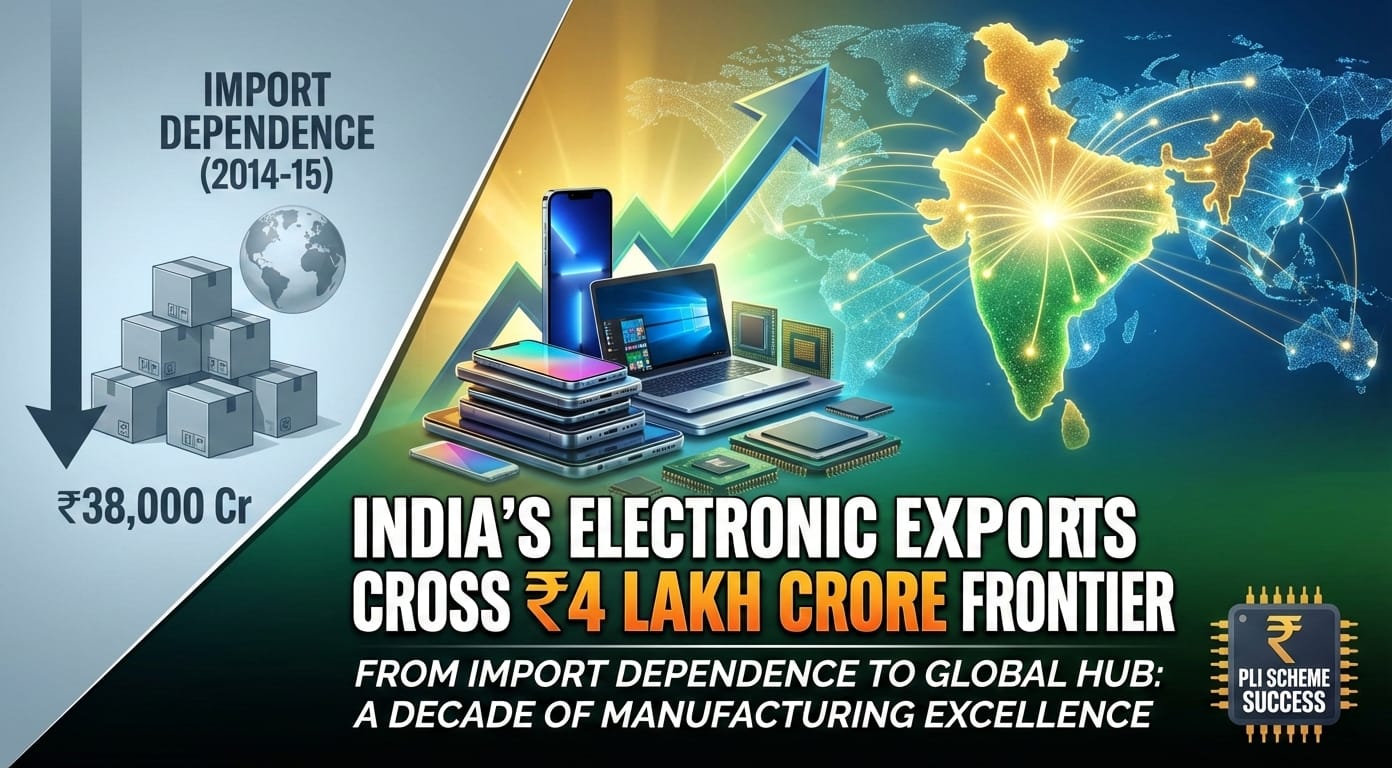
India’s electronic export trade has, over the last decade, undergone a stunning transformation, going from just Rs 38, 000 crore in 2014–15 to reaching the peak amount of Rs 4 lakh crore in 2025. That is about US$48.2 billion at the current exchange rate. If there is a big success story about India’s manufacturing sector, then certainly this star of the show is the one that regained more than eight, fold in just eleven years. When we put this growth scenario in the context of the general industrial change that the numbers show, the story turns out to be quite mind- blowing.
Exports of electronics in India in the 2014, 15 period at just Rs 38,263 crore, or USD 5.7 billion, hardly made a mark on the country’s trade statistics. However, by 2024-25, the sector had already reached Rs 3.3 lakh crore, and this can be seen as the initial phase of a transformation that will reach Rs 4 lakh crore by the calendar year 2025, thus indicating the growing speed of this revolution, which has been continuously growing at a CAGR of over 22.7 percent, a much faster rate than most of the country’s export sectors.
As Union Minister Ashwini Vaishnaw said, “Electronics exports have crossed Rs 4 lakh crore in 2025, thus creating jobs and bringing in foreign exchange. The momentum is expected to continue in 2026 when four semiconductor plants come into commercial production, ” the growth’s foreign exchange implications are significant and strategic for India’s economic stability.
It can be seen that electronics exports are different from the other traditional exports that can bring in a lot of foreign exchange instantly. The PIB data released sets out the baseline of the early 2010s, when electronics exports barely contributed to India’s forex reserves, a mere USD 5.7 billion. However, the sector has since broken the Rs 4 lakh crore mark in 2025 and is now contributing nearly US$ 48.2 billion annually; furthermore, it has become the third, largest export category of India, whereas, just over ten years ago, it was ranked seventh. This massive foreign exchange inflow supports the balance of payments of India thus, reducing the dependence on loan…
As India manages its import bills, particularly for crude oil and other essential commodities, the sector’s contribution to foreign exchange has become especially crucial, and the growing exports of electronics greatly offset these outflows. This accomplishment is made even more noteworthy by the fact that, in contrast to 2014–15, when India was importing electronic goods valued at Rs 2,25,600 crore, the nation has now turned the tables by becoming a significant exporter, radically altering the dynamics of trade and bolstering the rupee through steady inflows of dollars.
The government’s intentional policy interventions are the primary cause of this dramatic change, as numerous PIB releases have explained in detail. Launched in 2020 for large-scale electronics manufacturing, the Production Linked Incentive scheme has changed the game. In just the last five years, this scheme alone has created over 1.3 lakh jobs, attracted investments worth over Rs 14,065 crore, and generated production valued at Rs 9.8 lakh crore. Offering incentives of 4% to 6% on incremental sales over base year for a period of five years, the program specifically targeted mobile phones and certain electronic components, making it an attractive business case for international manufacturers to establish or grow operations in India.
Mobile phone production increased from Rs 18,900 crore to Rs 5.5 lakh crore in 2014–15, and exports skyrocketed from a pitiful Rs 1,566 crore to Rs 2 lakh crore in 2024–25, a startling 77-fold increase. The story of mobile phones is especially striking, as the number of manufacturing units surged from just two in 2014–15 to over 300 today. As Minister Vaishnaw noted when announcing this milestone, iPhone exports alone reached Rs 2.03 lakh crore in 2025, almost twice as much as the Rs 1.1 lakh crore exported in 2024. This shows how Apple has grown to become a symbol of India’s manufacturing success by growing its business following US tariffs on China.
However, the change has been fueled by other supportive initiatives such as the PLI Scheme for IT Hardware products such as laptops, tablets, and servers, the SPECS scheme for supporting the manufacture of electronics components/semiconductors, and the Modified Electronics Manufacturing Clusters Scheme offering world-class facilities. The production of electronics in the country has grown from Rs 1.90 lakh crore during 2014-15 to Rs 11.32 lakh crore during 2024-25 with a CAGR of over 17 percent, which has been validated from PIB facts. The whole sector has grown significantly.
Besides just incentives, the government also strategized through the Phased Manufacturing Programme notified in 2017 to encourage domestic value addition, BIS certification requirements for imported products that are resold in India, and tax policies aimed at making local manufacturing competitive. The development of the ecosystem has been comprehensive with the government approving the Electronics Component Manufacturing Scheme of Rs 22, 919 crore, which attracted 249 applications worth Rs 1.15 lakh crore of investment and Rs 10.34 lakh crore of production, and which Minister Vaishnaw stated to be the highest, ever investment commitment in India’s electronics sector, thus indicating industry confidence.
Equally impressive has been the impact on employment: according to PIB, the electronics sector now employs about 25 lakh people across the entire value chain, with much more to come as four semiconductor manufacturing plants are set to begin commercial operations in 2026, as emphasized by Minister Vaishnaw, who has equated semiconductor production with sustained foreign exchange earnings and job creation.
The larger strategic repercussions of this paradigm shift are highly significant for India’s role in international supply chains. India has succeeded in positioning itself as the second largest mobile phone manufacturer in the world. With current domestic manufacturing accounting for 99.2 percent of mobile phones sold in India compared to 26 percent in 2014-15, it has lessened its import dependence significantly while also developing strengths in the sector for exports.
The coming up of new semiconductor facilities like silicon fabs, silicon carbide fabs, and advanced packaging facilities with a cumulative investment of Rs 1.6 lakh crores will increase this dependence significantly by lessening import dependence on electronics products, which are still around US 98.6 billion.
The double advantage of lessening import dependence while also enhancing exports has significantly helped foreign exchange management while also easing India’s imports deficit worries for the world. This condition was acute in 2013-14 with 67 percent of the 23.5 billion dollar deficit occurring with China.
The success achieved in the electronics sector is also providing a blueprint for other sectors, which are learning from this success of what India can achieve with its policy interventions and development of a manufacturing ecosystem. “As multinational companies seek out diversified sources of their supply chains instead of focusing solely on one country, the success of India’s manufacturing of consumer electronics, with its billion+ consumer base of cellphone subscribers, its improved infrastructure with 200+ Electronic Manufacturing Clusters planned, and its developing semiconductor skills makes India a preferred destination for manufacturing investments,”
This transformation linked to foreign exchange benefits goes beyond simple export earnings, as PIB documents highlight that growth in the sector has created a virtuous cycle: dollar inflows support rupee stability, make import financing for critical inputs easier, reduce external vulnerability, and give greater flexibility to the Reserve Bank of India in the conduct of monetary policy, while the government’s target of reaching USD 300 billion in electronics production by 2026 promises even greater foreign exchange security in the years ahead.

