
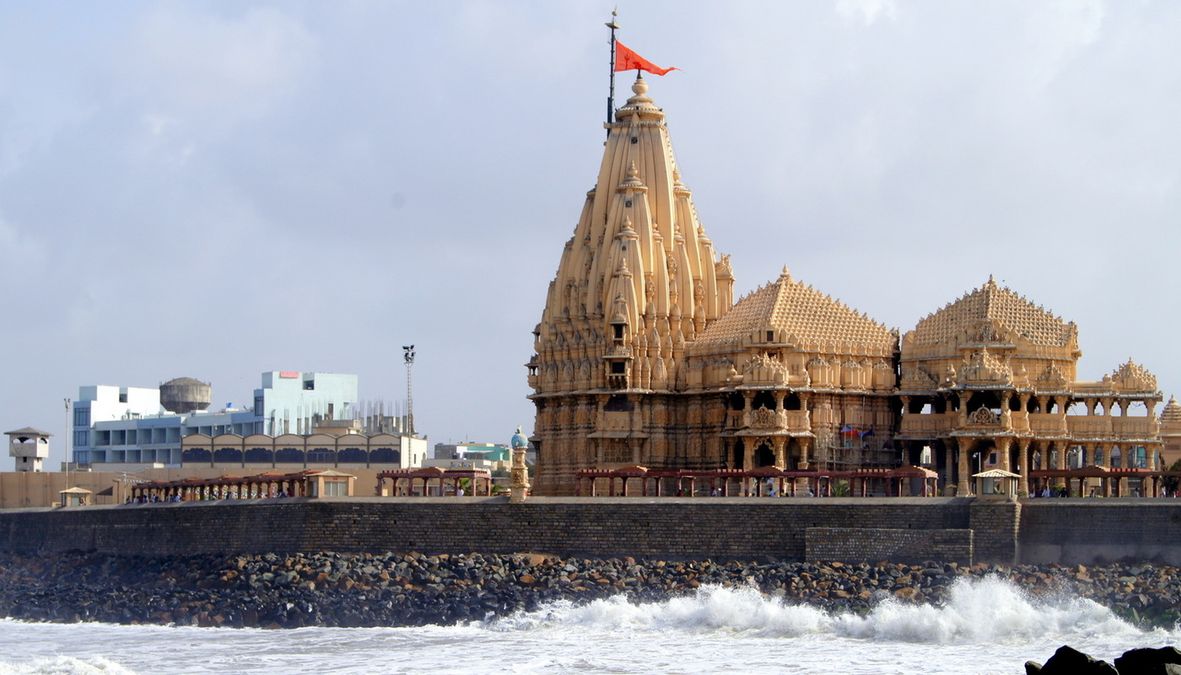
Shri Somnath Temple is a civilisational marker, standing at the confluence of faith, sea, commerce and memory. For a thousand years, it has embodied something deeper than ritual devotion: the refusal of a civilisation to disappear. To understand Shri Somnath is to understand how Bharat prayed, traded, sailed, was attacked, fell and rebuilt itself again and again.
Located on India’s western edge, the Shri Somnath Temple faces the Arabian Sea. That geography is not accidental. In ancient and medieval India, temples along the Saurashtra coast were not isolated religious sites; they were integral to thriving maritime networks. Ports like Prabhas Patan and Veraval connected India to Arabia, Africa and the wider Indian Ocean world. Shri Somnath stood at the heart of this system spiritually anchoring sailors and economically anchoring a prosperous coastline.
Faith and the sea: A maritime civilisation
Shri Somnath’s deity, Mahadev, faces the ocean symbolising openness, continuity, and confidence. This was the worldview of a civilisation that did not fear the sea but mastered it. Merchants, pilgrims, scholars and sailors passed through these shores. Temples accumulated wealth not merely through offerings but through their proximity to trade routes and ports. To strike Shri Somnath, therefore, was to strike both India’s faith and its economic lifelines.
This is why Shri Somnath was repeatedly targeted. Nearly 1,000 years ago, Mahmud of Ghazni attacked and destroyed the temple. As recent commentary and reporting underline, this was driven by religious fanaticism intertwined with plunder. Shri Somnath represented immense material wealth and civilisational prestige. Its destruction was meant to send a message: that India’s spiritual and economic confidence could be shattered. It failed.
Destruction, reconstruction, continuity
What defines Shri Somnath is not that it was destroyed but that it was rebuilt every time. Century after century, rulers, devotees and communities restored the shrine. This rhythm of destruction and reconstruction became a civilisational instinct. Shri Somnath turned into a living symbol of Dharma’s resilience: battered, yet unbroken.
This matters because civilisations do not survive by denying trauma; they survive by absorbing shock and restoring continuity. Shri Somnath’s repeated reconstruction was never about revenge. It was about remembrance. The message was simple: we are still here.
Independence and the crisis of confidence
After 1947, Shri Somnath again became a test, this time of India’s post-colonial self-understanding. Leaders like Sardar Vallabhbhai Patel viewed the reconstruction of Shri Somnath as national healing, a reclaiming of history after centuries of rupture. The temple was rebuilt and consecrated in 1951. But not all leaders were comfortable.
Jawaharlal Nehru famously avoided the ceremony and discouraged others from attending. He feared that public assertion of civilisational symbols would blur the line between state and religion. Later debates, including those referenced in recent articles, have criticised Nehru’s writings particularly Discovery of India for portraying Mahmud of Ghazni more as a warrior of faith than as a plunderer, a framing BJP leaders have called a historical distortion.
This hesitation shaped an era in which civilisational confidence was often subordinated to elite discomfort.
A shift in politics, a shift in tone
Decades later, a different political language emerged. The Bharatiya Janata Party did not treat Shri Somnath as an embarrassment to be managed, but as a civilisational inheritance to be acknowledged. Under leaders like Narendra Modi, Somnath has been framed as a symbol of India’s endurance vandalised, looted, invaded, yet never erased.
This is where Hindutva, subtly but decisively, asserts itself: not as exclusion, but as civilisational continuity. It rejects the idea that Hindu identity must remain apologetic or invisible in public life. In doing so, it completes what earlier leaders hesitated to fully embrace.
The sea returns to the story
Somnath’s relevance today is amplified by India’s renewed focus on maritime power. Port-led development, coastal infrastructure, blue-economy initiatives, and western sea-lanes are once again central to India’s growth strategy. Gujarat’s ports, modern logistics corridors and coastal connectivity echo an older truth: India’s strength has always flowed from the sea.
In this sense, contemporary maritime development does not merely modernise the economy, it restores historical balance. The temple and the port, once inseparable, are aligned again.
A thousand years, one lesson
Shri Somnath stands today as a rare synthesis:
A temple that survived repeated destruction. A port region that once powered global trade. A deity facing the horizon, not hiding from it. A civilisation that refused to disappear.
Its story tells us that Dharma survives not by retreat, but by rebuilding. That confidence returns when memory is reclaimed. And that a civilization that keeps reconstructing itself over a thousand years cannot be defeated. Somnath is not just history. It is proof. A proof that India tried to be killed again and again and chose, every single time, to rise.

