
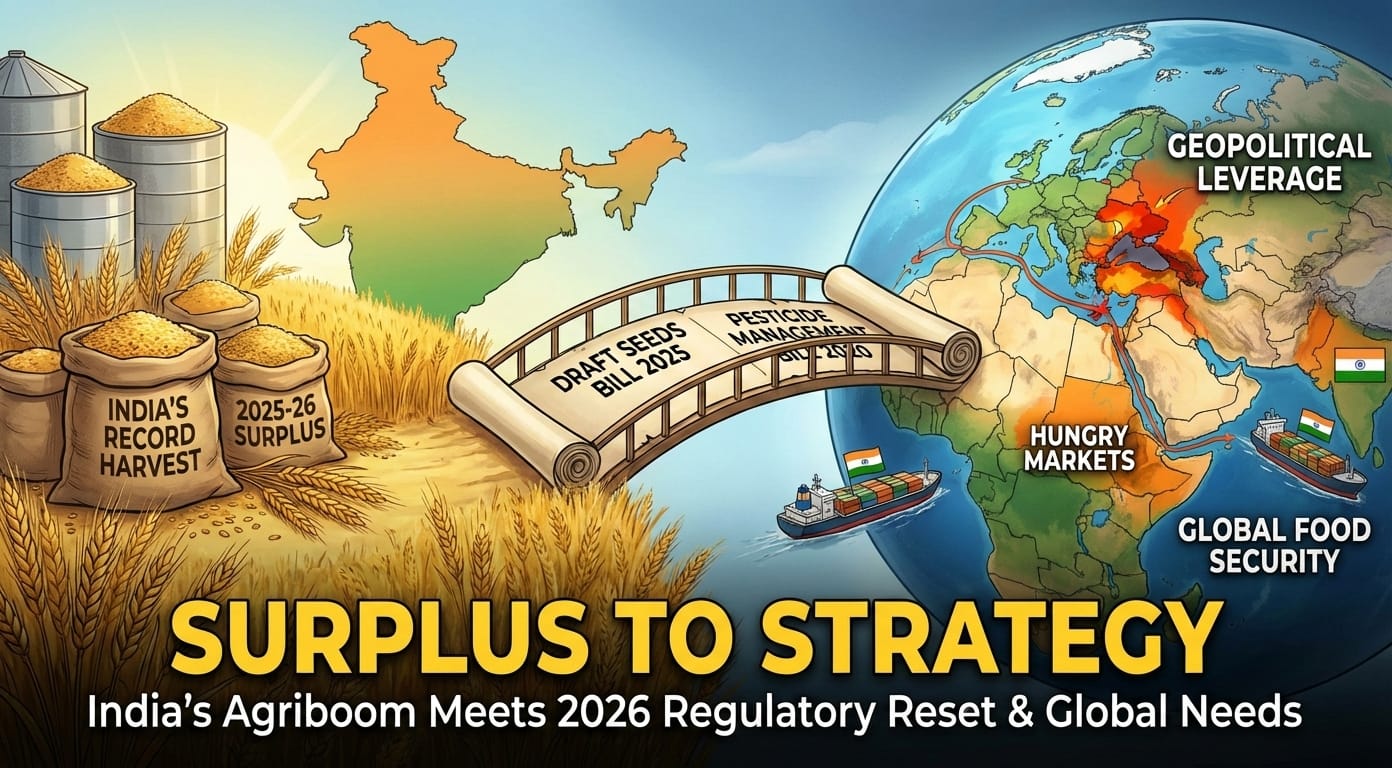
Why does a record harvest matter beyond domestic headlines, and can India translate production prowess into geopolitical influence? The answer lies not in the fields of Punjab or the mandis of Madhya Pradesh, but thousands of kilometers away in the fractured grain corridors of the Black Sea, where Russia’s ongoing war with Ukraine has redrawn the map of global food security.
India’s agriculture sector closed 2025 with a projection of record food grain output expected to surpass last year’s 357.73 million tonnes, according to Agriculture Secretary Devesh Chaturvedi in his statement to PTI, driven by above-normal southwest monsoons that lifted kharif production to a record 173.33 million tonnes for 2025-26, up from 169.4 million tonnes in 2024-25 as per the agriculture ministry’s first advance estimate .
But here is the critical question rarely asked in domestic policy circles: at a moment when Russia and Ukraine—who together control approximately 25 percent of global wheat and barley exports, 15 percent of maize exports, and a staggering 60 percent of sunflower seed oil exports according to a 2025 systematic review published in Frontiers in Sustainable Food Systems analyzing peer-reviewed studies on supply chain impacts remain locked in conflict, does India’s surplus create a unique window to step into markets that are desperate, diversifying, and willing to pay?
The evidence suggests yes, but only if India can marry quantity with credibility, and that credibility hinges on two legislative interventions expected to surface in the upcoming Budget Session of Parliament, likely beginning January 28, 2026, with the Union Budget presentation on February 1 as per reports from NDTV and Moneycontrol citing cabinet committee decisions .
Agriculture Minister Shivraj Singh Chouhan stated at an October 30 event that the government aims to introduce both the Draft Seeds Bill, 2025 and the Pesticide Management Bill, 2020 during the Budget Session early this year, as reported by The Indian Express. Why do these bills matter in the context of export leverage?
Because the Russia-Ukraine war has not merely disrupted grain flows; it has triggered what researchers call a “multi-layered disruption”—energy shortages spiking fertilizer costs (which depend heavily on natural gas), fertilizer shortages cutting crop yields, and yield reductions pushing food prices higher in a domino effect documented by a Frontiers study examining five impact domains including food security, energy volatility, material shortages, transport bottlenecks, and financial responses.
A study published in Transportation Science in January 2025 and cited by INFORMS revealed that a 100 percent reduction in wheat exports from Russia and Ukraine without alternative sources would slash yearly per capita wheat consumption by 19 percent in South Asia, 57 percent in Sub-Saharan Africa, 26 percent in Southeast Asia, and nearly 39 percent in Central Asia, the Middle East, and North Africa according to ex-ante simulations.
These are not hypothetical markets; they are live opportunities where 36 countries import more than half their wheat from the warring duo, as noted by ScienceDirect research on concentrated grain market structures. India already ranks eighth globally in agricultural exports, with expected revenue of $36 billion in 2025 per Liberty Exports analysis, and the Middle East alone sources over 30 percent of its fresh produce from India thanks to diverse agro-climatic zones and cost-effective logistics, with top buyers including Iran, Saudi Arabia, UAE, and Iraq for rice, according to MK Exports and Tradologie export intelligence.
Yet despite overall agricultural export growth of 9 percent year-on-year during April-September 2025 driven by non-US markets as APEDA Secretary Sudhanshu confirmed following US reciprocal tariffs that impacted India’s $5-6 billion annual agri exports to America across shrimp, spices, rice, guar gum, cashews, and dairy, the real question is not whether India can export more, but whether it can export better because international buyers in Africa, the Middle East, and Southeast Asia are not merely price-sensitive; they demand traceability, residue compliance, and consistent quality, trends highlighted at Gulfood 2025 in Dubai where sustainable sourcing, eco-friendly certifications, and ethical labor practices emerged as key differentiators for suppliers.
This is precisely where the Draft Seeds Bill, 2025 becomes a strategic instrument rather than a bureaucratic footnote: the bill mandates registration of all seed varieties, seed dealers, distributors, producers, nurseries, processing units, and certification agencies to stop unapproved or unverified seeds from entering the market, and it proposes advanced seed quality conditions with stricter penalties including criminal prosecution and license cancellations for violations, according to detailed analysis by Lawrbit and statements from Agriculture Minister Chouhan pledging tougher enforcement in the upcoming Parliament session. Why does this matter for exports?
Because fake seeds and substandard pesticides the very targets of the Pesticide Management Bill, 2020 also awaiting passage do not merely hurt domestic yields; they corrode the uniformity and trust that export contracts depend on, and they undermine India’s ability to compete with countries like the United States, Canada, and Australia, which researchers at the University of Illinois found increased wheat production in response to higher prices triggered by the Russia-Ukraine conflict, effectively replacing Ukrainian exports through reliable supply chains.
If India wants to capture the estimated $200.9 billion ethnic food market projected by 2032, as cited by Liberty Exports examining global trends in Indian agro-product accessibility, then the combination of record output—rice production predicted to exceed 124.5 million tonnes and maize at 28.3 million tonnes for 2025-26, with rabi sowing as of December 19 reaching 659.39 lakh hectares including wheat covering 301.63 lakh hectares and pulses expanding to 126.74 lakh hectares year-on-year and regulatory tightening through the two bills creates a rare alignment: supply meets credibility at the exact moment when geopolitical fractures have made reliability a premium commodity.
The 56th GST Council’s decision to cut rates on farm inputs from 18 percent to 5 percent effective September 22, 2025, covering tractors under 1800cc, harvesters, irrigation systems, parts, tyres, bio-pesticides, micronutrients, and fertilizer raw materials, while exempting UHT milk, paneer, chhena, and Indian breads at zero percent—delivering input cost reductions of 7-13 percent and enabling farmers to save Rs 50,000 to Rs 1 lakh on tractor purchases according to CNH India President Narinder Mittal—has already laid the cost-competitiveness foundation.
But cost alone will not win long-term contracts in a world where 222 million people in 53 countries suffered severe food crises and needed emergency assistance due to conflict-driven supply shocks, as documented by food security researchers . India’s path from record harvest to reliable global supplier requires the legislative backbone that the Budget Session 2026 can provide: if the Draft Seeds Bill and Pesticide Management Bill pass with real enforcement teeth—criminal prosecution, swift license cancellations, transparent quality testing—then Indian exporters can offer not just volume but verifiable standards, not just competitive pricing but consistent compliance, and not just emergency shipments but sustained partnerships with nations in Africa and the Middle East scrambling to diversify away from Black Sea dependence.
The Russia-Ukraine war will not end tomorrow, and even when it does, the permanent shifts in global supply chain configurations and trade relationships documented by supply chain researchers will persist beyond the conflict’s resolution, creating lasting demand for alternative sources . India’s record 2025 output is the raw material; the upcoming legislative session is the quality seal, and together they could transform surplus into strategy, production into power, and a good harvest into geopolitical goodwill.

