

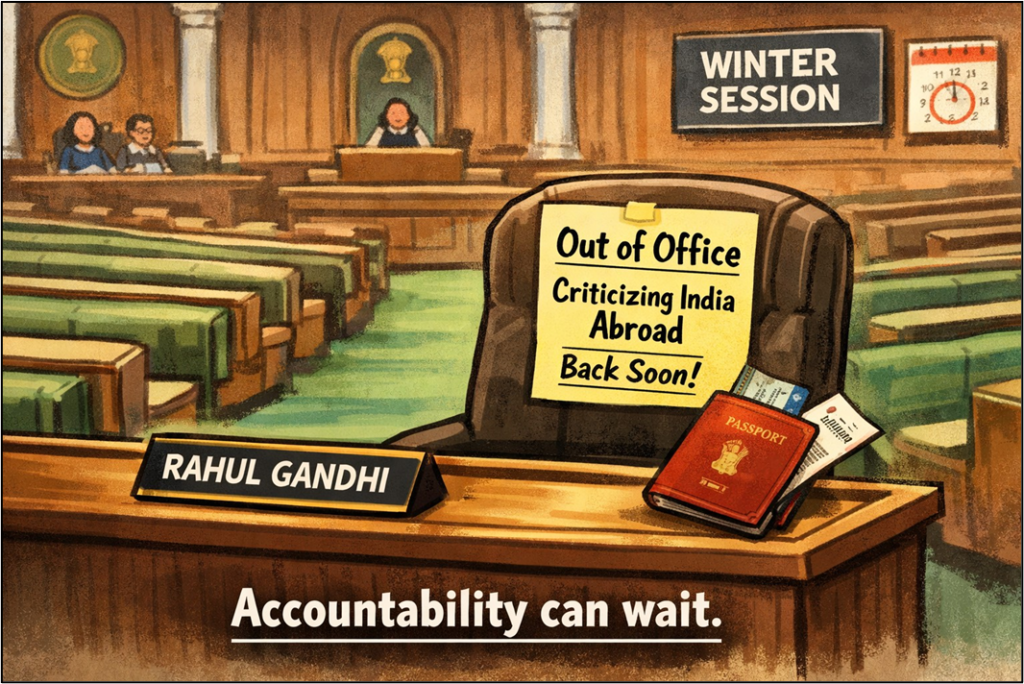
Rahul Gandhi, Leader of the Opposition in Lok Sabha, visited Germany from 15th to 20th December, 2025, during the Winter Session of Parliament, a timing that itself raised questions about the priorities of Videsh Nayak.
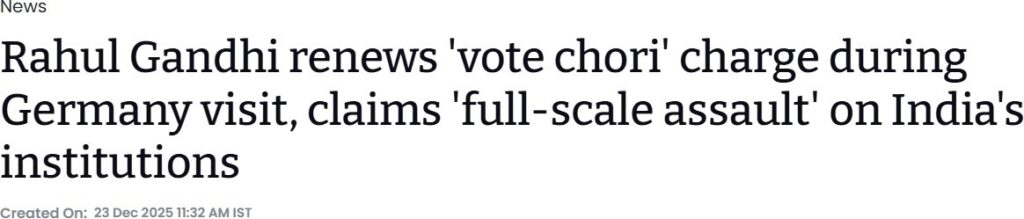
While abroad, he repeatedly launched unsubstantiated attacks on India’s democratic institutions, echoing a long-standing pattern of criticising the nation on foreign soil for domestic political gain.
A Recurring Pattern, Not an Isolated Lapse
This was not an aberration but continuity. Across multiple overseas visits in recent years, Rahul Gandhi has consistently chosen to internationalise domestic political disputes, framing India’s constitutional system as compromised while standing outside the country. Germany merely became the latest venue for a script that has already been performed in the US and the UK.
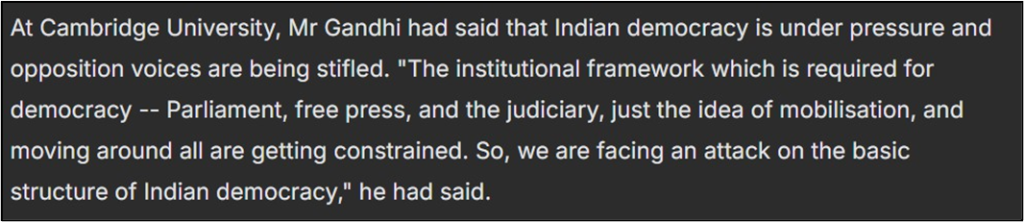
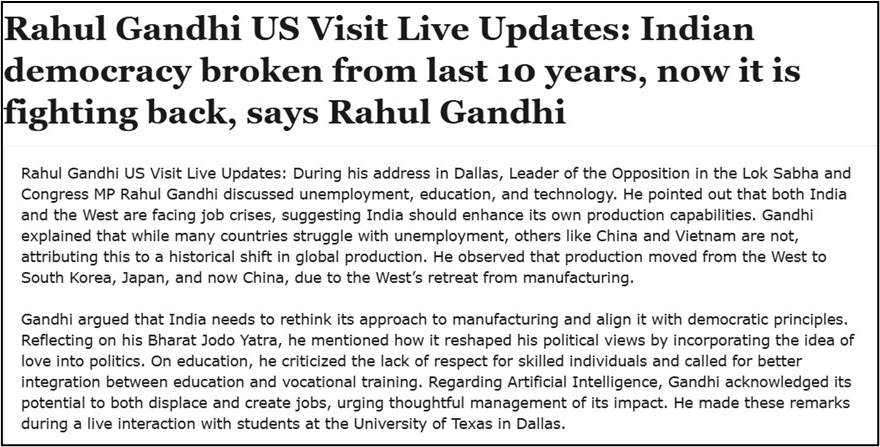
The issue is not criticism per se – opposition critique is integral to democracy – but where and how it is voiced. Democratic systems function on the premise that institutional disputes are addressed within the country, through Parliament, the courts, constitutional bodies, and public debate at home. Exporting these allegations abroad blurs the line between dissent and denigration.
Rahul Gandhi’s speech at the Hertie School in Berlin on 22nd December, 2025, covered institutional capture, democracy, and manufacturing challenges, with explicit critiques of India’s economic policies favouring China. He expanded on manufacturing during the same address, linking it to job losses and political unrest in democracies.
| Rahul Gandhi’s Anti-India Stance on Global Platform: Key Statements |
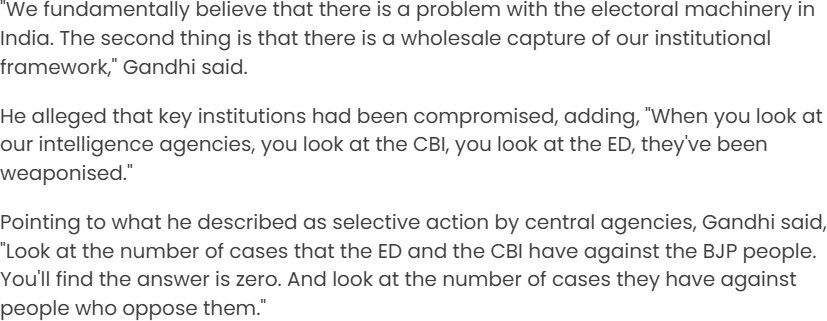
| – “There is a wholesale capture of our institutional framework. Our intelligence agencies, ED and CBI, have been weaponised. ED and CBI have zero cases against the BJP, and most of the political cases are against the people who oppose them.” – “If you are a businessman and try to support the Congress, you are threatened. The BJP uses the institutional framework of India as a tool to build political power. Look at the money the BJP has and the Opposition has.” – “We’re not fighting the BJP. You have to understand that we’re fighting their capture of the Indian institutional structure.” – “What we are witnessing in India is an attack on the core idea of the Constitution that every Indian has equal value, regardless of caste, religion, language, gender, or state. When the voting system is weakened, the message is clear – some lives matter more than others. That is not democracy.” |
Platforms chosen, messages delivered, damage done
The Germany visit featured a sequence of engagements that systematically projected India as a failing democracy before foreign audiences, using platforms and interlocutors with a documented record of adversarial positioning on India.
1. Friedrich Ebert Stiftung (FES) roundtable: India put on the dock
Rahul Gandhi attended a roundtable discussion organised by the Friedrich Ebert Stiftung (FES), where he stated that democracy in India is eroding under the Modi government and that Indian institutions are compromised.
What FES is:
- FES is a 100-year-old globalist, pro-NATO German political foundation, aligned with international social-democratic advocacy.
- FES lists the Open Society Foundations as an official partner on its website.
- FES is funded by the Ford Foundation.
- FES has published material critical of India, including a 2022 report placing references to “cow vigilantes in Modi’s India” alongside authoritarian regimes, collapsing a constitutional democracy into a generic “authoritarian” frame.
- FES is pro-immigration in Germany and is banned in Russia, underscoring its explicit ideological alignment.
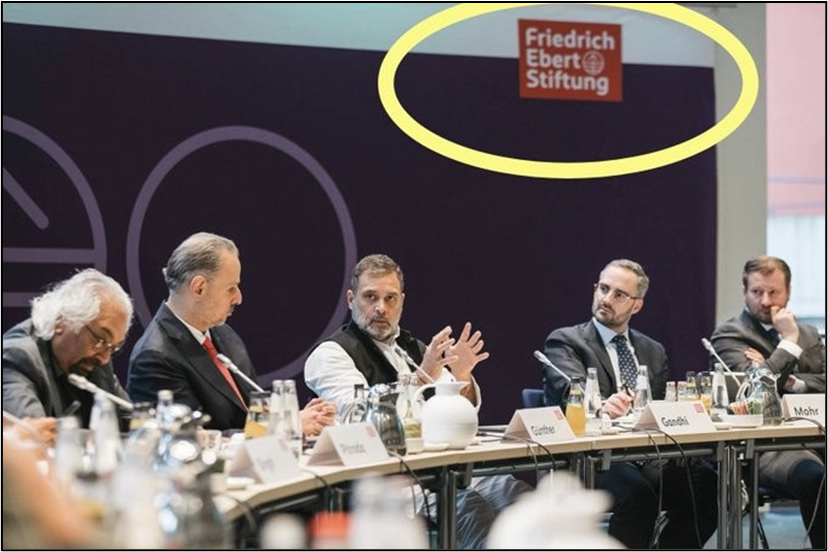
By choosing FES as a forum and using it to declare democratic erosion in India, Rahul Gandhi internationalised India’s internal politics through an advocacy ecosystem already primed to disseminate hostile narratives about India.
1. Hertie School & Cornelia Woll: The Soros-Network conduit
Rahul Gandhi delivered a lecture at the Hertie School and interacted with its leadership, Cornelia Woll.
- Cornelia Woll is President of the Hertie School and a prominent scholar of political economy.
- She serves as a trustee of the Central European University (CEU).
- George Soros founded CEU and is institutionally associated with the Open Society network.
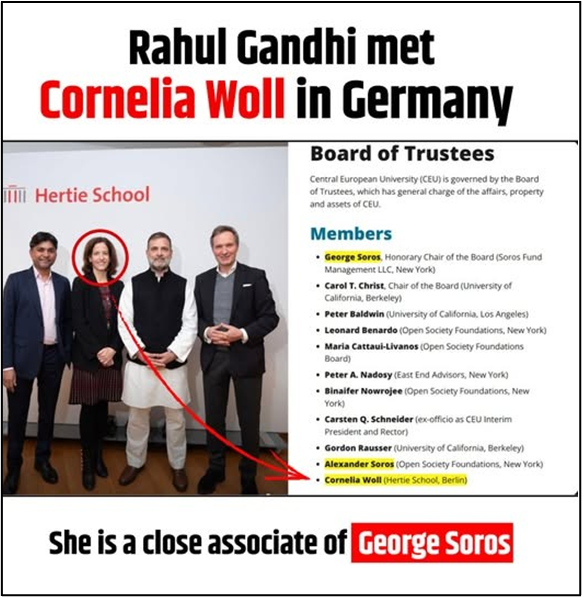
The interaction placed India’s Leader of the Opposition on a stage institutionally connected to the Open Society ecosystem, followed by remarks portraying India as institutionally broken. This embedded India’s domestic political claims within a transnational advocacy network that routinely frames India negatively.
Public messaging abroad: Democracy, Institutions, Manufacturing – All framed as failure
Across Germany, Rahul Gandhi:
- Declared India’s democracy to be in decline.
- Claimed institutional capture without presenting judicial findings or constitutional determination.
- Used an industrial visit to BMW (Munich) to state that manufacturing has declined in India, projecting economic pessimism abroad.
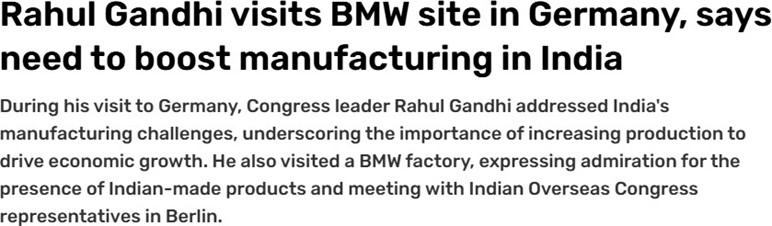
These statements were delivered outside India, to foreign institutions, policy networks, and diaspora forums, creating international soundbites against India’s constitutional order and economic trajectory.
The Putin episode: Misunderstanding protocol, projecting grievance
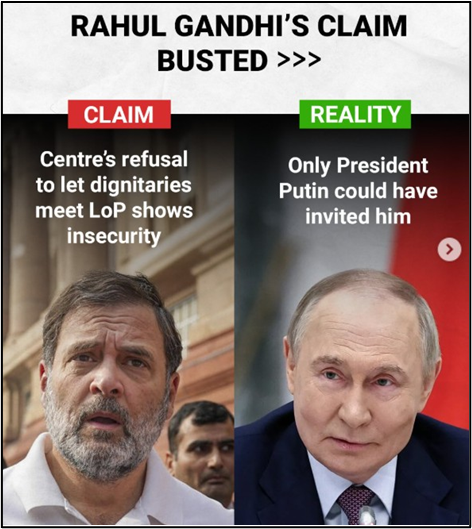
Rahul Gandhi also publicly questioned why he was not permitted to meet Vladimir Putin during the Russian President’s recent visit to India. This complaint reflected a troubling misunderstanding of diplomatic protocol.
Engagements with visiting heads of state are governed by national interest, security considerations, and formal state-to-state processes, not by the personal stature or expectations of individual political leaders, including those in opposition.
Why this is juvenile, Not statesmanlike
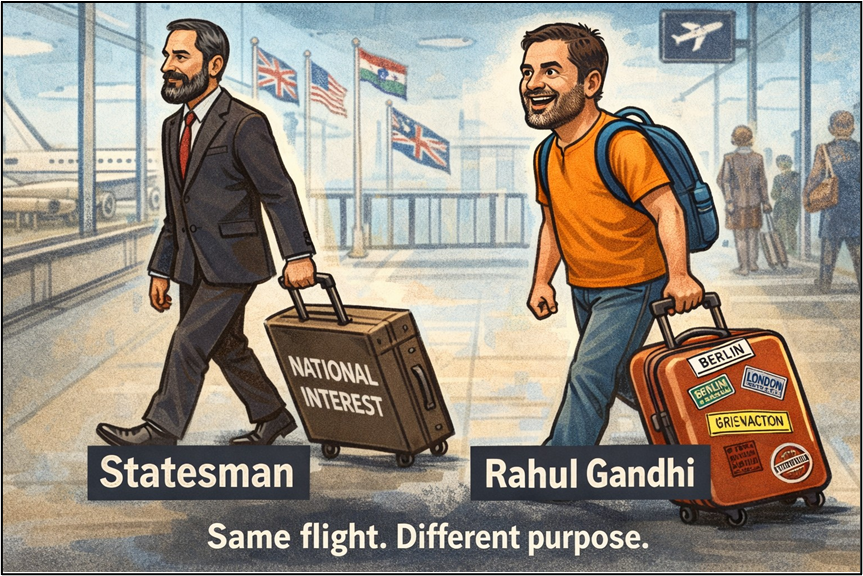
Travel tip for leaders: When you fly economy on foreign policy, don’t check your party’s grievance list at the gate. Overseas diplomacy generally sells trade, security and soft power, not internal subpoenas.
Soundbite ≠ Strategy: Saying “institutions are captured” to a Berlin think-tank generates headlines and the kind of global clippings that late-night comedians recycle for months. Drama scores applause; diplomacy wins deals.
If it walks like a campaign stop… Meeting the diaspora, touring BMW plants and then delivering a domestic complaint? It reads like a rolling election rally with better catering. The optics: lots of access, limited restraint.
Quick comparison: What responsible visitors actually do
- Rishi Sunak in India: Focused public remarks on trade, investment and bilateral cooperation, not on UK party infighting. Foreign visits emphasise country-to-country business, not intra-party score-settling.
- US congressional delegations/parliamentary visits: Public engagements centre on bilateral ties, diaspora outreach, or policy exchange, rather than on the internal electoral disputes.

The modern diplomatic norm is to avoid turning foreign soil into a partisan courtroom. Rahul’s routine violates that norm – repeatedly.
It’s Not Just Theatre – It Carries Costs
- Diplomatic cost: It gives foreign media a replay of domestic rows, making India’s debates a foreign headline rather than an internal resolution.
- Domestic cost: Repeating litigated or investigatory claims abroad can look like outsourcing grievance amplification instead of using domestic remedies (courts, parliamentary forums). And we’ve seen the repercussions of such acts by his Great- Grandfather before, when the Kashmir issue was politicised on the international platform.
Rahul Gandhi says, “We think people will fight with each other, we think India will fail“
Can a man who loves Bharat want India to fail?
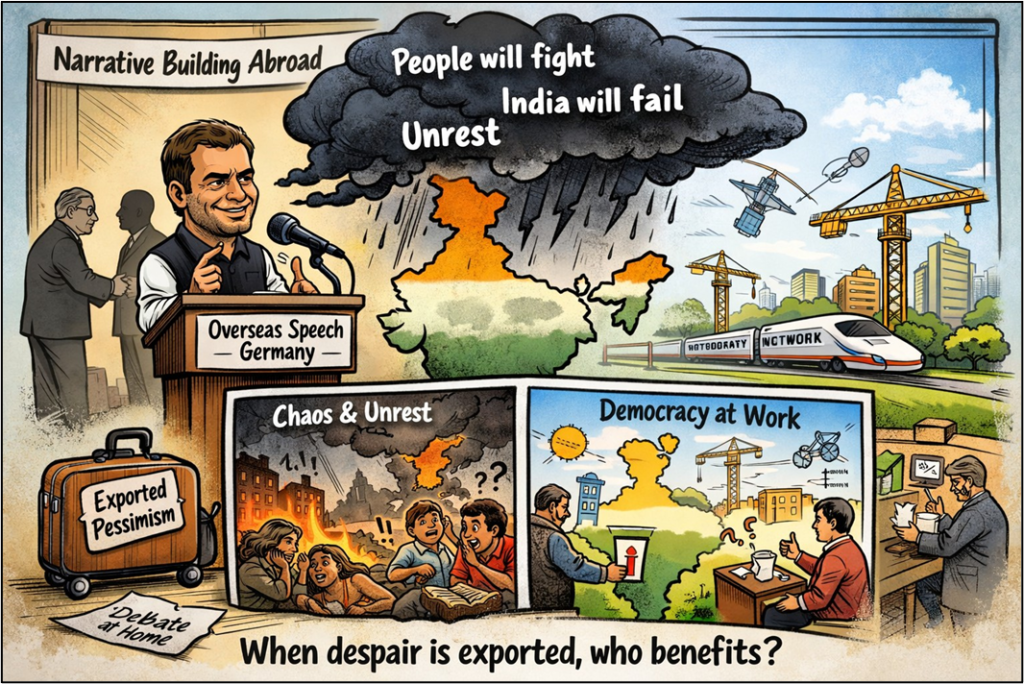
Rahul Gandhi in Germany says he thinks: People will fight each other, India will fail, Unrest will happen! From fighting Indian state, to threatening Anarchy. Rahul Gandhi’s Congress, with his ideological patron George Soros, wants chaos and unrest in Indian Democracy. Rahul goes abroad to unite such anti-India forces.

