
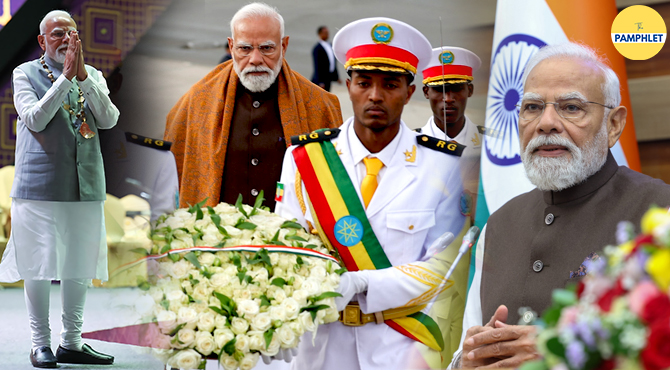
Marking the final engagement during the two-day visit to Ethiopia in the second leg of a three-nation tour, Prime Minister Narendra Modi addressed a joint session of the parliament of Ethiopia. PM Modi’s speech in Ethiopia is a historic step towards ascertaining India’s efforts, voice and vision in the Global South, in the backdrop of the constantly-evolving geopolitical events in the world.
PM Modi was honoured with the ‘Great Honour Nishan of Ethiopia’, becoming the first global Head of State or Head of Government to receive Ethiopia’s highest honour. During PM Modi’s first bilateral visit, India and Ethiopia have taken mutual cooperation and historical-ties to the next level of a strategic partnership. In Addis Ababa, the elevation of relations came amid wide-ranging talks between Ethiopia’s PM Abiy Ahmed Ali.
Signing eight MoUs/agreements that include upgrading ties to ‘Strategic Partnership’, the two nations are making the ties deeper with customs cooperation, cooperation for the building of a data centre at the Ethiopian Foreign Ministry – which was one of the highlights of PM Modi’s speech, debt-restructuring under G20, UN Peacekeeping training cooperation, and added ICCR scholarships.
Cultural clarity for strategic partnership: PM Modi’s Ethiopia speech is uniquely futuristic
PM Modi illustrates that his discourse with Ethiopia during his first bilateral visit is a conversation imbued with a cultural approach and outreach to India’s Global South deliberations. He has referred to the most crucial binding principles in the context of a strategic partner in a swiftly changing and challenging world order. He said: “I am told that there is a saying in Ethiopia, ‘when spider webs unite, they can tie up a lion.’ We too believe in India, that मन मिलें तो पर्वत भी रास्ता दे देते हैं – when hearts are united, even mountains give way.” These are emotions embedded deeply in people-histories and cultures in both nations. These are words from the essence of life and living in the two civilisations.
Talking of Global South while making note of sensibilities on the aspect of “strength” pertaining to a spider’s web and the heart (and soul – in the Indian context) PM Modi is concentrating on the aspect of “overcoming” through a combining and convergence of efforts. It’s a riveting description of objectives in mutual partnerships in perception of strengths that exist – independently.
For two nations that take pride in the carving tangible heritage out of monoliths, and draw life lessons from nature, this pulling together of words to reimagine a new language of mutual creativity, is uniquely-reflective of the deep commitment to unfolding the layers of culture and its understanding that PM Modi is known for. This speech celebrates commonalities – civilisational, cultural, and of human values, in a unique way. There is something deeply reassuring in the warmth in PM Modi’s interaction Ethiopia. Its intent has unusual clarity and edge.
There are aspects of the host nation’s culture that PM Modi makes known to people like us, to Indians at large. It is perhaps to constantly introduce and reintroduce us with people from another land who matter to us – as Bharatiyas, as shapers of 2047, as enablers to PM Modi’s own dream for India’s global standing. For me, it is one of PM Modi’s speeches on foreign soil that speaks with intensity on culture, civilisational connections and soft power.
How PM Modi opened the layers of cultural understanding for strategic partnership
PM Modi’s emphasis on the scope for India and Ethiopia to expand their role in strengthening peace, connectivity, cooperation in trade, investment, mining, agriculture and food security, accompanies his underlining the importance of a Global Development Compact. The speech roughly reflects three layers of PM Modi’s conscious efforts to create the deserving spot for Ethiopia in a partnering role in the Global South. The first layer is the identification and edification of cultural ties and historical ties, the second is as a nurturing partner and enabler in progress and development, technology sharing, affordable finance, capacity building, food security, health security, and trade for sustainable growth. The third is from the global perspective of the G-20, helping in Africa’s progress, skill-multiplying initiatives, building local capacities, and helping efforts towards inclusive and sustainable development. Culture is the edifying soil to strategic partnership and PM Modi knows its interior and exterior and expresses it most effectively in words, dialogue and partnership.
Decoding the democratic sensitivity that connects Ethiopia with India, with gratitude
“Ethiopia sits at the crossroads of Africa. India sits at the heart of the Indian Ocean. We are natural partners in regional peace, security, and connectivity. Our commitment to mutual security becomes stronger with the signing of a defence agreement earlier this year,” PM Modi said. The visit focuses on closer military cooperation and includes collaboration in cyber security, defence industries, joint research, and capacity building. PM Modi expressed his gratitude to Ethiopia for the expression of solidarity for India after the terror-attacks in Pahalgam, for receiving India’s all-party delegation with immense warmth, and for affirming the commitment to zero tolerance towards terrorism.
For a democracy to welcome representatives of the other – to be a recipient in an interaction containing complex nuances political in nature, is a sign of mutual partnership and understanding. It is a reflection of the generosity that’s needed for the creation of an opportunity as a “listener”. PM Modi’s gratitude is for a nation that “heard” India and “listened” with sensitivity – during challenging hours.
PM Modi’s speech is also a dialogue on the way of life between two vibrant and diverse democracies. He referred to the celebration of democracies as a way of life and journey. He stressed on the importance of belief amid the shaping of democracies through debate and disagreements but always “by rule of law and the wheel of the people.” Both our constitutions reflect this spirit. India’s Constitution begins with the words: “We, the People of India.” Ethiopia’s Constitution begins with: “We, the Nations, Nationalities and Peoples of Ethiopia.” Their message is the same: our destiny is in our hands — this was PM Modi’s message.
PM Modi mentioned Ethiopia’s democratic values and said that he is honoured to be present at a “temple of democracy – in the heart of a nation with ancient wisdom and modern aspirations.” This is PM Modi’s first bilateral visit to Ethiopia. His speech to the members of Parliament of Ethiopia mentioned that he comes with “deep respect” for the Parliament. Noteworthy is the connection that PM Modi is extending to forge through stronger relations with the African nation while representing 1.4 billion people of India — the world’s largest democracy, a civilisational state, that is establishing its rising position in the new world order on the strong foundations of ancient wisdom. Reciprocation of warmth with a potential cultural and strategic partner in East Africa with the values of “friendship, goodwill and brotherhood”, while backing it with common heritage of ancient wisdom, and expressing his respect for the nation’s “democratic journey” – is of significance to this first bilateral visit.
The Indic’s whisper of common heritage, roar of lion-heritage: At home in Ethiopia, and Africa
Extending a note of warmth to his message of being at home in Ethiopia, PM Modi referred to the rich heritage of lions. He said that he felt at home in Ethiopia because his home Gujarat is known as the home of lions. While this point in PM Modi’s speech underlines the connection between India and Ethiopia — two vibrant democracies – through faunal aspects in heritage, it reiterates the cultural bonds India shares with African nations in sharing faunal heritage. Prior to this visit to Ethiopia, instances of sharing faunal heritage with other African nations, have planted the seed of the celebration of life in multi-dimensions.
It is important to recall that in 2022, PM Modi released cheetahs – which had become extinct from India – in Kuno National Park, Madhya Pradesh. These cheetahs were brought from Namibia for introduction in India under Project Cheetah. It was the world’s first inter-continental “large wild carnivore” translocation project. In 2023, 12 cheetahs were flown from South Africa over a translocation project after an MoU was signed between India and South Africa. “Feeling at home” in the home of lions while coming from a state that celebrates the wealth and pride of lions, indicates two threads blending into one. It is not only a celebration of the roaring common heritage between two nations, but also a reminder of the continuity of the abundance of nature that binds India and Ethiopia – an African nation.
Celebration of floral heritage. And why “Tulsi Bhai” is important.
PM Modi picked the common thread of sensitivity towards and sustenance of floral heritage through government programmes. Mahatma Gandhi gave us the concept of trusteeship. PM Modi said: “We do not own this beautiful planet and its resources. Instead, we are trustees who must take care of them and pass them to our children. The spirit of trusteeship that guides India’s “एक पेड़ माँ के नाम” – “A Tree for Mother” initiative – is also reflected in Ethiopia’s Green Legacy Initiative.” Another common value celebrating prosperity percolates into policy and administration in the two nations. A note of belongingness. That’s the message.
PM Modi’s appreciation for the civilisational salience of Ethiopia became the central point of his speech. “Ethiopia is one of the oldest civilisations in human history. Here history is alive in the mountains, in the valleys and in the hearts of Ethiopian people. Today, Ethiopia stands tall because its roots are deep. To stand in Ethiopia is to stand where the past is honoured.”
This is the recognition of similar heritage that extends from the realms of geography to the centuries old reservoirs of rich human history.
PM Modi’s drew attention towards India’s role as the “Pharmacy of the world”, medical cooperation, India’s contribution to the fight against the Pandemic “despite limited resources” with vaccines and medicines to Ethiopia and other countries, was laden with a light hearted but humble reference to Dr. Tedros Adhanom Ghebreyesus — the Director-General of the World Health Organization (WHO) and the “son of Ethiopia” — as “Tulsi bhai”. PM Modi mentioned the components of building health security cooperation.
Why does PM Modi address Dr. Tedros as “Tusli bhai”? Endearing is he who endearing gives and endearing receives. Endearing is PM Modi’s style and method to bring to light cultural aspects of importance to strategic partnership, mutual-trust building and India’s role in global contributions. Dr. Tedros, according to PM Modi’s own speech a few years ago, requested he should be given a Gujarati name by the Gujarati. It was in Gujarat, during a public interaction (at the Global AYUSH Investment and Innovation summit) in the presence of Dr. Tedros himself, that PM Modi gave him the name “Tulsi Bhai”.
PM Modi told the audience that Dr. Tedros said that he’d feel like a Gujarati after being given a Gujarati name. The context to Dr. Tedros’s emotion is even deeper. He was taught by an Indian teacher (underlines the importance of India’s contribution to education in the East African nation). The other culturally-enriched deeper context to PM Modi’s choice of name for Dr. Tedros is the profound civilisational, ritualistic, medicinal and cultural importance of “tulsi” in the Indian context. It fits into all dimensions of Dr. Tedros’s work and cultural inclinations towards India, just about right.
Ancient wisdom, monolithic heritage commonalities, ‘motherland’, and Ayodhya
His speech establishes his appreciation for the nation’s rootedness in history, and the continuity of the honouring of history and heritage. “The blend of old and new, this balance between ancient wisdom and modern ambition, this is the true strength of Ethiopia.” Another highlight of common cultural expressions was PM Modi’s mention of the spirit of synergy.
Tangible heritage is a timeless bridge between cultures. It bears the impressions of civilisations and time on the canvas of architecture. Monolithic heritage of devotion is another common aspect that draws attention to the connection between these two nations continents apart. “Like the monolithic churches of Lalibela, the ancient rock temples of Tamil Nadu in India are also prayers set in stone,” PM Modi highlighted a lesser-known aspect about Ethiopia’s tangible heritage dedicated to faith and belief.
PM Modi was referring to the Rock-Hewn Churches of Lalibela – which is a centre of Christian devotion in Ethiopia. According to the UNESCO website, these are 11 medieval monolithic cave churches. They are addressed as ‘New Jerusalem’ and date the 13th-century. The UNESCO website mentions: “The churches were not constructed in a traditional way but rather were hewn from the living rock of monolithic blocks. We, too, are an ancient civilisation, walking confidently into the future.”
PM Modi’s visit to Ethiopia happens during the 150th year of Vande Mataram. Hence this mention marks his relentless efforts to celebrate the ideals of the motherland and the celebration of the manifestation of the feminine in the two democracies, ancient civilisations and nations. “Our emotions for our motherland also reflect our said perspectives. India’s national song Vande Mataram and the Ethiopian national anthem, both, refer to our land as the mother. They inspire us to take pride in the heritage, culture, national beauty and protect the motherland,” PM Modi said. The emotion seemingly resonated with Ethiopia’s MPs, particularly, the women among them.
PM Modi’s appreciation for Ethiopia’s continuity in celebration of human history and shared beginnings
While “continuation” is the broader theme in the context of strengthening relations with Africa, and within the continent, Ethiopia, PM Modi spoke of a “beginning” – “a beginning that belongs to all of us”. The profound context is of human history, of Ethiopia being a prominent seat of the evolution in human history, and shared heritage — which is millions of years old.
PM Modi mentioned the early footprints in science and trade as cultural anchors to the relations between the two nations. He referred to Dinkinesh — the Ethiopian name for “Lucy”, which is the human-ancestor fossil and said that when the world speaks of Lucy, of Dinkinesh, they are not speaking of Lucy alone but of “a beginning.” The fossil, according to reports, was found in an Ethiopian village and is believed to be “the oldest early human”. He brought home the sense of belonging with the concept of “Vasudhaiva Kutumbakam” between Addis Ababa and Ayodhya. “It reminds us that beyond politics and beyond borders, beyond differences, we share a common origin. If our beginning was shared then our destiny must also be shared.” While the highlighting of this aspects covered India’s vast expanse – from the south of India to the north of India, it established Ayodhya as the fountain-bed of India’s civilisational history on a foreign dais.
Gujarat connection in civilisational ties, the seed of education, water to sweat
The importance of Gujarat as a connection of importance came to the fore the second time in the speech. Oceanic connections between the two civilisations for trade, cotton, coffee and gold and the harvest of ideas from trade relations between people 2000 years ago, the sharing of stories and the way of life and the prominence of maritime interaction between Adulis and Dholera arose as aspects of deep relevance in PM Modi’s cultural dialogue during his speech made at the joint session of Parliament in Ethiopia. Water, sweat, courage and freedom mingle as cultural emotions in the shared history. PM Modi referred to Ethiopian soldiers fighting alongside Indian soldiers. The said reference is to their being part of the British Army “that ended the Italian occupation of Ethiopia (1936-41)”.
These are aspects of focus in his leadership and work as prime minister in India. Their reflection on a land and nation known for being the oldest in human history, solidifies his perspective on the cultural dialogue he looks forward to establishing with Ethiopia. Noticeably, such profound echoing of common expressions of culture are heard in PM Modi’s speeches in his dialogue with the ASEAN nations or with nations that are cradle to Indian heritage of Girmitiya history. “The present is full of purpose and the future is welcome with open hearts.”
PM Modi mentioned the importance of the Parliament of Ethiopia as the place where the will of the people and the will of the state meet the affirmation of progress. PM Modi said: “Through you, I am also speaking to the farmers in the fields, to entrepreneurs building new ideas, to the proud women leading communities and institutions, and to the young people of Ethiopia, who are shaping the future.” The people to people connection with Ethiopia convincingly extends to the soil to soil connection.
PM Modi thanked Prime Minister Abiy Ahmed Ali and the hosts for honouring him with the ‘Great Honour Nishan of Ethiopia’. Prior to his address to the Ethiopian Parliament, he dedicated the award to ‘countless Indians’ who have shaped the relationship between India and Ethiopia. PM Modi is the first global Head of State or Head of Government to receive the highest highest honour Ethiopia.
There is immense clarity in PM Modi’s speech regarding his positioning with a sense of humility and respect for Ethiopia’s history and present. However, bolder is his expression of India’s stance since Independence, to establish relations with Ethiopia in the essence of “continuity” and “future”. India established diplomatic relations with Ethiopia soon after Independence with a lease of efforts between 1948 and 1950. PM Modi said that before even the Embassy was set up, our people began writing “a new chapter together.”
The arrival of Indian teachers in the different cities of Ethiopia to contribute to the educational horizons of the nation, the continuing footprints for education of people between the two nations for knowledge, the contribution of Indian education in the shaping of youth who return to their motherland as nation builders, were mentioned by him. PM Modi pressed a note of joy and laughter when he said: “I am told that some of them are present in this Parliament right now.” Adding to shared happiness for him and his listeners was the fact that the Honourable Speaker of the Ethiopian Parliament Tagesse Chafo is one of those who has the Indian imprints on his educational journey. “They are also playing a role in building our people to people ties.”
Food softpower, Shree Anna’s distant cousin, celebrating slowness of eating together
The fertile soil of rich civilization offers a harvest that itself takes the manifestation of heritage. India’s bounty of the heart-warming, soul enriching and range of millets titled as Shree Anna has a distinct and distant cousin in teff – rich in nutrition and slated to be the next big cereal in the West is as traditional to the African nation as Shree Anna to India. Though the popularity of teff is reported widely in the media in Africa and the Western media, teff’s nutrition, flavour and value is largely unknown in India. PM Modi’s endearing mention to the flavour of the Ethiopian “teff” being very comforting for Indians and his mention to the “Ethiopian Beyaynetu” – as a sumptuous and cultural parallel to the Indian “thaali”, brings home the imagery of the diversity of flavours in food, their slow absorption in the senses just the Indic way. The colourful, popular, and careful arrangement on the platter, featuring and offering unique flavours includes a flat bread. Flavour is an Indian response that PM Modi has extended in ties through soft power.
As I mentioned above, the concept of slowness to achieve the maximisation in the nurturing aspect of food, is important to PM Modi. In Ethiopians, he witnessed keen listeners and practitioners of the idea of consuming the gifts of crop harvest. There is another realisation. What is Indian happens to be also Ethiopian. “My personal association with tea is well-known. But, it is impossible to come to Ethiopia and not mention coffee! It is one of your greatest gifts to the world! In an Ethiopian coffee ceremony, people sit together, time slows down, and friendships deepen. In India too, a cup of tea is an invitation to talk, to share, to connect. And, just like Ethiopian coffee and Indian tea, our friendship is brewing stronger!”
Making India count in Ethiopia’s progress, development and security
PM Modi highlighted the role of Indian companies as the largest foreign investor in Ethiopia. “They have invested more than 5 billion dollars in diverse sectors like textiles, manufacturing, agriculture, health and more. And they have created more than 75,000 local jobs. But, I am sure, we can all agree our partnership has a lot more potential. That is why PM Abiy Ahmed Ali and I took a big step forward yesterday. We have decided to elevate our bilateral relationship to the level of a strategic partnership. This will unleash the potential of our economics through cooperation in technology innovation, mining sustainability and clean energy. It will also secure the future of our peoples through cooperation in food security, health security, and capacity building.” PM Modi added. The enhancement of trade, and cooperation on defence and security matters will strengthen the way forward. PM Modi is looking at strengthening partnerships where the two nations contribute to each other’s progress.
PM Modi described agriculture as the backbone of the two nations as the nurturer of people, farmers, and of the connection between tradition and innovation. He delivered a message on the path forward towards working for the development of seeds, irrigation systems, empowering climate resilient farming and soil health technologies. He indicated working on an ascent from dairy farming to farm mechanisation, from working on research and food processing for farming prosperity.
The dialogue with Ethiopia, the voice for the Global South
Prime Minister Shri Narendra Modi laid a wreath and paid his respects at the Adwa Victory Monument in Addis Ababa. According to a government document, The Adwa Victory Monument is dedicated to Ethiopian soldiers who gave the ultimate sacrifice for the sovereignty of their nation at the Battle of Adwa in 1896. It reflects the nation’s proud legacy of “freedom, dignity and resilience.”
PM Modi has appreciated the symbols and components of democratic perspectives, has made a careful inclusion of outcomes of policy making in the development sphere and security building, while weaving the memory of anticolonial emotions that have left their imprints on the transformation of the two democracies and their determination for dignity and freedom. “This morning, I had the honour to lay a wreath at the Adwa Victory Monument. This monument is a timeless reminder of how Ethiopia’s victory inspired the entire colonised world in its quest for dignity and freedom. And in these times of conflict and uncertainty, it is a reminder that the people of the Global South can stand up for themselves,” he said during his visit.
The refrain of strengths and abilities of the Global South to stand boldly while carrying the civilisational and cultural legacy, on the soil of Ethiopia, also calls for building resilience together. “Both our nations believe in caring for Mother Earth. Both believe in giving back to nature. Together, let us work on renewable energy and green jobs. Let us work on disaster resilient infrastructure and bio-fuels. And let us raise a strong voice for climate justice. India will be happy to support Ethiopia’s efforts to give a powerful voice to the Global South at COP-32 in 2027.”
PM Modi’s mention of India’s robust digital system and its role in bolstering identity, government services, particularly payments, financial assistance, and access to digital services, to a partnering developing nation is gravity and consequence. “Welfare benefits worth over 500 billion dollars have reached hundreds of millions of beneficiaries directly in the bank accounts without leakages or corruption.” PM Modi added that India is ready to share expertise and experience with Ethiopia – the nation that has picked India as a trusted partner for building the data centre for its foreign ministry.
PM Modi’s address to the joint session in the Parliament in Ethiopia is a call for solidarity, strength, and cooperation to a partner nation in the Global South against formidable challenges that might be posed in the global churning. The address is a voice of one ancient civilisation to another, a friend and member of the Global South family. Across the stretch of the serene Indian Ocean has travelled the African Union as a permanent member of the G20. It was in New Delhi that Ethiopia witnessed inclusion as a full member of the BRICS — against the assuring background of PM Modi’s consistent efforts during 11 years at the centre to strengthen connections between India and Africa. In the background is the fruitful exchange of more than 100 visits at the level of Heads of State and Government. India wishes to reimagine and affirm the writing of a new journey with Ethiopia in the vision for the Global South. And this is how the vision would shape: “A world where development is fair, where technology is accessible, and where sovereignty is respected. A world where prosperity is shared, and peace is defended. And, a world where decision-making reflects today’s reality, not the world of 1945. Because the world cannot move forward if its systems remain locked in the past.”
In the current context, and in future, when the two nations reflect on and take into account their strengthened relations during celebrations of the strategic partnership and through global challenges, PM Modi’s efforts to bolster ties with the enormity of personal warmth, insights on the cultural connections and his faith in the spirit of the Global South, will make their lustrous presence felt. PM Modi’s warm articulation of cultural aspects in Ethiopia marks a transformational leap in how India is emerging as a global economy with the required depth to upholding the interests of African nations, bilateral relations with Ethiopia, and with the Global South.

