
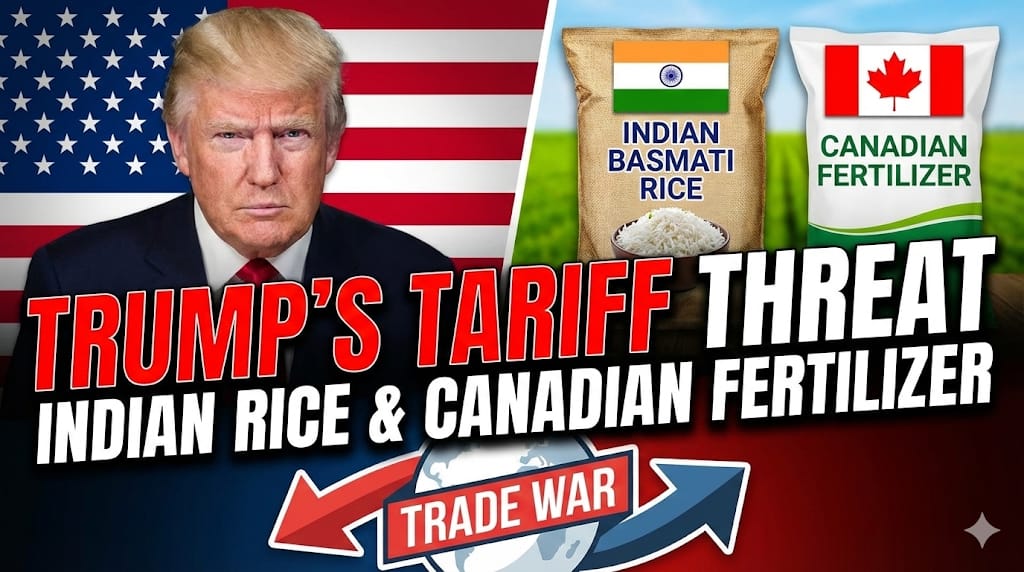
At a White House event meant to reassure US farmers, Trump hinted that he might slap new tariffs on Indian rice, saying he would “take care” of what he called “dumping” of cheap Indian rice into the US market. Is India really dumping rice, or is this more politics than economics? For many US farmers, perception matters more than proof right now.
They say cheap rice from India, Vietnam and Thailand is undercutting their prices, and Trump knows very well that farmers form one of his most loyal political bases, especially with key elections on the horizon.
So what exactly is at stake for farmers on both sides? On one hand, American rice growers argue that they are already dealing with inflation, higher fuel, labor and transport costs, and lingering impacts from earlier trade actions. When Trump says “they shouldn’t be dumping,” he is echoing what farmer groups have been telling his administration for months.
On the other hand, Indian exporters see the US as a premium market where basmati and non-basmati rice have built a strong brand over time. If Washington moves ahead with new tariffs on Indian rice, could it hurt India’s export revenues and damage its image as a reliable supplier? Indian trade officials will now be asking themselves the same question: is this a temporary political threat or the beginning of a new long-term barrier?
The story doesn’t stop with rice. Trump also took aim at Canadian fertilizer imports, hinting at “very severe tariffs” on products that American farmers themselves heavily depend on. Isn’t that a contradiction—trying to help farmers by making their inputs more expensive?
Canada is the largest supplier of potash to the US, and American growers already complain about high fertilizer costs. If tariffs hit Canadian fertilizer, could US farmers end up paying more just to plant the crops Trump claims he wants to protect? The irony is striking: in trying to appear tough on trade, the administration risks pushing up the very costs that are squeezing farm incomes.
Farmers have also struggled with phosphate, another crucial fertilizer sourced mostly from abroad, and both potash and phosphate were recently added to the US critical minerals list. Wasn’t that supposed to assure steady supply and encourage domestic production, not add uncertainty with more tariff threats?
For India, the timing of Trump’s comments could not be worse. New Delhi has been chasing a broader trade deal with Washington, hoping to resolve old disputes and secure better access for its exports. But have those talks led to any real breakthrough?
So far, the answer appears to be no. The US has already hit Indian goods with tariffs of up to 50% over issues ranging from market access to India’s discounted purchases of Russian oil. With a US delegation set to visit India this week, many in Delhi were hoping for at least a partial thaw.
Now the question is different: will rice become the latest flashpoint that derails even modest progress? Indian negotiators must now balance domestic political pressure from farmers and exporters with the need to avoid a full-blown confrontation with Washington.
Canada is also watching closely. This is not the first time Trump has dangled tariff threats over a close partner. In the past, he has floated raising duties on Canadian goods outside the USMCA framework by up to 10%, which in some cases could have pushed total tariff levels to around 45%.
If the US can threaten a neighbor and treaty partner like Canada with such steep hikes, what does that signal to India, which is still fighting for a stable long-term trade arrangement? With both India and Canada trying to protect their market access to the US, Trump’s remarks send a clear message: no partner is safe from sudden tariff shocks when domestic politics and election cycles take over.
The bigger question is this: are these tariff threats really about unfair trade, or are they about winning votes in America’s farm belt? Trump’s political calculus is simple—farmers helped power his rise, and he cannot afford to lose them now. By talking tough on Indian rice and Canadian fertilizer, he gives the impression that he is willing to stand up for “forgotten” producers.
But can such tactics backfire by triggering retaliation, price volatility and supply disruptions that hurt the same farmers he claims to protect? If India responds with countermeasures, or if fertilizer tariffs push costs even higher, US farmers may find themselves caught in the crossfire of a trade war they thought was supposed to save them.
In the end, Trump’s latest comments hint at a future where trade relations with India and Canada remain tense, unpredictable and heavily politicized. For Indian rice exporters, the fear is clear: will their product become the next symbol of “unfair trade” in US political rallies? For American consumers, another question emerges: are they willing to pay more at the grocery store just so tariffs can make a political point?
As Washington, New Delhi and Ottawa all maneuver to protect their interests, one thing is certain: the humble grain of rice and the invisible granule of fertilizer are now firmly at the heart of a much bigger geopolitical and economic story.

