
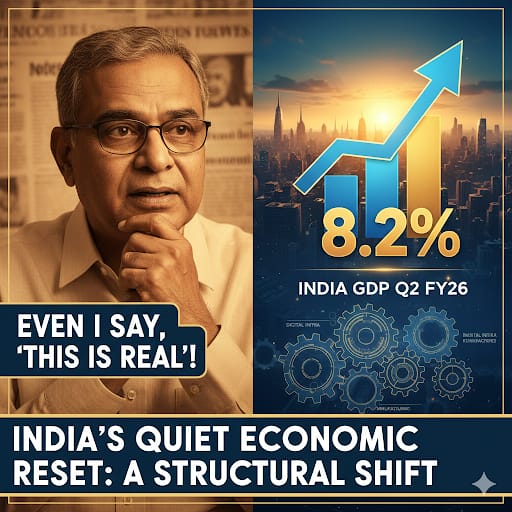
India’s Q2 FY26 GDP growth of 8.2% is the kind of number that normally invites two reactions: Celebration in government corridors and skepticism in op-ed columns. For years, Swaminathan Aiyar has been the patron saint of that skepticism – A veteran economic commentator, associated with hard‑hitting editorials and a long record of calling out what he saw as government over‑claim and institutional erosion.
So when a critic of his vintage begins to concede that recent growth is “too strong, too broad‑based” to be dismissed as a statistical illusion, the question almost writes itself inside the reader’s mind: What exactly has changed that forced even Aiyar to recalibrate his stance?
The macro story itself is by now familiar, but its texture is new. Real GDP in Q2 FY26 has surged 8.2%, taking first‑half growth to around 8%, while estimates from SBI’s Soumya Kanti Ghosh and other economists now peg full‑year FY26 growth near 7.6%, despite expectations of some moderation in the second half.
A year ago, many analysts were whispering about a mild stagflation risk; today, India is running high real growth alongside sharply softened inflation, with several trackers describing price pressures as “almost non‑existent” relative to the recent past.
Is this a lucky streak in a bad global year, or the early proof that incremental reforms have quietly compounded into something bigger than anyone had dared to forecast?
Look below the headline and the usual “base effect” brush‑off starts to feel lazy. Gross value added in the market economy (excluding agriculture and public administration) has risen about 8.5% year‑on‑year, far above the 5.6% pace a year earlier, with industry and services forming an unexpectedly strong core.
Agriculture growing around 3.5% in a period of climatic uncertainty, industry near 7.7%, manufacturing above 9%, and services over 9% – powered in part by double‑digit growth in financial, real estate and professional services – is not the profile of a lopsided, one‑engine recovery.
This is precisely the terrain on which Swaminathan Aiyar’s grudging acceptance becomes so significant. For decades he has framed India’s story as one of private‑sector success and government failure, arguing that reforms were partial, institutions were weakening and governance quality lagged economic ambition.
As recently as 2024, he was still wondering aloud on television how high GDP prints could coexist with weak consumption signals and statistical “mysteries,” capturing the instinctive suspicion that official numbers were flattering reality.
When someone with that long memory of disappointment begins to say, in effect, “These numbers are too consistent, too corroborated by sectoral data and tax collections to be dismissed,” it is less a compliment to the government and more a data‑driven surrender to evidence.
What is the evidence forcing this shift? One part of the answer lies in productivity, not just in higher investment. India’s investment‑to‑GDP ratio has climbed towards the mid‑30s, up from about 30% in 2024, yet growth is running close to or above 8%, implying an improvement in the output delivered per unit of capital compared to the earlier incremental capital‑output norms.
At the same time, tax‑base broadening under GST, rationalization of rates, deepening of digital public infrastructure and the formalization of transactions have combined to push up both revenues and efficiency without the kind of headline‑grabbing “big bang” reform that typically dominates political narratives.
Aiyar has long warned about governments claiming too much from too little reform, but here he is confronted with a stack of small and medium changes — in logistics, taxation, digital governance, public capex and regulatory clarity — that together add up to the kind of structural lift even a critic struggles to wave away.
Another part of the answer is the breadth of the ecosystem now anchoring growth. Over 1,600 global capability centers by multinationals operating not just in back‑office roles but in design, R&D and AI, rising PE–VC inflows, and a triple‑digit unicorn count all point to an economy whose frontier has moved well beyond low‑end services.
Add the opening up of defense production, space and even nuclear‑linked opportunities to private players, and a pattern emerges of new sectors where Indian entrepreneurs and engineers, often trained in multinational hubs, are building globally competitive firms.
For a commentator who once emphasized the “missing middle” of Indian manufacturing and the state’s chronic inability to deliver quality public goods, seeing sustained 9%‑plus manufacturing growth alongside upgraded infrastructure and disciplined fiscal arithmetic must be intellectually disorienting in the best possible sense.
The temptation now is to script a neat conversion story: the critic has conceded, the debate is over, the model is vindicated. That would be too convenient, and Aiyar himself would probably be the first to resist such closure. The trade deficit has widened even if it remains manageable, global risks from tariffs and geopolitical fragmentation are intensifying, and the second half of FY26 is widely expected to see slower growth as world demand softens and public capex normalises.
The more honest reading is that a long‑time sceptic, steeped in three decades of watching reforms underdeliver, now accepts that this particular phase of India’s story shows genuine, broad‑based momentum — and that this very success raises the stakes, because any complacency could quickly confirm his older warnings on institutions and governance.
So the real question after this 8.2% print is not “has Swaminathan Aiyar turned pro‑government,” but “what would it take for someone with his historical scepticism to remain convinced five years from now?” His evolving view hints at the answer: keep the focus on productivity, not just scale; deepen institutional quality instead of taking growth for granted; and treat this phase not as a trophy to brandish, but as a fragile, hard‑won window that can close as quickly as it opened if politics once again outruns economics.
If even the toughest graders of India’s economic performance are adjusting their marks upward, it is less a cue for triumphalism and more an invitation to ask a harder, more uncomfortable follow‑up: can the state, having finally surprised its critics, now avoid the older habit of eventually proving them right?

