
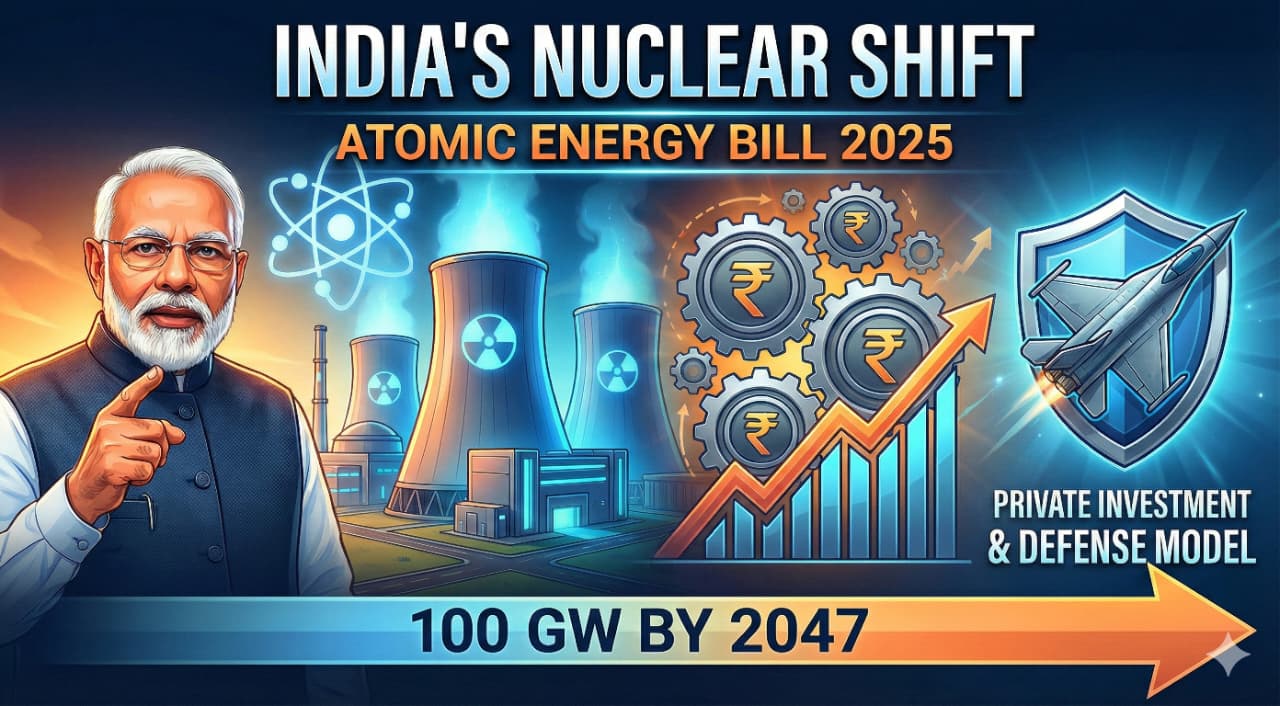
Prime Minister Narendra Modi recently announced a major shift in India’s energy policy by declaring the country’s nuclear power sector will soon open up to private players. This landmark reform, embodied in the forthcoming Atomic Energy Bill, 2025, aims to disrupt decades of state monopoly over nuclear energy and usher in private sector participation to boost India’s energy security and technological leadership. Why does the government consider opening the tightly regulated nuclear sector necessary now? The answer lies in India’s ambitious target to more than tenfold expand its nuclear power capacity to 100 gigawatts by 2047, aligning with its commitment to clean and reliable energy transition.
Presently, nuclear power contributes a modest 8.8 gigawatts from 23 reactors run solely by the state-owned NPCIL. The private sector’s involvement is expected to inject much-needed capital, innovation, and expedited project execution into this strategically vital but capital-intensive field to meet growing power demands and reduce dependence on fossil fuels .
Now the question arises that why has the PM announced the opening of India’s nuclear power sector for private players now? The answer lies in India’s urgent need to strengthen energy security through diversified sources of power generation. Nuclear power, known for providing reliable, large-scale, and low-carbon energy, remains pivotal in India’s roadmap towards sustainable growth and reducing dependence on fossil fuels.
Currently, the nuclear sector operates under a government monopoly through NPCIL with only 8.8 GW installed capacity, far short of the ambitious target of 100 GW by 2047. To bridge this enormous capacity gap, the government recognizes that private sector participation is essential to mobilize the required investment, innovation, and efficiency.
The private sector can accelerate deployment of new technologies like small modular reactors and advanced nuclear innovations, enhancing India’s technological leadership and energy security. Thus, the Prime Minister’s statement and the upcoming Atomic Energy Bill, 2025, represent a strategic policy shift to unlock private capital and expertise for a more robust nuclear energy future in India .
Why is this shift important, and what role does private investment play in the nuclear power sector? Nuclear projects are highly capital intensive, involve complex safety and regulatory challenges, and have typically been a government domain due to national security and liability concerns. Private firms have hesitated due to the risk of liability for accidents and restrictions on foreign investment.
However, the government’s plan to amend liability laws and potentially allow private firms to mine, import, and process uranium aims to create a comprehensive ecosystem conducive to private sector involvement. With India’s domestic uranium reserves enough to fuel 10,000 MW for 30 years but covering only 25% of future demand, private participation can enhance fuel processing capacity and secure international supply chains. Opening the sector to private companies will bring in much-needed investment for research, development, and faster project execution.
Clear regulatory frameworks and risk-sharing mechanisms will make nuclear projects financially viable, attracting major industrial players. Essentially, private investment is critical for achieving India’s clean energy targets and energy independence in a time of global energy volatility and climate concerns.
How does this emerging nuclear sector reform compare with private sector participation in India’s defense manufacturing over the past eight years? The transformation in defense manufacturing offers a compelling precedent. Since 2014, the government has actively promoted private sector involvement with new policies, licensing reforms, and investment incentives under the ‘Atmanirbhar Bharat’ initiative.
This has helped increase the private sector’s contribution in defense production from minimal levels to around 22-23%, boosting both capacity and innovation. Notably, defense exports surged over 30 times from a few hundred crores to ₹23,622 crore in 2024-25, reflecting growing global demand and private industry competitiveness.
This successful inclusion of private companies in a security-sensitive domain demonstrates how strategic sectors can benefit from market-driven efficiencies, innovation, and global integration without compromising national priorities.
The nuclear sector, similarly vital for energy security, can leverage the private sector to enhance scale, innovation, and international collaboration while maintaining strict regulatory oversight. India’s defense manufacturing story shows how private participation can drive self-reliance and global competitiveness, lessons that the nuclear sector opening aims to replicate.
What are the main hurdles delaying private entry into nuclear power, and how can they be overcome? The nuclear sector’s highly technical nature, safety and liability risks, and ambiguity around ownership and commercial terms have created uncertainty among bidders.
For instance, NPCIL’s 2024 tender for small modular reactors faced multiple delays due to unanswered queries from major firms regarding costs, charges, and operational responsibilities, pushing bid deadlines from early 2025 to as late as March 2026. To overcome these obstacles, the government must provide clear regulatory guidelines, reduce liability risks through legal reforms, and enable transparent, fair commercial frameworks.
Harmonizing these factors with strong oversight will make projects more attractive and financially viable for private players. Moreover, enabling private access to the entire nuclear fuel cycle—from uranium mining to processing and reactor operation—will allow integrated business models and economies of scale. The government’s willingness to amend existing laws and open uranium mining to private firms signals its intent to remove these barriers and create a thriving private nuclear sector.
Will the government successfully open the nuclear sector to private players soon? With the Atomic Energy Bill, 2025 listed for Parliament’s winter session, there is a strong political will to formalize private sector participation legally. The bill is designed to create a regulatory framework that balances national security, safety, and commercial interests. Lessons from space and defense reforms suggest that targeted policy changes can attract private capital and technology partnerships, fueling rapid capacity expansion.
Additionally, considering allowing up to 49% foreign investment in nuclear plants could bring advanced technologies and global best practices. While challenges remain, the government’s comprehensive approach—including liability amendments, fuel cycle liberalization, and tender clearances—indicates a clear trajectory toward opening the sector. If well executed, this reform will enhance India’s energy security, reduce carbon footprint, and position the country as a leader in nuclear innovation by 2047.
In conclusion, Prime Minister Modi’s announcement to open India’s nuclear power sector to private players is more than a policy change; it is a strategic imperative for India’s energy future. Private investment will be indispensable for scaling up nuclear capacity, fostering innovation, and securing reliable, clean power as India moves towards its climate and energy security goals. India’s success in ramping up private sector defense production and exports offers an encouraging model of how private participation in strategically critical sectors can drive growth and global leadership.
By addressing regulatory, liability, and operational challenges through the Atomic Energy Bill and allied reforms, the government aims to build a vibrant nuclear sector ready to meet India’s growing energy demands sustainably and securely. This bold transition could transform India’s energy landscape, making nuclear power a cornerstone of its alternative and secure energy path.

