From GST 2.0 to the SHANTI Act, tax, labour, nuclear and education reforms aim to make 2025 a year of “continuous reforms”.
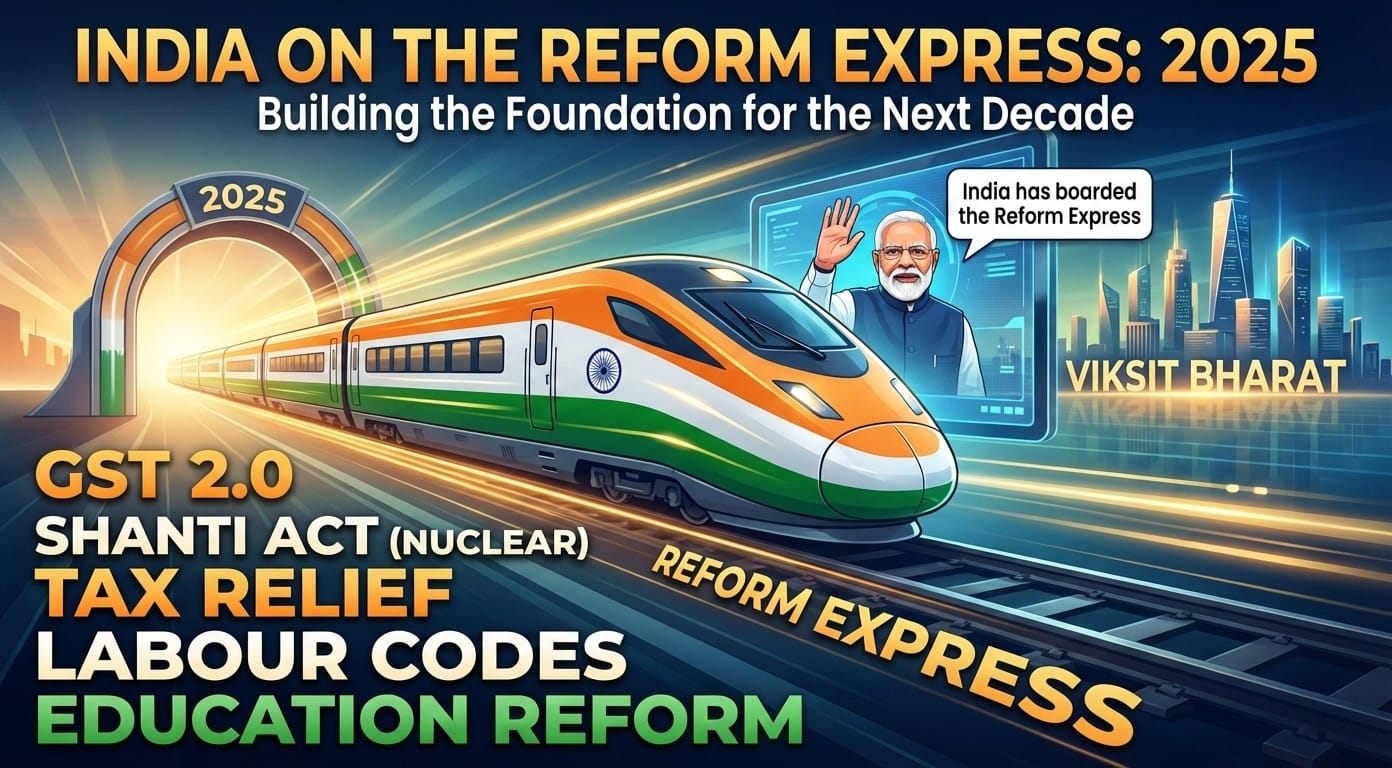
When India’s Prime Minister says that “India has boarded the Reform Express”, the policies of 2025 clearly support this claim with data and concrete actions. This year is not just a list of scattered reforms. It represents a continuous mission, where every sector—from tax to trade, from nuclear energy to education—has received the same message: India now believes more in cooperation than control, and more in facilitation than obstacles. The real meaning of the Prime Minister’s statement is that reforms are no longer episodic; they are continuous. The goal is not just growth, but building the long-term foundation of a Viksit Bharat.
Starting with taxation, GST received its biggest overhaul since 2017 in 2025. The earlier multi-slab structure was simplified into two main slabs—5% and 18%—covering almost the entire economy, while a 40% special slab was kept for luxury and sin goods. According to analyses by ClearTax and other tax platforms, nearly 99% of items earlier taxed at 12% and about 90% of items in the 28% slab were shifted to lower rates.
This reduced the tax burden on daily essentials, agricultural equipment, healthcare products and some consumer goods, helping support consumption. What the Prime Minister describes in political language as a boost to festive demand and consumer sentiment is, in technical terms, tax rate rationalisation—meant to reduce disputes, simplify compliance and support demand.
Similarly, on direct taxes, the 2025 Budget brought both psychological and real relief for the middle class. Under the new tax regime, annual income up to ₹12 lakh now has zero effective tax liability. For salaried individuals, with the standard deduction, income up to ₹12.75 lakh is practically tax-free. Reports from Mint, The Hindu and The Economic Times show that under the new slabs, income up to ₹4 lakh is taxed at 0%, ₹4–8 lakh at 5%, ₹8–12 lakh at 10%, and higher incomes face progressive rates.
As a result, a taxpayer earning ₹12 lakh can save their entire earlier tax liability, gaining nearly ₹80,000 in disposable income. When the Prime Minister calls this “unparalleled relief for the middle class,” he is also pointing toward the replacement of the old 1961 Income Tax Act with a new, digital and simplified Income Tax Act, 2025, focused on trust-based, technology-driven compliance rather than fear and punishment.
The repeated emphasis on “ease of doing business” and “reducing compliance burden” is closely linked to making life easier for small and medium enterprises. By increasing the turnover limit for small companies to ₹100 crore, thousands of firms will face lower legal and compliance costs. This can speed up formalisation and growth, strengthening the jobs and investment cycle that the government connects to its broader growth story.
Alongside this, the large-scale review and withdrawal or suspension of Quality Control Orders (QCOs) shows that the government is not just adding regulations but also removing unnecessary ones to reduce costs, friction and delays. This is especially important for sectors like textiles, footwear and auto components, helping them compete better in global export markets.
Labour reforms are another key part of the Prime Minister’s narrative. By merging 29 separate labour laws into 4 modern labour codes, the government has created a new framework covering minimum wages, timely payment, industrial relations, social security and workplace safety.
The government claims these reforms bring contract and unorganised workers under ESIC and EPFO, allow flexible working norms and night shifts to increase women’s workforce participation, and simplify dispute resolution. The aim is to balance worker security with business flexibility. When Modi says these reforms are about “dignity” and “clarity and trust,” he is presenting labour not just as a cost, but as a partner in growth.
In energy and strategic sectors, the SHANTI Act 2025 has been highlighted as a key reform linked to India’s clean energy and AI-driven growth vision up to 2047. The Sustainable Harnessing and Advancement of Nuclear Energy for Transforming India (SHANTI) Act replaces the 1962 Atomic Energy Act and the 2010 Civil Liability for Nuclear Damage law with a unified framework.
For the first time, it allows private and foreign players to build, own and operate nuclear power plants, while keeping state control over strategically sensitive activities. According to reports by The New Indian Express, The Indian Express and World Nuclear News, the law introduces a graded liability framework, gives statutory powers to the nuclear regulator AERB, supports new technologies like small modular reactors, and sets a target of 100 GW nuclear capacity by 2047.
This is meant to support the clean, reliable power needs of data centres, AI computing, green hydrogen and high-tech manufacturing. The Prime Minister’s references to energy demand in the AI era and the role of youth in frontier technologies are directly linked to these provisions.
Through maritime and blue economy reforms, a new Securities Market Code, 100% FDI in insurance, a new education regulator called Viksit Bharat Shiksha Adhishthan, and Jan Vishwas–style decriminalisation, a larger picture emerges. India is moving away from a control-heavy, inspector-raj style economy toward a trust-based, competition-driven and investor-friendly framework.
When the Prime Minister speaks of “collaboration over control” and “facilitation over regulation” as guiding principles, he is positioning the government as an enabler and referee, not a monopoly player in every sector. This is why trade deals with New Zealand, Oman, the UK and EFTA countries are linked on the same canvas as domestic reforms in GST, tax, labour and nuclear energy. The message is clear: India wants to be simplified internally and open, confident and competitive globally.
Finally, the Prime Minister’s emotional appeal—“keep trusting India and investing in our people”—is not just for investors, but for ordinary citizens as well. The metaphor of the Reform Express shows that the journey which began in 2014 has entered a new phase by 2025. Tax relief, balanced labour reforms, bold opening of the energy sector, and governance reforms based on decriminalisation and simplification together create a strong narrative: Viksit Bharat is not a distant slogan, but the result of year-by-year institutional and policy reforms. Data and laws together suggest that 2025 will be remembered as a “Year of Reforms”—a turning point where policy direction was clear, execution was fast, and the message unmistakable: India has boarded the train of change, and there is no intention of switching tracks.