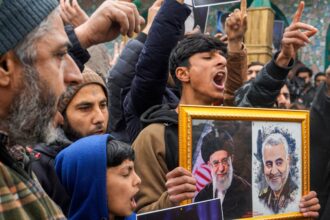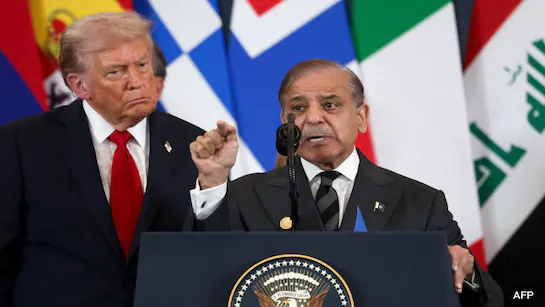
The recent decision by Pakistan to formally align itself with the United States through President Trump’s Gaza Board of Peace is not merely a diplomatic pivot but a theological earthquake that threatens to fracture the very soul of Pakistan. By integrating itself into a security architecture that implicitly necessitates cooperation with Israeli interests, the Pakistan Army has committed an act of spiritual treason against the very constituency it spent decades cultivating. For the radicalised masses who have been fed a steady diet of end times prophecies, this move is not seen as geopolitical pragmatism but as an open alliance with the forces of the Dajjal (the Antichrist). The military establishment, whose motto remains Iman, Taqwa, Jihad fi Sabilillah, meaning Faith, Piety and Jihad in the path of Allah, has effectively handed its domestic detractors the ultimate weapon by positioning itself on the side of those whom Islamic eschatology identifies as the primary antagonists of the final days. This widening chasm between the state’s foreign policy and its religious obligations creates a volatile internal pressure that can only be relieved by redirecting the fury of the faithful toward a sanctioned enemy.
The most damning evidence of this double game is not found in the sanitised press releases of the Foreign Office but in the shadow world of the Deep State’s assets. It was only recently that the headquarters of Lashkar e Taiba and Jaish e Mohammed in Pakistan Occupied Kashmir played host to a delegation of Hamas militants. This meeting was not a clandestine gathering of rogue elements but a state sanctioned summit between the proxies of the Pakistan Army and the very group the Gaza Board of Peace is ostensibly meant to manage. The presence of Hamas on Pakistani soil, hosted by the Deep State’s favourite sons, lays bare the lie at the heart of Pakistan’s new diplomatic status. The generals are shaking hands with American diplomats in the daylight while their intelligence assets are coordinating with designated terrorists in the dark. This calculated schizophrenia allows the state to project an image of moderation to the West while simultaneously assuring its jihadist base that the war against the infidel continues unabated.
It is within this context of theological betrayal and compensatory aggression that one must interpret the recent rhetoric emerging from Pakistani deep state’s proxies. When the legitimacy of the military establishment crumbles at home, it invariably seeks to recover its Islamic credentials by reigniting the holy war on its eastern border. The logic is structural and ruthless; the only way to prove that the army has not become a mercenary for the West is to launch a fresh offensive against the perceived enemies of the faith in the East. The recent proclamation by Saifullah Kasuri, in which he christened Pakistan as the Prince of Skies in 2025 and prophesied its rise as the Prince of Seas in the coming year, is not a statement of naval doctrine but a desperate attempt to reclaim the narrative of jihad. It acts as a prelude to terror, a rhetorical bugle sounded to drown out the accusations of apostasy coming from the street.
Kasuri’s rant regarding the seas is not a cartographic coordinate but a declaration of intent to continue the jihad in India through a new and possibly more devastating vector. However, one must not view Kasuri’s metaphors in isolation; they are the jagged edge of a much larger state policy that was recently laid bare by Defence Minister Khawaja Asif. In a revealing interview with Geo News, when asked directly to reconcile the contradiction between the new partnership on Gaza and the state’s posture towards India, Asif did not offer a vision of regional stability. Instead, he seized the moment to reassure his base, explicitly declaring that Pakistan’s engagement on the Kashmir issue would not merely continue but would “intensify” in the coming months.
This choice of word, intensify, is not accidental. It is a dog whistle to the establishment’s jihadist assets that the peace deal in Gaza will be paid for by a war in Kashmir. Asif’s statement confirms that the ‘Prince of Seas’ rhetoric is not the ramblings of a rogue cleric but a sanctioned narrative component of the state’s bigger game plan. The reference to the skies was a retrospective glorification of the standoff that followed the Pahalgam attack, a period where the Pakistani state claimed a moral and perceptual victory to satiate its base. The shift to the seas, endorsed by the Defence Minister’s promise of intensification, is a signal that the terror infrastructure has been primed for a strike that will once again draw the two nations into a crisis. It serves as a warning that the machinery of asymmetric warfare has not been dismantled by the diplomatic handshakes in Washington but has merely been hidden beneath the surface, waiting for the order to surface and strike. Just as General Asim Munir’s aggressive posturing regarding the partition and Hindu identity served as the atmospheric prelude to the Pahalgam tragedy, Kasuri’s metaphor of the seas, backed by Asif’s pledge of intensification, is the thunder that warns of the approaching storm.
This strategy reveals a stunning level of geopolitical cunning that aims to score two bullseyes with a single arrow. The first target is the financial solvency of a bankrupt state. By joining the Gaza Board of Peace, Pakistan secures the goodwill of the United States and the international financial institutions it controls, ensuring the continued flow of IMF bailouts and aid packages that are essential to keep the economy from collapsing. The second and perhaps the more dangerous target is the acquisition of a diplomatic shield that grants a veneer of legitimacy to their acts of terror. By embedding itself in the Trump administration’s signature peace initiative, Pakistan effectively purchases a legitimate backing from the US. The Deep State calculates that if it launches a terror campaign against India now, Washington will be paralysed by the fear that an Indian retaliation would destabilise a key partner in the Middle East peace process. Pakistan is banking on the fact that its new status as a peacemaker gives it the license to be a warmonger, using the American flag to drape over its jihadist ambitions so that its acts of terror have a legitimacy they would otherwise lack.
The turbulence generated by this decision will likely make the Pakistani military even more reliant on its extremist proxies to maintain order. In a society where the narrative of Ghazwa-e-Hind holds more sway than the constitution, the army cannot afford to be seen as abandoning the fight against the infidel. Therefore, the very aid and legitimacy that flows from the Gaza Board of Peace will be diverted to reinforce the networks of terror that provide the state with its ideological alibi. The Deep State is riding a tiger of its own making and to avoid being devoured by the monster of extremism, it must constantly feed it with new wars.
It is a profound irony that the United States continues to place its trust in a military establishment that has institutionalised betrayal as a tool of statecraft. The US is repeating the catastrophic error of the War on Terror, where for twenty years Pakistan accepted billions in Coalition Support Funds to fight the Taliban while simultaneously sheltering its leadership in Quetta. The Deep State mastered the art of the double game in the Hindu Kush, selling the Americans a narrative of alliance while arming their enemies and now the will apply that same treacherous template to the Middle East. The assumption that the Pakistan Army can be a partner in stabilising Gaza while it actively nurtures the very ideology of radicalism at home is a contradiction that Western policymakers seem unwilling to confront. The extremist elements within Pakistan are not merely rogue actors but are often the product of a state narrative that has for decades prioritised religious militancy over civic nationalism. The Pakistani Deep State cannot simply switch off this machinery because it signed a deal in Washington. On the contrary, the pressure to prove its Islamic credentials to a skeptical domestic audience will likely force the army to rely even more heavily on its jihadist assets. The terror groups that operate under the state’s umbrella are the only constituency that remains ideologically aligned with the army’s vision of perpetual conflict. Therefore, the aid and legitimacy flowing from the Gaza Board of Peace will likely be diverted to reinforce the very networks that threaten peace in South Asia.
For India, it must view the coming months with a profound sense of caution. The threat is not just a matter of border infiltration but of understanding the existential panic of a neighbour that has sold its soul to survive. The rant about the seas is not a claim of naval strength but a scream of desperation from a regime that knows it is losing the battle for the hearts and minds of its own people. The danger lies in the fact that a weak and compromised Pakistan is far more likely to lash out than a confident one. The prelude to terror has been spoken and the Deep State is now waiting for the moment to turn its rhetoric into reality, hoping that the flames of a new terror campaign will burn bright enough to blind its people to the betrayal that has taken place in the corridors of power. The warning has been delivered not in the movement of ships but in the metaphors of a warlord and India must be ready for the inevitable violence that such language always foretells. The world too must wake up to the reality that the arsonist has once again been hired as the firefighter and the cost of this delusion will be paid in blood on the streets of the subcontinent.
Note: Above article is written by Ajmal Shah, an advocate practicing at the High Court of Jammu & Kashmir and Ladakh in Srinagar.