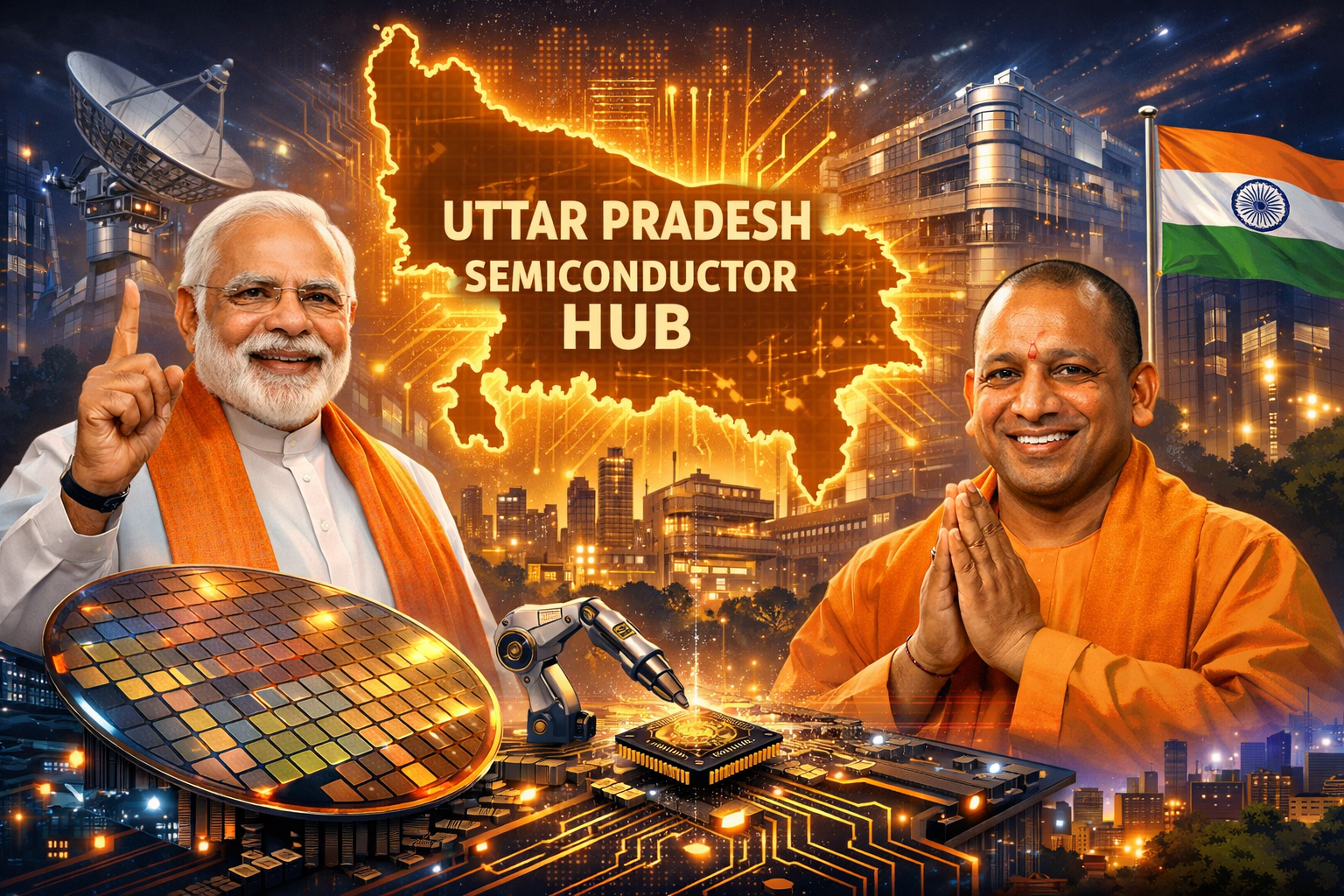
Prime Minister Narendra Modi is set to lay the foundation stone for North India’s first semiconductor manufacturing plant in Gautam Buddh Nagar in Uttar Pradesh. This landmark project signals not merely the arrival of a high-technology unit, but the consolidation of a new economic identity for Uttar Pradesh.
For a state once burdened by the ‘BIMARU’ tag and associated with stagnation, the emergence of semiconductor manufacturing represents a structural transformation of historic proportions.
Semiconductors are the backbone of modern industry. From smartphones and automobiles to defence equipment and medical devices, chips power the digital age. Hosting such a facility is not simply about industrial diversification; it is about embedding Uttar Pradesh into global value chains that define 21st-century growth.
From ‘BIMARU’ to beacon of progress
For decades, Uttar Pradesh struggled with persistent challenges, limited industrialisation, weak infrastructure, law-and-order concerns, and insufficient private investment. The perception of the state often revolved around missed opportunities rather than emerging potential. However, the past several years have witnessed a marked departure from this narrative.
Under the leadership of Chief Minister Yogi Adityanath and in close coordination with the Union Government, the state has prioritised structural reforms, infrastructure expansion, and investor facilitation. This shift has altered both perception and performance indicators. Industrial corridors have expanded, expressways have multiplied, and investment summits have translated into tangible projects.
The semiconductor plant is a natural culmination of these efforts rather than an isolated achievement.
The Noida-Greater Noida advantage
The Noida-Greater Noida belt has evolved into one of India’s most significant electronics manufacturing clusters. Over the past decade, it has attracted major mobile phone manufacturers, consumer electronics producers, and component suppliers. This existing ecosystem creates a ready-made supply chain, an essential prerequisite for semiconductor operations.
The region benefits from proximity to the National Capital Region (NCR), ensuring access to markets, institutions, and logistics hubs. The upcoming Jewar International Airport further enhances global connectivity, while extensive expressway networks, including the Yamuna Expressway, strengthen multimodal transport capabilities.
Reliable 24×7 power supply and improving urban infrastructure add to industrial viability. Semiconductor manufacturing is energy-intensive and precision-driven; therefore, infrastructure reliability is non-negotiable. Uttar Pradesh’s preparedness in this regard has significantly improved.
Policy stability and competitive incentives
The Electronics and Semiconductors Policy 2024 underscores the state’s intent to become a preferred destination for high-technology investments. The policy offers up to 50 percent capital subsidy, 75 percent land cost reimbursement, and 100 percent exemption on stamp duty. These measures enhance cost competitiveness relative to other states and international destinations.
Such incentives are not merely financial concessions; they represent policy predictability. Investors in semiconductor manufacturing require long-term stability because projects involve significant capital expenditure and extended gestation periods. The consistency of state-level reforms, aligned with the Union Government’s semiconductor mission, has provided that assurance.
Additionally, streamlined land allocation processes, single-window clearances, and digital governance mechanisms have reduced bureaucratic friction. The objective has been clear: make Uttar Pradesh not just an option, but a preferred choice.
Strategic investment and job creation
The semiconductor initiative has attracted major corporate participation, including firms such as Vama Sundari Investment and Keynes Com Private Limited. These investments aim to generate thousands of direct and indirect high-skilled jobs.
Beyond employment, the economic ripple effects are substantial. Semiconductor manufacturing stimulates ancillary industries, testing units, packaging services, logistics firms, and research centres. Educational institutions are likely to align curricula with emerging skill requirements, creating a virtuous cycle between academia and industry.
Moreover, domestic chip production reduces India’s dependency on imports, strengthening economic resilience. For Uttar Pradesh, this translates into participation in a strategic national priority while building a diversified industrial base.
Centre – State synergy
The semiconductor project is the outcome of sustained coordination between the Union and State governments. Semiconductor ecosystems require alignment across multiple domains, policy, land acquisition, environmental clearances, power supply, logistics, and financial incentives.
The collaborative approach ensured that regulatory bottlenecks were addressed proactively. It also reflects a broader development template where state-level initiatives complement national strategic objectives.
Prime Minister Narendra Modi’s decision to lay the foundation stone underscores the national significance of the project. It signals confidence in Uttar Pradesh’s governance framework and its readiness to host advanced manufacturing.
Infrastructure as the growth multiplier
The semiconductor plant aligns with a broader infrastructure-led development strategy. Expressways such as the Purvanchal and Bundelkhand corridors have reduced travel time and logistics costs. The Defence Industrial Corridor positions the state as a hub for strategic manufacturing.
Urban clusters like Noida are expanding as IT and digital service centres. Together, these developments create an integrated industrial environment rather than isolated growth pockets. Semiconductor manufacturing complements this ecosystem, enhancing technological depth and diversification.
Youth opportunity and skill transformation
Uttar Pradesh has one of India’s youngest populations. Converting demographic advantage into economic strength requires high-value employment avenues. Semiconductor manufacturing is knowledge-intensive and offers opportunities in design, fabrication, testing, and quality assurance.
This project can catalyse skill development programmes, technical training centres, and industry-academia partnerships. It also signals to young aspirants that advanced career opportunities need not be confined to traditional technology hubs.
By embedding high-technology industries within the state, policymakers aim to reduce migration pressures and foster localised prosperity.
A Journey worth recognising
The transformation from a state once labelled among India’s underperforming regions to a contender in semiconductor manufacturing illustrates deliberate governance. Law-and-order reforms, infrastructure expansion, policy incentives, and sustained engagement with investors have converged to produce tangible outcomes.
The semiconductor plant represents more than an industrial facility; it is symbolic of a broader shift in ambition and execution. Uttar Pradesh is no longer defined by outdated stereotypes. Instead, it is positioning itself as a participant in India’s high-technology future.
From mafia narratives to microchips, the state’s trajectory reflects continuity of reform and commitment to industrial resurgence. The foundation stone in Gautam Buddh Nagar is thus not merely a ceremonial milestone, it is a marker of sustained momentum.
As the semiconductor unit takes shape, it will stand as evidence that structural transformation is achievable when governance, policy clarity, and infrastructure converge. Uttar Pradesh’s journey demonstrates that long-held perceptions can be rewritten through consistent reform and strategic vision.
Authors- Maitreyaei Upadhyay(@MaitreyaeiU) is a Public Policy Consultant, specializing in policy debates, issue briefs and narrative tracking and research. Kritant Mishra is a Public Policy Consultant and head of an NGO (Anurudra Seva Foundation). He is interested in Socio-Anthropology, Economy, and Digital Health.