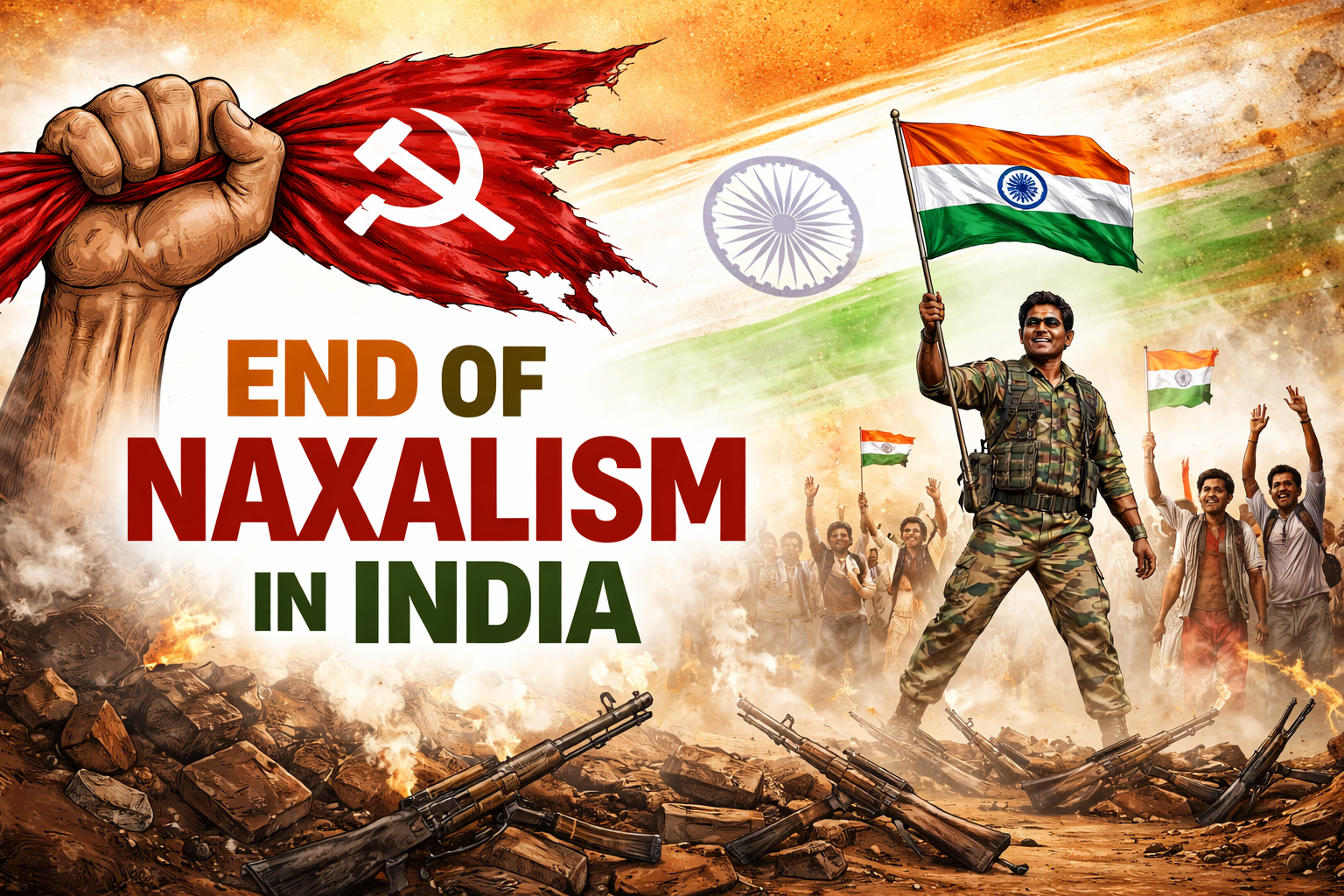
For decades, the “Red Corridor” was a jagged scar across the heart of India. From the Pashupati to Tirupati, a sickle-shaped arc of insurgency stalled the wheels of progress, fueled by a Maoist ideology that viewed the ballot box as an enemy and the schoolhouse as a target. At its peak in the early 2000s, nearly a quarter of India’s districts were under the shadow of the gun, and over 15,000 lives had been lost to a conflict that seemed perennial.
Fast forward to early 2026, and the narrative has shifted from one of “no-go zones” to one of “no more Naxals.” As the Union Government’s March 31, 2026, deadline to eradicate Naxalism approaches, the synergy of the “Double-Engine Sarkar”—the coordinated thrust of Central and State leadership—has achieved what many thought impossible: the reclaiming of the tribal soul through a blend of kinetic precision and cultural revival.
The Melody of Magadh: Ramjit Kumar’s quiet revolution
In the volatile Magadh region of Bihar, particularly the Gaya-Aurangabad border, the 1980s and 90s were defined by the terror of the MCC and other splinter groups. Here, “revolutionary taxes” were the only currency, and children were often conscripted as foot soldiers before they could read. Enrollment in villages like Semarwar and Ranka languished at a dismal 15%.
Enter Ramjit Kumar, a 42-year-old school teacher armed not with a weapon, but with a beat-up harmonium. Recognizing that fear had paralyzed the community, Kumar began a ritual in 2021 that would eventually become the “Harmonium Revolution.” Every morning at 5:30 am, the strains of Raghupati Raghav Raja Ram and Bhojpuri lullabies would drift through the crossroads.
“At first, I would get 20 children,” Kumar recalls. “Then 50. Now, across five school clusters, I have 450 children.” His efforts, recognized with the PM Rashtriya Shikshak Puraskar in 2025, have done more than just teach ABCs; they have sanitized the psychological landscape. When the harmonium plays, the “ghosts” of the insurgency retreat.
This grassroots success is bolstered by the structural backbone of the Samagra Shiksha Abhiyan. With an allocation of ₹2,500 crores, the Bihar government has transformed the former “Red Zone” with 500 smart classrooms and digital laboratories. The results are empirical: female literacy in Gaya has jumped by 18%, while Naxal recruitment has plummeted by 65%.
Dantewada: From ambush to anthem
Twelve hundred kilometers south, the Karregutta Hills of Chhattisgarh once stood as a grim monument to Maoist power. In 2010, this was the site of the deadliest ambush in CRPF history, claiming 76 brave hearts. For years, Karregutta was the “Epitome of Power” for the Maoist high command.
On Republic Day 2026, that monument was dismantled. For the first time in seven decades, the Tricolour was hoisted atop the hills in the presence of Chief Minister Vishnu Deo Sai and 2,500 local tribals. The transformation is part of Project Ground Zero, an initiative that has replaced hidden IEDs with solar grids, drone surveillance, and a 100-bed hospital.
“This flag signifies that our will is not made of cloth,” CM Sai remarked. For the Gond tribals like Maria Mandavi, the change is visceral. Her brother, once a mid-level Naxal cadre, surrendered in 2024. Today, her children attend school within the security campus. The roads that once facilitated ambushes now connect tribal produce to the markets of Jagdalpur.
The mechanics of the ‘Double-Engine’ strategy
The collapse of the Naxal movement is not an accident of history; it is a masterclass in integrated governance. Security analysts, including Ajai Sahni, note that the current approach has collapsed the “lifespan” of the insurgency by combining functions that were previously siloed.
The strategy rests on three pillars
- Kinetic Supremacy: The deployment of 450 special battalions, NSG anti-Naxal units, and high-tech assets like Israeli Hermes-900 UAVs has allowed security forces to dominate 92% of the former red corridors. Operation Octopus in Bihar and Operation Kagar in Chhattisgarh have neutralized hundreds of cadres and sanitized thousands of square kilometers.
- The Digital Panopticon: Using NATGRID’s AI-based situational awareness, the state has effectively choked the logistical and financial lifelines of the insurgents. Urban Naxal networks, the intellectual oxygen of the movement, are being dismantled via the UAPA and sophisticated cyber-monitoring.
- The Rehabilitation Carrot: In 2025 alone, 1,900 Naxals surrendered, incentivized by ₹10 lakh rehabilitation packages.
Development as a weapon
As Prime Minister Modi declared during his 2024 Bastar Rally, “Development is the new weapon of choice.” The infrastructure numbers are staggering:
- 15,000 km of blacktopped roads under the Pradhan Mantri Gram Sadak Yojana.
- 7,000 Eklavya Model Schools providing quality education to tribal youth.
- 5G Connectivity reaching 90% of aspirational blocks, ending the digital isolation that Maoists exploited.
Furthermore, the Van Dhan Yojana has empowered 50,000 Self-Help Groups (SHGs). In Karregutta, women-led cooperatives are now generating ₹50 lakh annually from leaf production—turning former “insurgency support bases” into thriving economic hubs.
A new dawn for Bharat
The most poignant testament to this victory comes from Pintu Manjhi. At 22, he is a mathematics instructor in Gaya. Only a few years ago, he was a child soldier for the Maoists.
“When we carried guns, they promised us a revolution,” he says. “Now with schools, we have achieved the revolution.”
As 2026 unfolds, the vision of a “violence-free India from Kashmir to Kanyakumari” is no longer a rhetorical flourish; it is an emerging reality. The Naxalites, once a formidable threat to the Indian state, have been reduced to “nothing more than ghosts.”
The legacy of this era will be defined by the image of a teacher with a harmonium and a tribal mother watching her children learn in the light of a solar-powered classroom. The guns have been silenced, not just by superior firepower, but by the overwhelming roar of progress.
Jai Hind.
Anirban Dutta is a Political Consultant and International Relations Expert, and tweets at @Anirban47576609