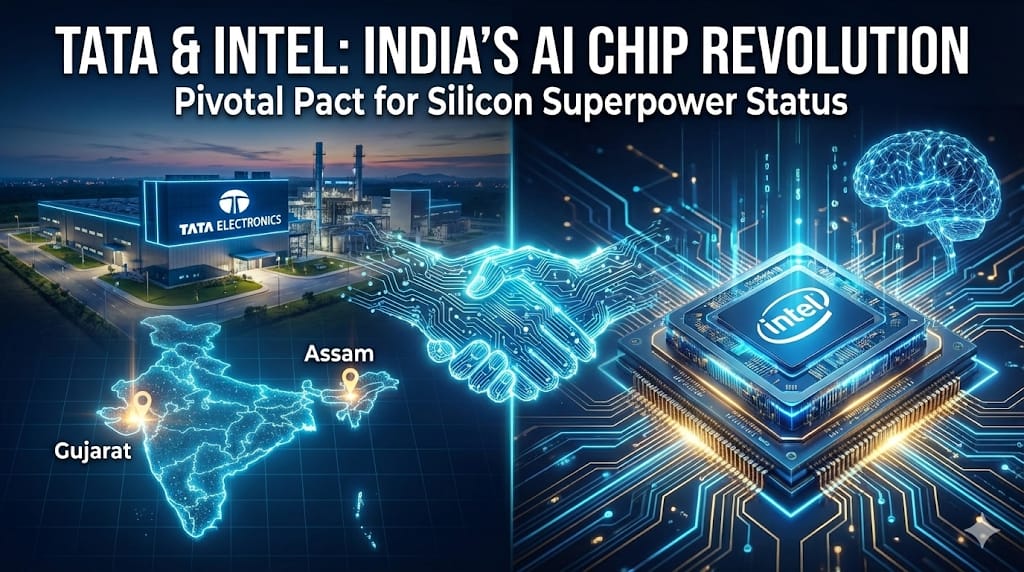
India’s semiconductor dream just found a powerful accelerator. In a move that could reshape the country’s position in the global technology supply chain, Tata Electronics has signed Intel as the first major prospective customer for its upcoming semiconductor facilities in India.
The agreement is not just about supplying chips; it is about co-creating an ecosystem where India moves from being a passive consumer of high-end technology to an active, influential manufacturer in the age of AI. For a country racing to reduce dependence on imported electronics and establish itself as a silicon powerhouse, this collaboration signals a decisive step forward.
At the heart of this deal lies Tata Group’s ambitious investment of around $14 billion in two critical semiconductor units. One is a fabrication plant, or “fab,” being set up in Gujarat, the state that has rapidly emerged as India’s electronics and manufacturing magnet. The other is an advanced assembly, testing, and packaging facility in Assam, promising to take high-value tech manufacturing deeper into India’s northeast.
Together, these facilities aim to give India end‑to‑end capabilities, from wafer fabrication to finished chips ready for deployment in everything from laptops and data centers to AI edge devices.
The memorandum of understanding between Tata and Intel goes beyond a simple supply contract. According to the joint statement, Intel and Tata intend to explore manufacturing and packaging of Intel products for local markets at Tata Electronics’ upcoming fab and OSAT (Outsourced Semiconductor Assembly and Test) facilities.
In parallel, the two giants will collaborate on advanced packaging technologies in India, an area that is becoming just as critical as chip design itself. As transistors shrink and AI workloads explode, the way chips are stacked, linked, cooled, and integrated can dramatically change performance, power efficiency, and cost. By anchoring advanced packaging capabilities on Indian soil, this partnership could give the country a rare strategic edge.
But the story does not stop at hardware. Intel and Tata also plan to rapidly scale tailored AI PC solutions for both consumer and enterprise markets in India. With India projected to become a global top five PC market by 2030, the timing could not be more critical. The age of the “AI PC” — computers with built‑in AI accelerators capable of running intelligent workloads locally — is beginning. From personalized productivity and content creation to on‑device language models and enterprise AI applications, the PC experience is being rewritten.
Tata brings deep Electronics Manufacturing Services (EMS) capabilities and unmatched access to the Indian market through the wider Tata Group, while Intel brings its AI compute reference designs and silicon expertise. Together, they are positioning themselves to ride the next big upgrade cycle in Indian computing.
Lip‑Bu Tan, CEO of Intel Corporation, encapsulated the strategic significance by calling India “one of the world’s fastest‑growing compute markets,” fuelled by surging PC demand and rapid AI adoption. This is more than a compliment; it is an acknowledgment that India is no longer just a volume market but a frontier for advanced compute deployment.
From startups building AI tools in Bengaluru and Gurgaon to government platforms digitizing services at scale, the appetite for AI compute is rising. For Intel, embedding itself into India’s manufacturing and AI infrastructure through Tata could be a way to future‑proof its position in a critical market.
On Tata’s side, Randhir Thakur, CEO and managing director of Tata Electronics, framed the MoU as a perfect fit with the company’s roadmap across EMS, OSAT, and semiconductor fab. The message is clear: Tata does not just want to assemble devices; it wants to stand on the frontlines of the global semiconductor race.
By aligning with Intel, one of the world’s most influential chip players, Tata aims to create a supply chain that is reliable, resilient, and rooted in India. The partnership promises cost competitiveness, faster time‑to‑market, and greater operational agility — exactly what is needed for Intel products to tap into the explosive demand for next‑generation AI compute in India.
Zooming out, the Tata‑Intel pact reads like a chapter from a much larger story: India’s long‑awaited rise in the semiconductor value chain. For years, the country’s tech strength was defined by software and services, while the silicon that powered its digital revolution was imported.
Now, with strategic investments, global tie‑ups, and a clear focus on AI‑era hardware, India is trying to script a new narrative — one where fabs in Gujarat, OSAT units in Assam, and AI PC assembly lines in Indian factories together supply not just the domestic market but the world. The question is no longer whether India will matter in the global semiconductor industry, but how quickly it can seize this window of opportunity that giants like Tata and Intel are prying open.