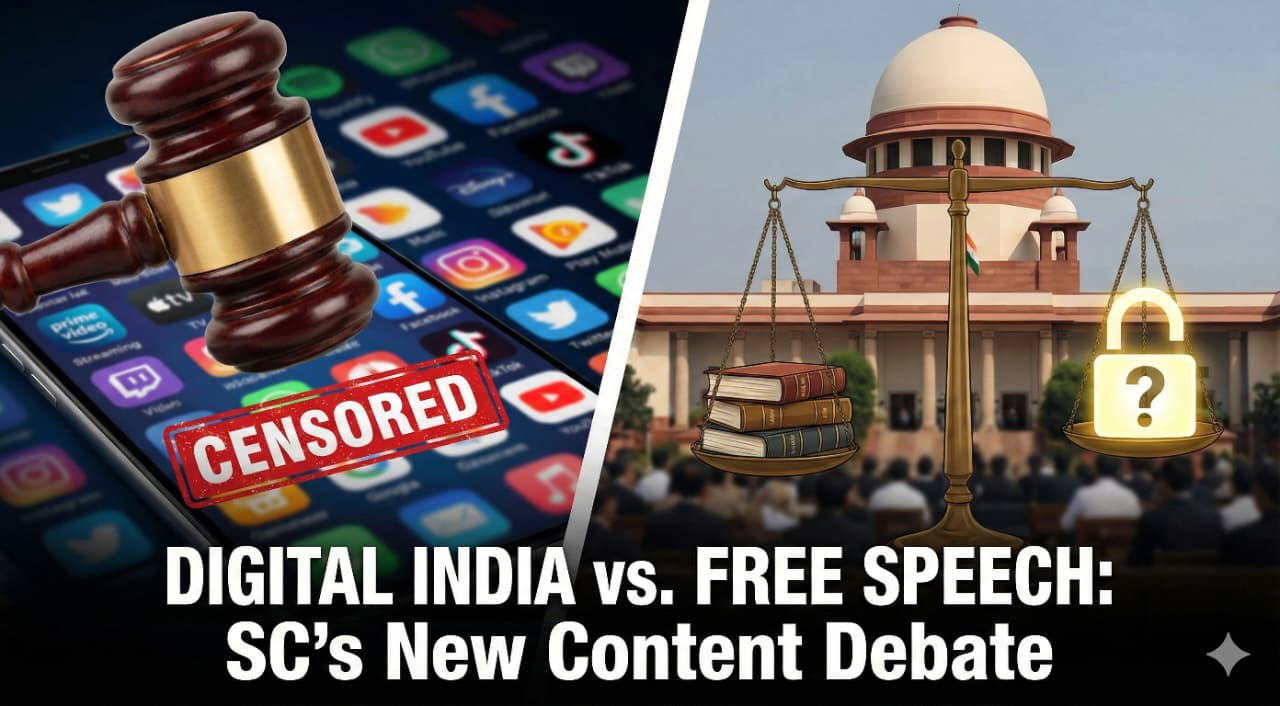
The Supreme Court, this week, lit a fresh spark in India’s decade‑long debate over online content, free speech, and obscenity. What began as a hearing on a comic show’s alleged “obscene comments” soon widened into a bigger conversation on how India must draw new lines in the fast‑shifting digital world. In a courtroom filled with lawyers, artists, and government representatives.
Chief Justice Surya Kant and Justice Joymalya Bagchi spoke a line that echoed far beyond the courtroom — “self‑styled mechanisms will not be effective.” With this, the bench suggested creating an autonomous regulatory authority, one that would stay free from both state pressure and corporate influence, to oversee what flows across India’s digital landscape.
At the heart of the exchange lay a complex question — how far can freedom of speech go before it begins to corrode the dignity of others? The government’s note to the court proposed a sweeping rewrite of the 2021 IT Rules, aiming to bring digital obscenity under tighter control. Ratings like “U”, “U/A 7+”, and “A” for OTT and online content would make the digital universe resemble the world of cinema under the Cinematograph Act. The goal, officials said, was not to curb expression but to create a framework “in accordance with Article 19(1)(a)” and the reasonable restrictions under Article 19(2). Yet, the undertone of these proposals also revealed a new layer — a “bar on anti‑national content” and clearer definitions of what counts as “obscene.
”The court’s proceedings read almost like a mirror of the times. Solicitor General Tushar Mehta argued that digital India today is flooded with content that is “not just obscene, but perverse,” pointing to the ease with which a 10‑year‑old can access explicit material online. “Freedom of speech,” he said, “is invaluable — but it cannot become a shield for perversity.” The bench seemed to agree, mulling if a momentary on‑screen warning was enough to protect minors. The CJI’s question — “Why can’t it verify age using Aadhaar or PAN?” — captured both the anxiety and possibilities of a tech‑driven regulatory solution. But that idea, too, opens new debates. Can privacy survive when identification becomes the price of access?
In the same hearing, another petition drew attention to humour that mocks people with disabilities. The court, visibly disturbed, asked whether India needed a law as stringent as the SC/ST Act to protect persons with disabilities from humiliation. It was a reminder that the fight over digital ethics is not only about censorship but also about respect — about whether free speech can coexist with empathy in the age of virality. “Humour,” the Solicitor General conceded, “cannot come at the cost of dignity.”The Ministry’s draft code tries to answer this by invoking the “community standard test” from the Aveek Sarkar case — that content should be judged by contemporary community values, not by the loudest moral voices. Yet, the proposed guidelines are sprawling, extending from prohibitions on obscenity and vulgarity to bars against content that “offends good taste, derides religion, promotes anti‑national attitudes, or denigrates women and children.” Critics fear that so wide a net could sweep satire, dissent, and artistic freedom into silence. For instance, a political sketch or dark comedy that exposes uncomfortable truths could easily be accused of being “anti‑national.” But does democracy not hinge precisely on allowing discomforting voices to speak?
Supporters, meanwhile, argue that the digital bazaar has grown too chaotic to self‑regulate. Unlike television broadcasters or newspapers, a YouTuber or podcaster faces almost no structural restraint. When the CJI noted that anyone can “create my own channel and not be accountable to anyone,” it summed up the regulatory vacuum that the government now seeks to fill. The challenge, however, is in balance — to design a body that can uphold decency without strangling dissent. A self‑styled industry council, the court warned, cannot be the sole gatekeeper, but a state‑controlled one would be even worse.So, the debate circles back to autonomy — a watchdog that is neither tamed by advertisers nor driven by political will. India’s digital future depends on it. Because between “perverse content” and “controlled content” lies the fragile space where freedom, responsibility, and dignity can still coexist — if only the law learns to keep pace with the screen.